HappyWorld-Bench tests video, spatial, and embodied world models for reliability
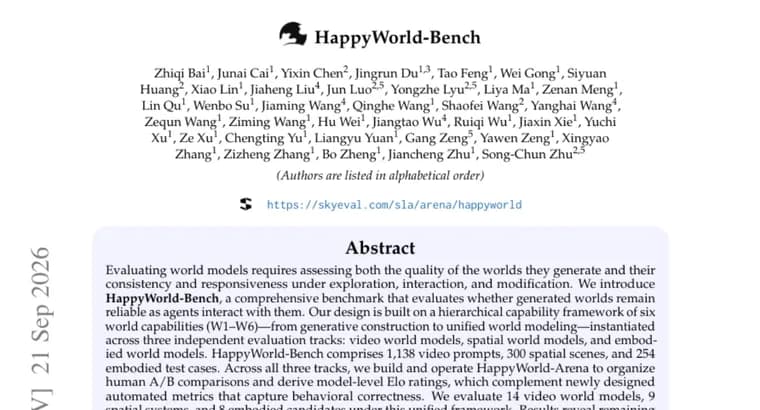
Researchers have introduced HappyWorld-Bench, a benchmark built to check not just how good the worlds generated by AI models look, but whether those worlds stay reliable once an agent starts exploring, interacting with, and modifying them. The benchmark is organized around a hierarchical framework of six world capabilities, labeled W1 through W6, ranging from generative construction to unified world modeling. These capabilities are tested across three independent evaluation tracks: video world models, spatial world models, and embodied world models. The benchmark comprises 1,138 video prompts, 300 spatial scenes, and 254 embodied test cases. For scoring, the team built and operates HappyWorld-Arena, a system that organizes human A/B comparisons and derives model-level Elo ratings, complemented by newly designed automated metrics meant to capture behavioral correctness rather than just visual quality. Using this unified framework, the team evaluated 14 video world models, 9 spatial systems, and 8 embodied candidates. The results show reliability gaps in every track. Video models become less consistent during extended rollouts and when a scene is revisited. Spatial models perform best at 70.14% placement accuracy and 73.33% edit execution rate, figures the authors describe as the top results among the systems tested rather than a universal standard. Embodied models struggle to preserve state across multi-step actions and to respond precisely when action conditions or physical rules are altered. The authors argue these findings show that world models need to be judged not only by how visually convincing their outputs are, but by whether they stay consistent in state and respond correctly to actions and interventions over time.
Key facts
- HappyWorld-Bench covers three tracks, video, spatial, and embodied world models, using 1,138 video prompts, 300 spatial scenes, and 254 embodied test cases.
- The benchmark is structured around six world capabilities (W1-W6), from generative construction to unified world modeling.
- 14 video world models, 9 spatial systems, and 8 embodied candidates were evaluated using human A/B comparisons and Elo ratings from HappyWorld-Arena, plus automated metrics.
- The best spatial models reached 70.14% placement accuracy and 73.33% edit execution.
- Video models lose consistency over extended rollouts and revisits, and embodied models struggle to preserve state across multi-step actions and to react correctly to altered action conditions or physical rules.
Why it matters
As world models are increasingly used to simulate environments for agents to explore and act in, visual quality alone does not tell you whether the simulated world stays coherent once something interacts with it. HappyWorld-Bench is built specifically to probe that gap: whether a generated world keeps its state and reacts correctly as an agent explores, edits, or revisits it, across video, spatial, and embodied settings.
Who it affects
The benchmark is aimed at researchers and teams building or evaluating world models, whether for video generation, spatial scene construction, or embodied agent simulation, since it gives them a shared framework and metrics to compare systems on reliability rather than just output quality.
How to use it
Evaluation runs through HappyWorld-Arena, which collects human A/B comparisons to produce model-level Elo ratings, alongside automated metrics designed to capture behavioral correctness. Together with the six-capability (W1-W6) framework and the three tracks, this gives a structured way to test and rank world models. The source text does not name the specific models evaluated or give access, pricing, or licensing details.
How solid is it
The account comes from the benchmark's own description of its design and results; the source text does not name the authors, their institutions, or a publication date, nor does it identify which specific video, spatial, or embodied models were tested, or explain the automated metrics beyond noting they aim to capture behavioral correctness.
Risks and caveats
The benchmark's own results show current systems still fall short: video models lose consistency over extended rollouts and when scenes are revisited, the strongest spatial models cap out at 70.14% placement accuracy and 73.33% edit execution, and embodied models struggle to preserve state across multi-step actions and to respond precisely to altered action conditions or physical rules.