HiPHI white paper presents 617.5-hour motion capture dataset for humanoid robots
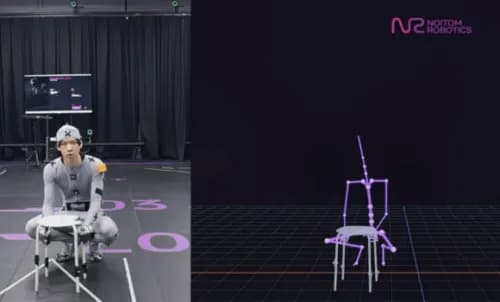
IEEE Spectrum and Wiley are offering a free white paper, sponsored by Noitom Robotics, about HiPHI: a whole-body human motion dataset aimed at humanoid robot learning. The page is a download landing page, so what follows is the white paper's own description of itself.
The starting point is a data problem. Humanoid robots must learn to balance, move and interact with objects across an enormous range of situations, but the training data has clear limits. Internet video shows diverse behavior but cannot capture precise physical states. Laboratory motion capture systems record accurate movement but usually cover only a narrow set of actions. The white paper presents HiPHI as a dataset built to close that gap.
HiPHI totals 617.5 hours of whole-body human motion, captured with optical motion capture at sub-millimeter accuracy. Of that, 245.7 hours is human-object interaction, recorded with synchronized object trajectories and meshes. According to the description, that pairing makes the interaction data useful for teaching robots real-world tasks such as carrying, pushing and pulling.
To decide what to record, the dataset organizes its coverage using FrameNet, which the page describes as a linguistic framework for human action. The idea is that FrameNet can guide motion capture collection so that a broad range of whole-body motion is covered systematically.
The paper also introduces a benchmark suite for measuring motion diversity and interaction grounding. Finally, it reports results from policies trained on the dataset and deployed on a physical Unitree G1 humanoid robot. The page says reinforcement learning policies trained on this motion capture data improve with scale, and that sim-to-real transfer carries them onto the physical robot.
The white paper is pitched at robotics researchers and engineers, and it frames humanoid robot learning as a central problem in embodied AI and Physical AI. Readers get it through a 'LOOK INSIDE' download.
Key facts
- HiPHI is a 617.5-hour whole-body human motion dataset captured with optical motion capture at sub-millimeter accuracy.
- 245.7 hours of it is human-object interaction with synchronized object trajectories and meshes, aimed at tasks like carrying, pushing and pulling.
- Coverage is organized using FrameNet, a linguistic framework for human action, and a benchmark suite measures motion diversity and interaction grounding.
- Policies trained on the data were deployed on a physical Unitree G1 humanoid robot; the page says they improve with scale.
- The white paper is published by IEEE Spectrum and Wiley and sponsored by Noitom Robotics.
Why it matters
Humanoid robot learning is short of the right data. The white paper argues that internet video is diverse but lacks precise physical states, while laboratory motion capture is accurate but covers few actions. HiPHI is presented as a way to get both breadth and precision: 617.5 hours of sub-millimeter optical capture, with 245.7 hours of object interaction. The use of FrameNet to plan coverage is an unusual detail, since it treats the question of what motions to record as a systematic one.
Who it affects
The page names robotics researchers and engineers as the audience, particularly those working on humanoid robots, embodied AI and Physical AI. Anyone training whole-body control policies or studying how robots learn to handle objects is the target reader. Noitom Robotics appears as the sponsor.
How to use it
The white paper is described as complimentary and is downloaded through the 'LOOK INSIDE' button on the landing page. The description lists what it covers: why humanoid learning needs better data, how FrameNet guides collection, why object trajectories and meshes matter for interaction tasks, and how policies scale and transfer from simulation to a real robot. The page does not say whether the dataset is publicly released, or under what license.
How solid is it
This is a sponsored white paper landing page, not an independent report or peer-reviewed paper. No authors or institutions of the paper are named; only the sponsor Noitom Robotics and the publishers IEEE Spectrum and Wiley appear. The dataset figures (617.5 hours, 245.7 hours, sub-millimeter accuracy) are concrete, but they come from the sponsor-backed description itself.
Risks and caveats
No quantitative results are given for the policies or the benchmark: no success rates, comparisons or scaling numbers. The page does not state how much of the real-robot transfer worked or on which tasks, so the claims that policies improve with scale and transfer to the Unitree G1 cannot be judged from it. No number of subjects, object categories or FrameNet frames is given, and no publication date. Treat the claims as the sponsor's framing until the full paper is read.
“Internet video shows diverse behavior but cannot capture precise physical states.”
— HiPHI white paper description, IEEE Spectrum and Wiley