HiUni uses one shared backbone for image understanding and generation
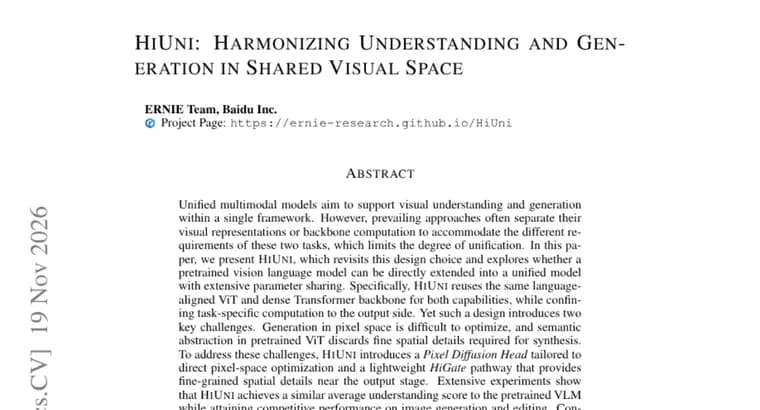
A paper on Hugging Face presents HiUni, a unified multimodal model that handles visual understanding and visual generation in a single framework. The authors start from a complaint about the field: prevailing unified models often separate their visual representations or backbone computation to meet the different needs of the two tasks, and that limits how unified they really are.
HiUni revisits that design choice. The paper asks whether a pretrained vision language model can be extended directly into a unified model with extensive parameter sharing. The answer it builds is to reuse the same language-aligned ViT and the same dense Transformer backbone for both capabilities, and to confine task-specific computation to the output side.
The authors say this design brings two key challenges. First, generation in pixel space is difficult to optimize. Second, the semantic abstraction in a pretrained ViT discards the fine spatial details that synthesis needs.
HiUni answers each with one component. A Pixel Diffusion Head is tailored to direct pixel-space optimization. A lightweight HiGate pathway supplies fine-grained spatial details near the output stage.
On results, the authors report that extensive experiments show HiUni reaching a similar average understanding score to the pretrained VLM, while attaining competitive performance on image generation and editing. Controlled comparisons and analyses, they say, further show that a single dense backbone can effectively support both capabilities without task-specific backbone computation. They frame this as a simpler path toward unified multimodal modeling.
Key facts
- HiUni extends a pretrained vision language model to both visual understanding and generation, reusing the same language-aligned ViT and dense Transformer backbone for both.
- Task-specific computation is confined to the output side, rather than split across separate backbones or visual representations.
- A Pixel Diffusion Head handles direct pixel-space optimization, and a lightweight HiGate pathway adds fine-grained spatial details near the output stage.
- The authors report a similar average understanding score to the pretrained VLM and competitive performance on image generation and editing.
- The two challenges the paper names are hard pixel-space optimization and fine spatial detail lost in the ViT's semantic abstraction.
Why it matters
Unified models that both understand and generate images often keep separate visual representations or backbone computation for each task, which the authors say limits unification. HiUni tests the opposite end: one pretrained VLM, one ViT, one dense backbone, with only the output side specialised. If it holds up, the authors argue, it points to a simpler path toward unified multimodal modeling.
Who it affects
Mainly researchers and engineers building unified multimodal models, and teams that already have a pretrained vision language model and want to add image generation and editing to it without adding a separate task-specific backbone.
How to use it
This is a research paper, not a product. No code, weights or release information is mentioned in the text, so there is nothing to try yet. The practical takeaway is the recipe: keep the VLM's ViT and dense backbone shared, add a Pixel Diffusion Head for pixel-space generation, and add a HiGate pathway to bring back fine spatial detail near the output.
How solid is it
The claims are the authors' own, from the paper's summary of its experiments and controlled comparisons. They are stated modestly: a "similar" average understanding score to the pretrained VLM and "competitive" generation and editing performance, with no claim of state of the art. No numeric scores, benchmark names or baselines are given in the text, so the size of the gaps cannot be judged from it. The pretrained VLM that HiUni extends is not named.
Risks and caveats
A similar understanding score is not an identical or higher one, and competitive generation is not best-in-class. The paper itself lists two weak points of the shared design, hard pixel-space optimization and lost spatial detail, and its fixes (the Pixel Diffusion Head and HiGate) add output-side components. No parameter counts, training data or compute are stated, so cost and scale are unknown.
“a single dense backbone can effectively support both capabilities without task-specific backbone computation”
— HiUni paper