InSight-doc zooms into pages, cuts document hallucination over 40%
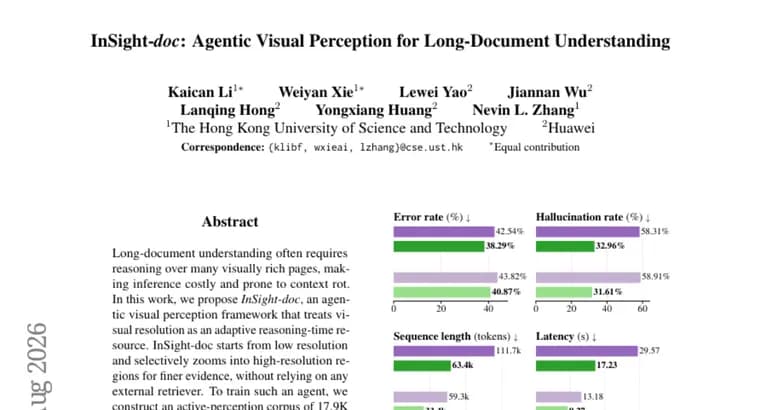
Reasoning over many visually rich pages makes long-document understanding costly and prone to what researchers call context rot, where model quality degrades as the input grows. A new paper proposes InSight-doc, an agentic visual perception framework that treats image resolution as a reasoning-time resource the model can spend selectively rather than a fixed setting applied to every page. InSight-doc starts a document at low resolution and selectively zooms into high-resolution regions to gather finer evidence where it is needed, without relying on any external retriever.
To train the model to zoom effectively, the authors built an active-perception corpus: 17.9K high-quality supervised fine-tuning (SFT) examples with region-level zoom-in trajectories, plus 19.2K harder reinforcement learning (RL) examples. Training combines SFT and RL. The resulting model, InSight-doc-8B, improves accuracy over the baseline by 4.3 to 16.4 points across document visual question answering (VQA) benchmarks. On long documents specifically, it reduces hallucination by more than 40% and inference latency by 41% to 68%, while still holding an accuracy lead over the baseline.
The authors have released the code, datasets, and model at github.com/m-Just/InSight-doc.
Key facts
- InSight-doc starts a document at low resolution and selectively zooms into high-resolution regions for finer evidence, without any external retriever.
- The training corpus has 17.9K high-quality SFT examples with region-level zoom-in trajectories, plus 19.2K hard RL examples; training combines SFT and RL.
- InSight-doc-8B improves accuracy over the baseline by 4.3 to 16.4 points across document VQA benchmarks.
- On long documents, it cuts hallucination by more than 40% and inference latency by 41% to 68%, while keeping an accuracy lead over the baseline.
- Code, datasets, and the model are released at github.com/m-Just/InSight-doc.
Why it matters
Long-document understanding over many visually rich pages is expensive and prone to context rot, where output quality degrades as the document gets longer. InSight-doc treats visual resolution as an adaptive resource instead of a fixed setting: it reads pages at low resolution by default and only spends compute zooming into specific regions when finer evidence is needed, rather than processing every page at full resolution or leaning on a separate retrieval step.
Who it affects
Anyone building or evaluating systems for long-document understanding, document visual question answering (VQA) in particular. The released code, training datasets, and 8B-parameter model give researchers in that space a concrete training recipe and a baseline to compare against.
How to use it
InSight-doc's code, the active-perception training corpus, and the model weights are released publicly at github.com/m-Just/InSight-doc. The paper reports results for an 8B-parameter version, InSight-doc-8B, trained by combining supervised fine-tuning with reinforcement learning on the released corpus of zoom-in trajectories and hard RL examples.
How solid is it
The reported gains, a 4.3 to 16.4 point accuracy improvement, more than 40% less hallucination, and 41% to 68% lower latency, are the authors' own figures from document VQA benchmarks that the source text does not name individually, measured against a baseline model that is likewise not named. The text does not state a publication venue or peer-review status, and it names no authors or institutional affiliations.
Risks and caveats
Because the specific benchmarks and the baseline model are not identified in the source, the headline numbers are hard to independently sanity-check without going into the released code and datasets. The hallucination and latency figures are the authors' own reported results rather than a stated third-party evaluation, and the text gives no license terms for the released code, datasets, or model.