Iris-mini and Iris-pro top open-source search agent scores
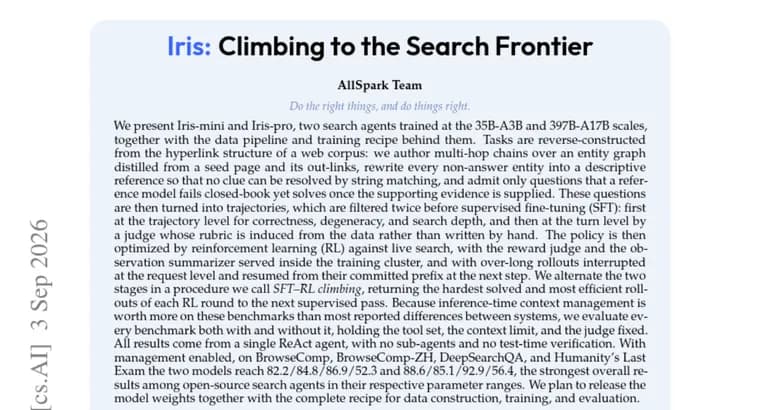
A research team presents two search agents, Iris-mini at the 35B-A3B parameter scale and Iris-pro at 397B-A17B, along with the full data pipeline and training recipe used to build them. Training tasks are reverse-constructed from the hyperlink structure of a web corpus: the authors build multi-hop question chains over an entity graph distilled from a seed page and its out-links, then rewrite every non-answer entity into a descriptive reference so that a clue cannot be resolved by simple string matching. A question is admitted into the dataset only if a reference model fails to answer it closed-book yet solves it once the supporting evidence is supplied, a filter meant to keep the tasks genuinely search-dependent rather than answerable from memorized knowledge.
These admitted questions are turned into agent trajectories, which are filtered at both the trajectory level and the individual-turn level before supervised fine-tuning (SFT). The resulting policy is then optimized with reinforcement learning (RL) against a live search environment, with the reward judge and the observation summarizer both served inside the training cluster. Rollouts that run too long are interrupted at the request level and resumed from their committed prefix at the next training step rather than discarded. The authors alternate SFT and RL in a cycle they call SFT-RL climbing, feeding the hardest solved and most efficient rollouts from each RL round back into the next supervised pass.
Because the authors find that inference-time context management moves benchmark scores by more than most reported differences between rival systems, they evaluate every benchmark twice, once with context management enabled and once without, while holding the tool set, the context limit, and the judge fixed across both runs. All reported numbers come from a single ReAct agent: no sub-agents and no test-time verification are used. With context management enabled, on BrowseComp, BrowseComp-ZH, DeepSearchQA, and HLE, Iris-mini scores 82.2, 84.8, 86.9, and 52.3, while Iris-pro scores 88.6, 85.1, 92.9, and 56.4. The authors describe these as the strongest overall results among open-source search agents in their respective parameter ranges. They plan to release the model weights together with the complete recipe for data construction, training, and evaluation, though no release date is given.
Key facts
- Iris-mini (35B-A3B) and Iris-pro (397B-A17B) are search agents trained with an alternating SFT-RL cycle the authors call SFT-RL climbing.
- Training tasks are reverse-constructed from a web corpus's hyperlink structure, with non-answer entities rewritten into descriptive references so clues cannot be solved by string matching.
- A question enters the dataset only if a reference model fails it closed-book but solves it once the supporting evidence is supplied.
- With inference-time context management enabled, Iris-mini scores 82.2/84.8/86.9/52.3 and Iris-pro scores 88.6/85.1/92.9/56.4 on BrowseComp/BrowseComp-ZH/DeepSearchQA/HLE, results the authors call the strongest among open-source search agents at these scales.
- The authors plan to release the model weights and the full data construction, training, and evaluation recipe, but give no release date.
Why it matters
The paper's central claim is less about a single benchmark number than about a training recipe: alternating SFT and RL, and feeding each RL round's hardest solved and most efficient rollouts back into the next SFT pass, is offered as a repeatable way to push open-source search agents up multi-hop search benchmarks. The authors also make a methodological point with real weight for anyone comparing agent systems: they report that inference-time context management alone can shift scores by more than the differences usually reported between rival systems, which is why they test every benchmark both with and without it under otherwise identical conditions.
Who it affects
The result targets teams building or evaluating open-source search or research agents, since the comparison is explicitly scoped to that category rather than to closed-source systems. It also speaks to anyone assembling training data for agentic search, given the emphasis on question construction that resists shortcut answers and on filtering trajectories before supervised fine-tuning.
How to use it
The models are not yet available to run: the authors state only that they plan to release the weights together with the complete data construction, training, and evaluation recipe, without naming a date. Until that release, the practical takeaway is the recipe itself, the reverse-constructed multi-hop question generation, the closed-book versus evidence-supplied admission filter, and the SFT-RL climbing cycle, which a team could in principle reproduce on its own agent.
How solid is it
All results come from a single ReAct agent with no sub-agents and no test-time verification, and the with/without context management comparison holds the tool set, context limit, and judge fixed, which is a controlled setup. The results and their interpretation are self-reported by the authors on the paper's own page, with no independent benchmark run to confirm them, and the abstract text does not itself state author names or institutional affiliations.
Risks and caveats
The claim of the strongest results is explicitly scoped to open-source search agents only; the paper draws no comparison to closed-source or proprietary systems. The abstract states that every benchmark was evaluated both with and without inference-time context management, but only the with-context-management numbers are given, so the size of that effect is not shown. No release date is given for the promised model weights or training recipe, so the reproducibility the paper's methodology section implies cannot yet be tested by outside teams.