IterSynth: a role-decoupled search agent design that beats prior 8B agents by 4.2%
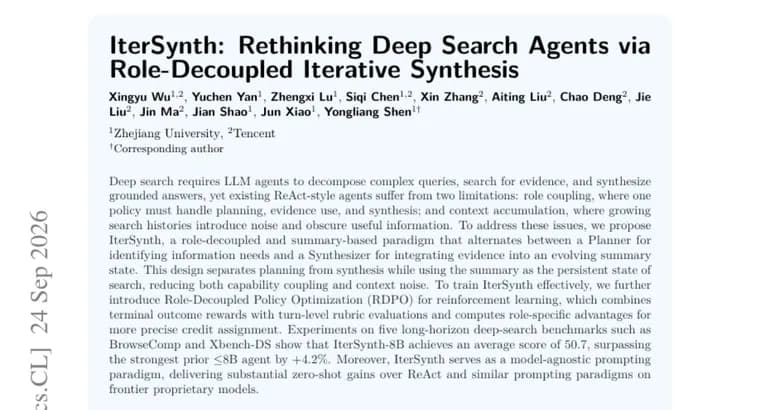
Researchers propose IterSynth, a new design for deep-search LLM agents, the kind that must break down a complex question, search for evidence, and stitch it into a grounded answer. The authors argue that existing ReAct-style agents suffer from two problems: role coupling, where a single policy has to handle planning, using evidence, and writing the synthesis all at once, and context accumulation, where the search history keeps growing and its noise buries the useful information. IterSynth addresses both by splitting the work into two alternating roles: a Planner that identifies what information is still needed, and a Synthesizer that folds new evidence into an evolving summary. That summary, rather than the raw growing transcript, becomes the persistent state the agent works from, which is meant to cut both the coupling between roles and the noise from accumulated context. To train this two-role setup, the authors introduce Role-Decoupled Policy Optimization (RDPO), a reinforcement-learning method that combines rewards for the final outcome with turn-by-turn rubric evaluations, computing separate, role-specific advantages so credit for good or bad performance is assigned more precisely to the Planner or the Synthesizer. On five long-horizon deep-search benchmarks, including BrowseComp and Xbench-DS, an 8B-parameter version of the system, IterSynth-8B, reaches an average score of 50.7, ahead of the strongest prior agent of 8B size or smaller by 4.2 percentage points. The paper also reports that IterSynth works as a model-agnostic prompting paradigm on its own: applied as a prompting scheme rather than a trained policy, it still produces substantial zero-shot gains over ReAct and similar prompting approaches when used with frontier proprietary models.
Key facts
- IterSynth splits deep-search agents into two alternating roles: a Planner that identifies information needs and a Synthesizer that integrates evidence into an evolving summary state.
- The design targets two flaws in ReAct-style agents: role coupling (one policy does planning, evidence use, and synthesis) and context accumulation (growing histories add noise).
- A new training method, Role-Decoupled Policy Optimization (RDPO), combines outcome rewards with turn-level rubric scores and computes role-specific advantages.
- IterSynth-8B averages 50.7 across five long-horizon deep-search benchmarks (including BrowseComp and Xbench-DS), beating the strongest prior agent of 8B size or smaller by 4.2%.
- Used purely as a model-agnostic prompting paradigm, IterSynth also produces zero-shot gains over ReAct-style prompting on frontier proprietary models.
Why it matters
Deep-search agents that browse and synthesize evidence are a core building block for AI research assistants, and current ReAct-style designs cram planning, evidence handling, and answer synthesis into one policy operating over an ever-growing, increasingly noisy history. IterSynth's pitch is that separating those roles and replacing the raw transcript with a maintained summary state addresses both problems at once, which is why the paper frames it as a rethink of the agent architecture rather than an incremental tweak.
Who it affects
The work is aimed at researchers and engineers building or evaluating long-horizon search and research agents, particularly those working with smaller (around 8B parameter) open models where the reported gains were measured, as well as anyone applying prompting paradigms to proprietary frontier models, where the paper also reports zero-shot benefits.
How to use it
IterSynth is presented as two things at once: a trainable role-decoupled architecture (paired with the RDPO reinforcement-learning method) for building an 8B-scale agent, and a model-agnostic prompting paradigm that can be applied directly to existing frontier proprietary models without retraining, in place of ReAct-style prompting.
How solid is it
The claims come from the paper's own reported benchmark results: an average score of 50.7 across five long-horizon deep-search benchmarks such as BrowseComp and Xbench-DS, and a 4.2 percentage-point improvement over the strongest prior agent of 8B size or smaller. The source text does not give per-benchmark scores, only the five-benchmark average, and it does not name the authors, their affiliations, publication date, training data, model architecture, or compute budget.
Risks and caveats
The comparison is scoped to agents of 8B parameters or smaller, so it does not establish how IterSynth-8B stacks up against larger prior agents. Details needed to independently assess the result, such as per-benchmark breakdowns, training data, and compute cost, are not given in the available text, and the improvement is reported by the paper's own authors rather than an independent evaluation.