Jeveration generates a 512x512 image in 78 ms in one forward pass
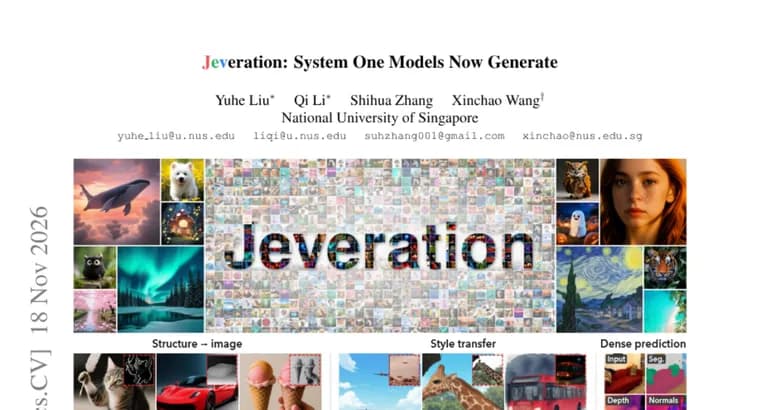
A paper on Hugging Face introduces Jeveration, a method that produces an image in a single forward pass instead of step by step. It starts from the idea that System One models such as Jev return decisions through fast, parallel prediction. The paper's claim is that the same decision paradigm can also generate high-quality images.
Jeveration builds on a frozen vision-language model and repurposes its visual-semantic knowledge for holistic image generation. The key challenge, the authors say, is global consistency. A single prompt admits many valid images, yet parallel predictions must converge on one coherent whole.
Their answer is to condition all positions on a shared random state. That coordinates the parallel predictions, so each draw yields a different but coherent image. There is a complication: the model tends to ignore this state under direct image supervision. To get around it, the authors first learn a distribution over discrete image codes, and that distribution guides single-pass generation.
The method is not limited to text-to-image generation. The authors also unify image-to-image generation and dense prediction within the same architecture, so one checkpoint supports all three tasks, each in one forward pass.
On results, the paper reports that Jeveration generates a 512x512 image in 78 ms, up to 122x faster than existing unified models, while maintaining competitive image quality and dense prediction performance. The speed claim is the headline; on quality the wording is only "competitive", not better.
Key facts
- Jeveration generates images in a single forward pass, building on a frozen vision-language model.
- The authors report 78 ms for one 512x512 image, up to 122x faster than existing unified models.
- One checkpoint covers three tasks: text-to-image generation, image-to-image generation and dense prediction, each in one forward pass.
- To keep parallel predictions coherent, all positions are conditioned on a shared random state, guided by a learned distribution over discrete image codes.
- Image quality and dense prediction performance are described as competitive, not superior.
Why it matters
Most image generation takes many steps. This paper argues that fast, parallel prediction, the style of System One models such as Jev, can also produce high-quality images in one pass. If the reported 78 ms for a 512x512 image holds up, speed is the main gain: the authors put it at up to 122x faster than existing unified models. The harder part they name is global consistency, since many images fit one prompt but parallel predictions must settle on a single coherent result. The shared random state is their device for that.
Who it affects
The audience is researchers working on image generation, unified multimodal models and dense prediction, who may care about a design that reuses a frozen vision-language model. The paper's setting is one checkpoint that handles text-to-image generation, image-to-image generation and dense prediction. Anyone weighing latency in such systems has a reason to follow it.
How to use it
There is nothing to run yet from the text available. No code, weights or checkpoint release is mentioned. For now the useful takeaway is the recipe: keep a vision-language model frozen, condition all positions on a shared random state, and first learn a distribution over discrete image codes so the model does not ignore that state.
How solid is it
This is the authors' own report of experiments, in a paper summary of about a thousand characters. The 78 ms figure comes with no stated hardware, and it is not stated whether it is a mean, median or best case. The 122x figure is an "up to" maximum, and the text does not say which existing unified models were compared or which one gives that number. No image-quality metrics such as FID or GenEval and no dense prediction scores are given, only the word "competitive". No authors or institutions are named in the text.
Risks and caveats
Treat the speed claims as unverified until the full results are available. The best-case 122x comparison may not reflect typical gains. Quality is described only as competitive, so a speed advantage may come with a trade-off that the text does not quantify. The text also does not say which vision-language model is the frozen base or explain what Jev is beyond calling it a System One model. The authors themselves note the model tends to ignore the shared random state under direct image supervision, which is why the extra step of learning discrete image code distributions is needed.
“The key challenge is to maintain global consistency.”
— Jeveration paper abstract