JoyAI-Echo-1.5 tops WBench with persistent audio-visual generation
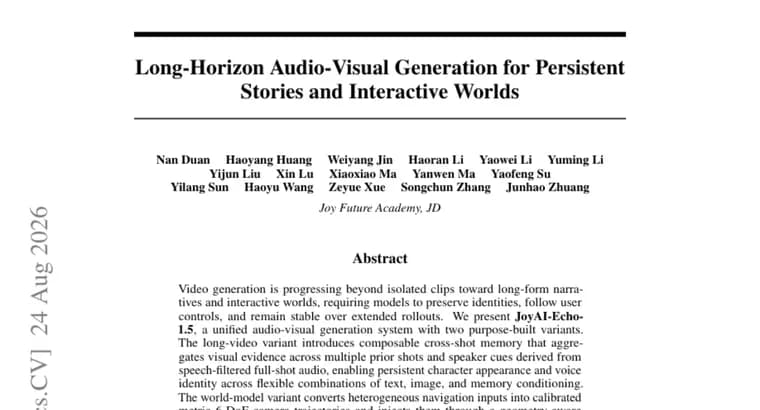
Researchers presented JoyAI-Echo-1.5, a unified audio-visual generation system built to move video generation beyond isolated clips toward long-form narratives and interactive worlds. It ships in two purpose-built variants that target two different problems in long-horizon generation.
The long-video variant is built to keep a character's identity stable across a long narrative. It introduces composable cross-shot memory, which aggregates visual evidence gathered across multiple prior shots, together with speaker cues derived from speech-filtered full-shot audio. Combined, these let the system preserve a character's appearance and voice identity across flexible combinations of text, image, and memory conditioning.
The world-model variant targets interactive, explorable environments. It converts heterogeneous navigation inputs into calibrated metric 6-DoF (six degrees of freedom) camera trajectories and injects them through a geometry-aware conditioning pathway. This lets a user interact with the generated world from flexible viewpoints regardless of what controller or input scheme they use.
To make long-horizon generation efficient enough to run, the authors transform a bidirectional audio-visual backbone into a causal few-step generator. The conversion uses progressive teacher forcing plus short- and long-horizon Self-Gradient Forcing applied to the model's own self-generated rollouts, rather than only to ground-truth sequences.
On results, the authors report that JoyAI-Echo-1.5 improves over existing long-video baselines in cross-shot consistency, visual quality, text alignment, and speech fidelity, though the paper states these as qualitative gains without giving quantified comparison numbers. The world-model variant ranks first on WBench, with an average score of 81.7, and the authors also report it achieves leading visual quality and long-horizon persistence on SANA-WM-Bench. The authors conclude that memory, geometric control, and rollout-aware training together form a practical foundation for generating coherent stories and continuously evolving interactive worlds. A project page is available at echo-team-joy-future-academy-jd.github.io/Echo-1.5-Page, but the paper gives no release date, timeline, or availability of code, weights, or a public demo, and the abstract text names no individual authors or institutional affiliations.
Key facts
- JoyAI-Echo-1.5 is a unified audio-visual generation system with two variants: one for long-video narratives and one for interactive world models.
- The long-video variant uses composable cross-shot memory plus speaker cues from speech-filtered full-shot audio to keep a character's appearance and voice consistent across shots.
- The world-model variant converts navigation input into calibrated metric 6-DoF camera trajectories via a geometry-aware conditioning pathway, enabling controller-agnostic viewpoint control.
- The world-model variant ranks first on WBench with an average score of 81.7 and reports leading visual quality and long-horizon persistence on SANA-WM-Bench.
- Training converts a bidirectional audio-visual backbone into a causal few-step generator using progressive teacher forcing and short- and long-horizon Self-Gradient Forcing on self-generated rollouts.
Why it matters
Video generation models have mostly been built to produce short, isolated clips. JoyAI-Echo-1.5 targets the harder problem of long-horizon generation: keeping a character's face, appearance, and voice stable across many shots in a story, and keeping an interactive 3D world coherent as a user moves through it from arbitrary viewpoints. Solving identity drift and geometric consistency over long rollouts is a prerequisite for AI-generated narrative video and explorable interactive worlds to become usable rather than a novelty.
Who it affects
The system is aimed at researchers and engineers building long-form AI video, animation, and interactive world generation tools, as well as anyone tracking progress on persistent-character video and controllable world models. The paper's abstract does not name individual authors or institutions, so it is not possible to say which lab or company is behind the work beyond what the project page shows.
How to use it
The paper points to a project page at echo-team-joy-future-academy-jd.github.io/Echo-1.5-Page for more material. No code, model weights, public demo, pricing, or release date is given in the source, so there is currently no stated way to run or license JoyAI-Echo-1.5 beyond visiting that page.
How solid is it
The world-model variant's headline result is concrete: first place on WBench with an average score of 81.7, plus reported leading visual quality and long-horizon persistence on SANA-WM-Bench. The long-video variant's claims are softer: the authors report improvements over existing baselines in cross-shot consistency, visual quality, text alignment, and speech fidelity, but the source gives these as qualitative statements without the underlying comparison numbers. All results are self-reported by the authors in the paper itself, with no independent or third-party evaluation mentioned.
Risks and caveats
Several gaps limit how much can be verified here. The abstract names no individual authors or institutional affiliations, so provenance cannot be checked. There is no stated release date, and no code, weights, or public demo beyond the project page link, so the system cannot currently be tested independently. The long-video variant's baseline comparisons are qualitative only, without published numbers, which makes the size of its claimed improvement impossible to assess from this source.