Kling report: video generation quality depends on multimodal understanding
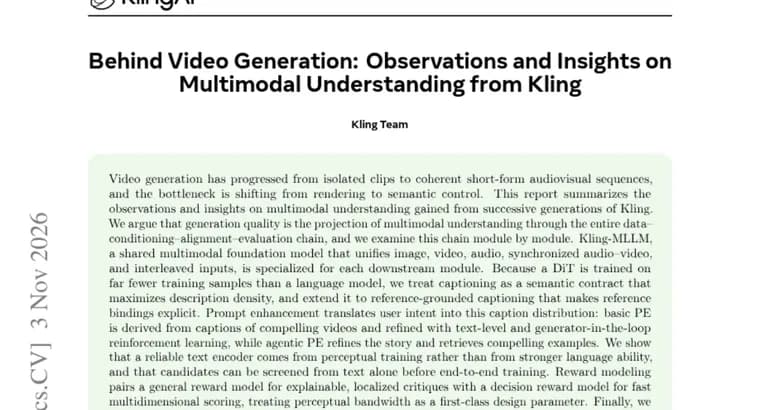
A report listed on Hugging Face Papers sums up what was learned about multimodal understanding across successive generations of Kling, a video generation system. Its starting point is that video generation has moved from isolated clips to coherent short-form audiovisual sequences, and that the bottleneck is shifting from rendering to semantic control.
The central argument: generation quality is the projection of multimodal understanding through the entire data, conditioning, alignment and evaluation chain. The report examines that chain module by module. Running through it is Kling-MLLM, a shared multimodal foundation model that unifies image, video, audio, synchronized audio-video and interleaved inputs, and is specialized for each downstream module.
Captioning comes first. Because a DiT is trained on far fewer samples than a language model, the authors treat captioning as a semantic contract that maximizes description density. They extend it to reference-grounded captioning, which makes reference bindings explicit.
Prompt enhancement (PE) then translates user intent into this caption distribution. Basic PE is derived from captions of compelling videos and refined with text-level and generator-in-the-loop reinforcement learning. Agentic PE goes further: it refines the story and retrieves compelling examples.
On text encoders, the authors show that a reliable one comes from perceptual training rather than from stronger language ability, and that candidates can be screened from text alone before end-to-end training.
Reward modeling pairs two models. A general reward model gives explainable, localized critiques; a decision reward model gives fast multidimensional scoring. The design treats perceptual bandwidth as a first-class parameter.
Finally, the report reviews task-specific automatic evaluation, focusing on protocols that expose scoring shortcuts and help trace failures back to their upstream source. The authors hope the lessons give practical guidance for building the understanding stack behind controllable video generation.
Key facts
- The report says the bottleneck in video generation is shifting from rendering to semantic control.
- Its thesis: generation quality is the projection of multimodal understanding through the data, conditioning, alignment and evaluation chain.
- Kling-MLLM is a shared multimodal foundation model covering image, video, audio, synchronized audio-video and interleaved inputs, specialized for each downstream module.
- Captioning is treated as a semantic contract that maximizes description density, because a DiT sees far fewer training samples than a language model.
- A reliable text encoder comes from perceptual training rather than stronger language ability, and candidates can be screened from text alone before end-to-end training.
Why it matters
The report frames a change in where the hard problem sits. With video generation already producing coherent short audiovisual sequences, it says the limit is no longer rendering but semantic control: getting the model to do what the user means. Its answer is to treat quality as something that flows from understanding at every stage, from data captions to evaluation, instead of from the generator alone.
Who it affects
Teams building or tuning video generators are the main audience, in particular those working on captioning, prompt enhancement, text encoders, reward models and automatic evaluation. The authors say they hope the lessons offer practical guidance for building the understanding stack behind controllable video generation.
How to use it
The report reads as a set of design lessons rather than a tool. Concrete ideas to take from it: write captions that maximize description density and make reference bindings explicit; derive prompt enhancement from captions of compelling videos; screen text-encoder candidates from text alone before costly end-to-end training; pair a general reward model for critiques with a decision reward model for fast scoring. The source does not state that Kling-MLLM is publicly released.
How solid is it
This is a summary of the Kling authors' own experience across successive generations of the system, and the claims are the authors' arguments. The abstract reports no benchmark results, metrics, model sizes or training-set sizes, and does not say how much the described methods improve video quality, so the claims cannot be checked against numbers here.
Risks and caveats
Without quantified results, it is hard to tell which of the lessons carry the most weight, or how well they transfer to other systems. The ideas are tied to Kling's own pipeline and to Kling-MLLM, whose public availability is not stated. No version numbers or release dates for Kling are given.
“the bottleneck is shifting from rendering to semantic control”
— Kling report abstract, Hugging Face Papers