Large Discovery Model pairs generative AI with Bayesian search
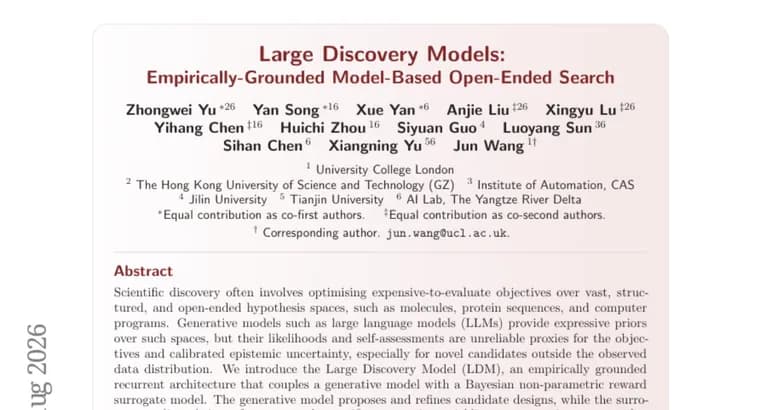
Researchers describe a recurring problem in scientific discovery: optimising expensive-to-evaluate objectives over vast, structured, open-ended spaces such as molecules, protein sequences and computer programs. Generative models, including large language models, offer expressive priors over these spaces, but their likelihoods and self-assessments are unreliable proxies for the actual objectives and for calibrated uncertainty, especially when a candidate falls outside the data the model has already seen. To address this, the researchers introduce the Large Discovery Model (LDM), a recurrent architecture that couples a generative model with a Bayesian non-parametric reward surrogate model. In the loop, the generative model proposes and refines candidate designs while the surrogate model predicts how well each candidate will perform and quantifies the uncertainty around that prediction. The two signals combine into an uncertainty-aware value that steers which candidates get generated, refined and selected next. Both the discovery memory and the surrogate model update continually as each new experimental observation comes in, rather than being retrained from scratch. The team tested LDM on three scenarios that span different design modalities and objectives: neural-network training, antibody design and molecular optimisation. Measured against LLM-only reflection and traditional statistical search, LDM achieved a 2.4 times greater reduction in validation bits-per-byte on the neural-network-training task, an 18.2% relative decrease in binding energy on the antibody-design task, and more than 60% relative gains in multi-objective performance on the molecular-optimisation task. The researchers conclude that LDM could work as a general-purpose discovery engine for searching open-ended hypothesis spaces of this kind.
Key facts
- The Large Discovery Model (LDM) couples a generative model with a Bayesian non-parametric reward surrogate that predicts candidate performance and quantifies uncertainty.
- The generative model proposes and refines candidates; the surrogate scores them, and the two combine into an uncertainty-aware value that guides selection.
- On neural-network training, LDM cut validation BPB 2.4 times more than LLM-only reflection or traditional statistical search.
- On antibody design, LDM produced an 18.2% relative decrease in binding energy versus the same baselines.
- On molecular optimisation, LDM delivered more than 60% relative gains in multi-objective performance versus the same baselines.
Why it matters
Scientific search over spaces like molecules, protein sequences or programs is expensive because each candidate has to be evaluated, often experimentally. Generative models can propose plausible candidates quickly, but the paper's core claim is that their own confidence scores are a poor guide to which candidates are actually good, particularly for candidates unlike anything in the training data. LDM's fix is architectural: pair the generative model with a separate Bayesian surrogate whose job is specifically to estimate performance and its uncertainty, then use that combined, uncertainty-aware signal to steer generation and selection rather than trusting the generative model's self-assessment alone.
Who it affects
The work targets researchers running expensive design-and-test loops: computational biologists doing antibody design, chemists and materials scientists doing molecular optimisation, and machine-learning researchers doing neural-architecture or training-recipe search. Anyone using LLMs as the sole judge of candidate quality in this kind of open-ended search is the direct comparison point, since LDM was benchmarked against exactly that setup.
How to use it
LDM operates as a loop rather than a one-shot model: the generative model proposes and refines candidate designs, the Bayesian surrogate scores each one and estimates uncertainty, and both the surrogate and a discovery memory are updated continually as new experimental results arrive, so the system keeps adapting rather than being retrained from a fixed dataset. The source text gives no release details, code availability, licence or pricing for LDM.
How solid is it
The evaluation covers three distinct scenarios (neural-network training, antibody design and molecular optimisation) against two baselines: LLM-only reflection and traditional statistical search. All three headline results are relative gaps against those baselines (2.4 times, 18.2%, more than 60%), not absolute scores, and the source text does not give the baselines' own absolute numbers. The abstract names no individual authors or institutions, and gives no dataset sizes, model parameter counts, training-compute figures, or publication date.
Risks and caveats
Because the source is limited to the paper's own abstract-level description, the reported gains cannot be cross-checked against independent benchmarks or the underlying baseline numbers from this text alone. There is no information here on reproducibility, code or data release, peer-review status, or when the work was done. The framing of LLM self-assessment as unreliable is the paper's own diagnosis of the problem it is solving, not an independently verified claim.
“Their likelihoods and self-assessments are unreliable proxies for the objectives and calibrated epistemic uncertainty, especially for novel candidates outside the observed data distribution.”
— the paper's abstract