Latent-to-4D generates 4D scenes directly from video model latents
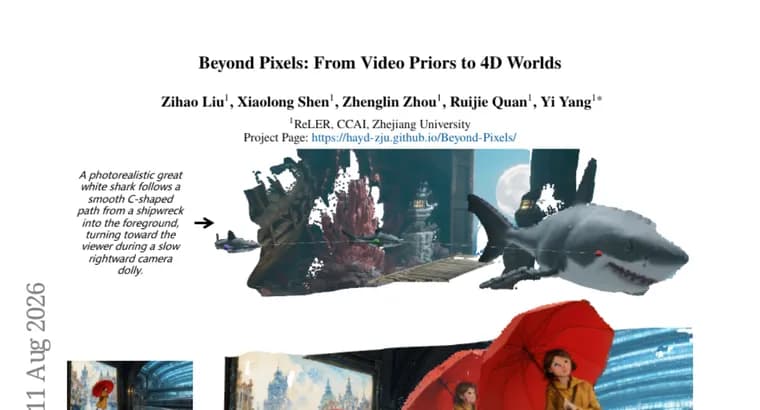
4D generation, the task of producing dynamic 3D scenes from a text prompt or image, has so far relied on two workarounds. The first reconstructs a separate 4D model from RGB video that a generator already produced, which suffers from distribution mismatch and error propagation between the two stages. The second adapts one specific video generator to predict geometry directly, which ties the 4D output to that single generator and can require retraining whenever the generator or its conditioning setup changes.
The researchers behind this paper ask a different question: can the final denoised latents of video models that share a variational autoencoder (VAE) serve as a reusable interface for 4D prediction, instead of routing through RGB video at all? Their answer is Latent-to-4D, a method that aligns a video model's latent directly with the token grid of a pretrained 4D decoder and refines it through frame-wise and global spatiotemporal attention, bypassing RGB entirely.
Latent-to-4D is trained on roughly 1,000 existing reconstruction clips, and the resulting single checkpoint transfers unchanged across multiple video diffusion transformers, as long as they share the same VAE family, with no retraining needed per generator. On the Text4D-200 and I4D-200 benchmarks, Latent-to-4D surpasses matched same-latent Wan+4RC cascade baselines in projection-based DINO-F1 score by 2.88 to 3.45 points and 5.81 points, respectively. Human raters also preferred Latent-to-4D's output over the cascade baseline for geometry, temporal stability, and overall quality.
Key facts
- 4D generation has relied on either reconstructing a separate 4D model from generated RGB video, which causes distribution mismatch and error propagation, or adapting one specific video generator to predict geometry directly, which requires retraining when the generator changes.
- Latent-to-4D instead aligns a video model's final denoised latents with the token grid of a pretrained 4D decoder, refined through frame-wise and global spatiotemporal attention, without ever reconstructing RGB frames.
- Trained on roughly 1,000 existing reconstruction clips, a single Latent-to-4D checkpoint transfers unchanged across multiple video diffusion transformers that share the same VAE, with no per-generator retraining.
- On the Text4D-200 and I4D-200 benchmarks, Latent-to-4D beats matched same-latent Wan+4RC cascade baselines in projection-based DINO-F1 score by 2.88 to 3.45 points and 5.81 points, respectively.
- Human raters preferred Latent-to-4D's output over the cascade baseline for geometry, temporal stability, and overall quality.
Why it matters
4D generation pipelines have needed either a separate reconstruction model bolted onto generated video, which introduces distribution mismatch and error propagation, or a 4D capability baked into one specific video generator, which breaks whenever that generator changes. Latent-to-4D shows that the shared latent space of video models built on the same VAE can act as a stable, reusable interface for 4D prediction, decoupling the 4D module from any single video generator.
Who it affects
Teams building 4D content pipelines, such as for game assets, visual effects, or simulation, who currently rebuild or retrain their 4D module every time they switch the underlying video generator. Anyone working with video diffusion transformers that share a VAE family gains a 4D capability that plugs in without retraining.
How to use it
Latent-to-4D is trained once, on roughly 1,000 existing reconstruction clips, and the resulting checkpoint then applies unchanged to any video diffusion transformer sharing the same VAE, with no further training step. The source does not mention a code, model, or dataset release, and states no pricing or licensing terms.
How solid is it
The method is measured on two benchmarks, Text4D-200 and I4D-200, against matched same-latent Wan+4RC cascade baselines using the projection-based DINO-F1 metric, where it improves by 2.88 to 3.45 points and 5.81 points respectively, and the gains are corroborated by human ratings on geometry, temporal stability, and overall quality. The comparison is against one cascade baseline rather than a broad field of prior methods, and the distribution-mismatch and error-propagation problems attributed to RGB-reconstruction approaches are asserted in the text rather than separately quantified.
Risks and caveats
The source does not quantify how severe the distribution mismatch and error propagation in RGB-reconstruction methods actually are; it only asserts the problem. No author names, institutions, publication venue, or timeline appear in the text, and no code, model, or dataset release is mentioned, so independent verification and reproduction are not yet possible from what is stated.
“a single checkpoint transfers unchanged across multiple video diffusion transformers within the same VAE family”
— the paper