LensErase: mask-based erase model trained on 101M examples
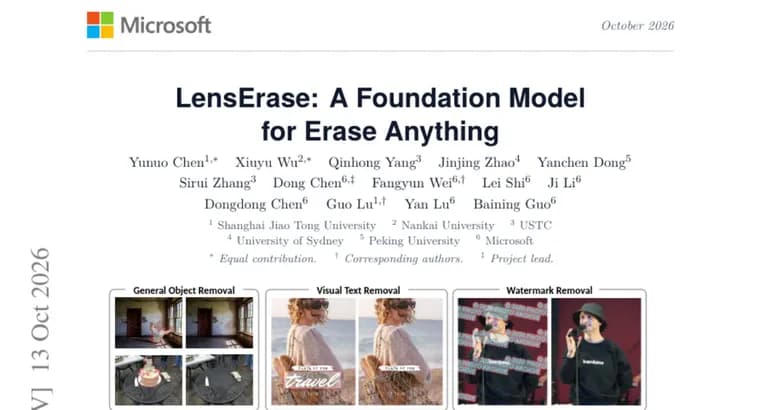
A preprint listed on Hugging Face Papers introduces LensErase, a general-purpose, mask-based "Erase Anything" foundation model. It is designed to cover a broad spectrum of real-world erase scenarios: diverse objects, visual text, watermarks, associated visual effects, multiple-object removal, and a wide range of object scales, aspect ratios and image resolutions.
The work has three parts. First, the authors build LensErase-100M, a dataset of 101.07 million paired source-mask-target examples spanning diverse erase scenarios. Second, they pretrain LensErase from the text-to-image model Lens, adapting its generative prior to mask-based erasing. To feed in the source image and the erase mask efficiently, they propose Mask-Aware RoPE, a 3D rotary positional encoding that injects mask information directly into the source-image tokens, with no separate mask token sequence.
Third, the model is refined with supervised fine-tuning and reinforcement learning using contract-guided, region-aware rewards. At inference, TraceFusion is applied to preserve high-fidelity content outside the effective edit region.
The authors evaluate on six public benchmarks and on their own LensErase-Bench. They report substantial improvements under both reference-based objective metrics and reference-free VLM evaluation, though the text gives no numeric scores. They say they hope LensErase can serve as a foundational model for erase-related applications and systems.
Key facts
- LensErase is a general-purpose, mask-based "Erase Anything" foundation model pretrained from the text-to-image model Lens.
- The accompanying LensErase-100M dataset holds 101.07 million paired source-mask-target examples.
- Mask-Aware RoPE is a 3D rotary positional encoding that injects mask information into the source-image tokens without a separate mask token sequence.
- Training adds supervised fine-tuning and reinforcement learning with contract-guided, region-aware rewards; TraceFusion at inference preserves content outside the edit region.
- The authors report substantial improvements across six public benchmarks and the new LensErase-Bench, under reference-based metrics and reference-free VLM evaluation.
Why it matters
Removing objects, text and watermarks from images is a common editing task, and LensErase aims to handle all of these in one model rather than several specialised ones. The paper pairs the model with a very large paired dataset and a dedicated benchmark, which is the kind of package a foundation model needs. The authors present it as a base for erase-related applications.
Who it affects
The work is aimed at people building image-editing and erase tools and systems, which the authors name as the intended use of LensErase as a foundational model. The text does not describe any specific product or user group beyond that.
How to use it
The source text gives no release, code, weights or licence information, so there is nothing to run yet. Anyone interested would need to look at the full paper for what is available. The erase workflow it describes takes a source image plus an erase mask and produces an image with the masked content removed.
How solid is it
This is a preprint with authors' own claims. They report substantial improvements on six public benchmarks and their own LensErase-Bench, under both reference-based objective metrics and reference-free VLM evaluation. No numeric benchmark scores, metric values or baseline names are given, so the size of the gains is not quantified. Evaluating on a benchmark the authors proposed themselves is worth keeping in mind.
Risks and caveats
The improvement claims are not quantified in the text available. The parameter count, dataset construction method and the origin of the base model Lens are not described, and no author names or institutions are given. A tool that erases watermarks is also one that could be used to strip them, though the source does not discuss this.