Leonida project recompiles Xbox GTA 6 for PC, but it does not boot yet
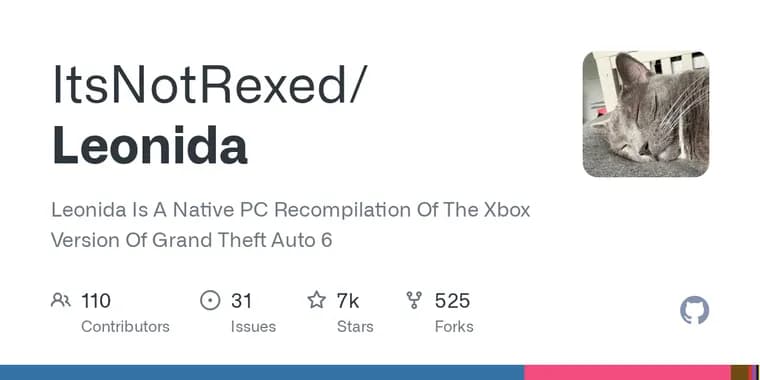
Leonida is a static recompilation project on GitHub that aims to run the Xbox Series version of GTA 6 on a PC. Its README describes the approach in a few steps. The Xbox Series CPU is x86-64, like a PC, so the game's code is loaded and run natively, while the console's system software is reimplemented. The console's precompiled RDNA2 GPU programs are translated to SPIR-V for Vulkan. Models, textures and audio are read from the user's own package. All of it happens on the user's PC.
The status line is blunt: "Early. The game does not boot yet." According to the README, everything that can be done without the game's executable is in place, so work on booting can start as soon as one is available to a developer.
The port is not distributed ready-made. The user builds it from their own copy of the Xbox Series package, version 1.0.2.1, with its files already readable on disk. The README says the repository does not contain the game, keys or an executable, and does not explain how to get them. It also says nothing in the project decrypts or works around any protection. Everything the build creates (generated shaders, extracted assets, the runtime folder and saves) comes from the user's game and stays on their PC, and the README tells users never to share those files.
The easy path is to install the prerequisites, clone the repository with its submodule (git clone --recursive), and double-click Build.bat. The script looks for the game in Downloads, Desktop, Documents, Games, the home folder and the top of every drive, two folders deep. It recognises the version from a few file sizes, asks which copy to use if there are several, and checks that the prerequisites and free space are in place before starting. Output goes to Documents\Leonida, and a stopped build resumes where it left off. A terminal route through make_game.py offers more control: listing copies (--find), checking a copy without building (--check), choosing paths (--game, --out, --work), running only some stages (--stages), and optionally decoding audio to WAV (--wav).
The prerequisites are heavy. They include Windows 10/11 x64 with about 350 GB free for work files (movable to another drive with --work), Python 3.12+, the .NET 8 SDK, the Vulkan SDK, LLVM 21+ with the AMDGPU target for llvm-mc, Visual Studio 2022 with C++ tools and Windows SDK 10.0.26100 or newer, and optionally ffmpeg. The official Windows LLVM build has no AMDGPU target, so the repo ships scripts\build_llvm_mc.ps1 to build one, or users can run llvm-21 under WSL. Build stages run in order: check, shaders, assets, runtime, pipelines. The last one creates every translated shader on the user's GPU driver and saves a pipeline cache so the first boot does not have to compile them. Shader translation is the longest step and runs across processes (half the CPU threads by default).
Shaders need special handling on NVIDIA and Intel GPUs, which have 32-wide subgroups. A wave64 emulation option (auto by default, or on or off) makes wave64 compute and mesh shaders translate exactly on any subgroup size.
Linux is partly supported. make_game.py runs there, but the runtime stage builds on Windows only, so Linux users need a Windows build of runtime/. The loader is a Windows program that runs under Wine or Proton, and CI runs its tests under Wine on every change to runtime/.
The README lists the biggest open pieces. First, the shader translator on hardware: compute, mesh and geometry shaders now translate, but the vertex-shader input layout (whether v0 is VertexIndex is unverified if the console runs vertex shaders as NGG) and wave64 cross-half code in vertex, pixel and geometry shaders on 32-wide subgroups remain open. Second, the Xbox D3D12 to Vulkan layer, meaning the command list and descriptor heap model. Third, model layouts the decoder rejects today. Contributors are pointed to CONTRIBUTING.md and told never to attach game files, extracted assets or generated shaders to issues or pull requests.
The credits name rpf9-explorer by breadbbbb (RPF9 model, texture-pool and AWC decoders, used through a git submodule), Mesa (GFX10 resource-descriptor layout and reference rules), Microsoft's libHttpClient (MIT, the XTaskQueue/XAsync implementation), LLVM's AMDGPU disassembler, SPIRV-Tools, and a logo icon by SlyDevil on SteamGridDB. The project is licensed GPLv3 or any later version, and the README states it is not affiliated with or endorsed by the owners of the Grand Theft Auto trademarks.
Key facts
- Leonida is a static recompilation project: the Xbox Series CPU is x86-64 like a PC, so game code runs natively, and RDNA2 GPU programs are translated to SPIR-V for Vulkan.
- The README says the game does not boot yet; boot work can start once a developer has the game's executable.
- Nothing is shipped: the repo has no game, keys or executable, and users build the port locally from their own Xbox Series package, version 1.0.2.1.
- The build needs about 350 GB of free disk space, Python 3.12+, .NET 8, the Vulkan SDK and LLVM 21+ with the AMDGPU target; the runtime stage builds on Windows only.
- Open work includes vertex-shader input layout, wave64 cross-half code on 32-wide subgroups, and the Xbox D3D12 to Vulkan layer. The license is GPLv3 or later.
Why it matters
Leonida takes a console-to-PC route that does not rely on a ready-made port. Because the Xbox Series CPU is x86-64, the project runs the game's code natively and reimplements the console's system software, then translates the RDNA2 shaders to SPIR-V for Vulkan. It is an attempt to bring an Xbox build of GTA 6 to PC from the user's own copy of the game. For now it is a skeleton: the README itself says the game does not boot.
Who it affects
Mainly developers and tinkerers with the hardware, disk space and technical patience to build it, and those who might contribute to the open pieces such as the shader translator and the D3D12 layer. The README asks contributors to read CONTRIBUTING.md and never to attach game files, extracted assets or generated shaders to issues or pull requests. Ordinary players cannot download a playable port from it.
How to use it
Install the prerequisites, clone with git clone --recursive https://github.com/ItsNotRexed/Leonida, then double-click Build.bat. It locates your copy of the game, checks for missing tools and free space, and writes the result to Documents\Leonida. For more control, run make_game.py with options such as --find, --check, --game, --out, --work, --stages and --wave64-emulate. You must supply your own Xbox Series package, version 1.0.2.1, with files readable on disk. The code is under GPLv3 or any later version. On Linux, the runtime stage needs a Windows build of runtime/, and the loader runs under Wine or Proton.
How solid is it
The only primary source is the project's own README. By its own account the project is early and the game does not boot. What exists is the pipeline around the executable: the shader translator handles compute, mesh and geometry shaders, and CI tests the loader under Wine on every change to runtime/. The README does not report any in-game result.
Risks and caveats
Booting is blocked until a developer has the game's executable, and the README lists open problems: unverified vertex-shader input layout, wave64 cross-half code on 32-wide subgroups (which affects NVIDIA and Intel GPUs), the D3D12 to Vulkan layer, and model layouts the decoder rejects. The build is demanding: about 350 GB of free space, a long shader translation step, and a long list of toolchain requirements, including an LLVM build with the AMDGPU target that the official Windows release lacks. The project says it is not affiliated with or endorsed by the owners of the Grand Theft Auto trademarks.
“Early. The game does not boot yet.”
— Leonida README