Liquid AI releases d1-3B and d1-omni-600M open decision models
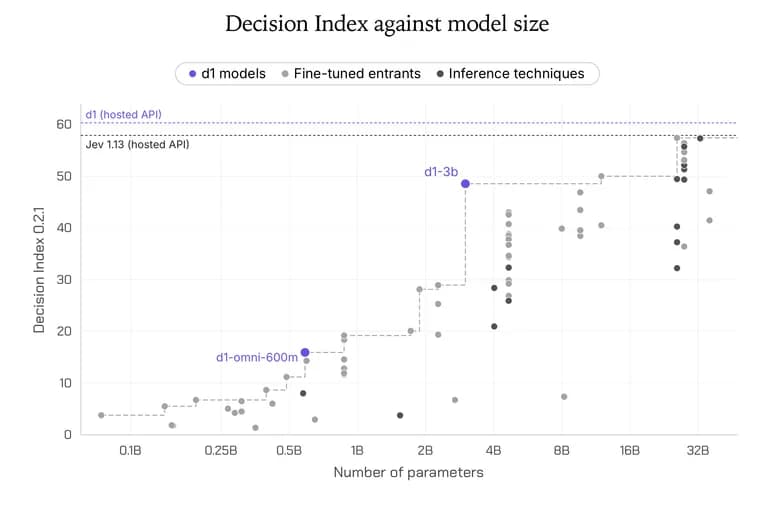
Liquid AI has released two open-weight models in a new d1 family of "decision models", both on Hugging Face, in a post dated October 7, 2026. The models are d1-3B and an experimental d1-omni-600M. According to the post, decision models differ from generative ones: they don't produce tokens and instead answer in a single forward pass.
d1-3B is trained from LFM2.5-VL-3B, a decoder-only model, and accepts text and images. d1-omni-600M is trained from LFM2.5-Encoder-350M, a bidirectional encoder with vision and audio encoders, and accepts text plus image or text plus audio. Liquid AI labels it experimental and calls it an early research release.
On quality, the post reports that d1-3B scores 48.57 on the Decision Index 0.2.1, which it describes as the best decision model under 10B parameters. The score is ahead of Decider 35B-A3B at 47.11. Across seven public datasets, d1-3B has the highest mean in the post's table at 82.9, against 78.4 for d1-omni-600M, 77.1 for Decider 2B and 81.1 for Decider 4B. On SQuAD 2.0 the four columns read 74.0 (d1-omni-600M), 83.3 (d1-3B), 67.7 (Decider 2B) and 76.0 (Decider 4B). The post also says d1-omni-600M beats Decider 2B with about a quarter of the parameters.
Speed is the other selling point, with the focus on edge hardware. Per the post, d1-3B answers a single question in 16 ms on a Jetson AGX Thor, 26 ms on a Jetson AGX Orin and 50 ms on a Jetson Orin Nano. Other single-question latencies listed are 30 ms on an Apple M5 Pro, 8 ms on an NVIDIA RTX 4090 and 9 ms on an AMD MI325X. Three questions take about 1.3x the time of one. d1-omni-600M speed numbers are not reported, since it is an early research release.
The usage example in the post needs transformers>=5.14 with trust_remote_code=True.
Key facts
- Liquid AI released two open-weight decision models on Hugging Face: d1-3B (text and images) and the experimental d1-omni-600M (text plus image or text plus audio), in a post dated October 7, 2026.
- Decision models don't produce tokens; they answer in a single forward pass.
- d1-3B scores 48.57 on the Decision Index 0.2.1, which the post calls the best decision model under 10B, ahead of Decider 35B-A3B at 47.11.
- d1-3B answers a single question in 16 ms on a Jetson AGX Thor, 26 ms on a Jetson AGX Orin and 50 ms on a Jetson Orin Nano; three questions take about 1.3x the time of one.
- d1-omni-600M beats Decider 2B with about a quarter of the parameters, but its speed numbers are not reported because it is an early research release.
Why it matters
Most small-model releases are generative: they emit tokens one by one. Liquid AI is offering a different shape of model, one that gives its answer in a single forward pass, and pairing it with latency figures aimed at edge hardware. If the reported numbers hold, a 3B model that answers a question in tens of milliseconds on a Jetson board is a practical option for classification-style and question-answering tasks on-device. The post also claims d1-3B beats a much larger Decider 35B-A3B on the Decision Index 0.2.1 (48.57 versus 47.11), which is the headline quality claim.
Who it affects
Developers building on edge devices such as Jetson boards or Apple laptops, where per-question latency matters. Teams that need quick decisions over text, images or audio rather than free-form generated text. Researchers interested in the experimental d1-omni-600M, which handles text with either an image or audio.
How to use it
Both models are published on Hugging Face. The usage example in the post requires transformers>=5.14 with trust_remote_code=True, so custom model code is executed on load. d1-3B is the model with reported speed numbers. d1-omni-600M is labelled experimental, so treat it as a research preview. No license name is given in the available text.
How solid is it
The primary source is unavailable in its original form, so the figures here are second-hand and could not be checked against the raw article. All benchmark and latency claims come from Liquid AI's own post, and the "best decision model under 10B" label is the post's description, not an independent finding. The d1-3B mean of 82.9 is the highest in the post's own seven-dataset table. The post does not say outright whether the Apple M5 Pro and GPU latencies refer to d1-3B.
Risks and caveats
The Decision Index 0.2.1 and the comparison models are the post's chosen yardstick, and results from the vendor's own tables should be reproduced before relying on them. d1-omni-600M is an early research release with no reported latency. The usage example needs trust_remote_code=True, which runs code from the model repository. No pricing, training data details or timeline for further models are given.