Liquid AI ships QAD-quantized LFM2.5 checkpoints, recovers 97% of lost accuracy
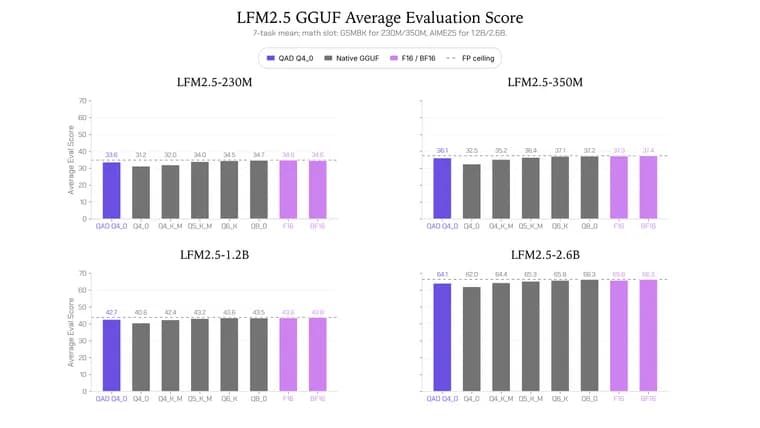
Liquid AI has released new Q4_0 GGUF checkpoints for its four LFM2.5 models: LFM2.5-230M, LFM2.5-350M, LFM2.5-1.2B-Instruct, and LFM2.5-2.6B. The checkpoints are trained with a method the company calls Quantization-Aware Distillation (QAD), in which a high-precision teacher model is distilled directly into a quantized student model, rather than quantizing a model after it has already been trained in full precision, the standard post-training quantization (PTQ) approach Liquid AI used for its earlier Q4_0 GGUFs of the same models.
Liquid AI reports that the QAD checkpoints keep the same low memory footprint and high throughput as native Q4_0 GGUFs while recovering 97% of the BF16 average accuracy that standard Q4_0 quantization otherwise loses, an aggregate figure across all four models. Individually, following the model order used throughout the rest of the post (230M, 350M, 1.2B-Instruct, 2.6B), the QAD Q4_0 checkpoints retain 97.1%, 96.5%, 97.4%, and 96.6% of their respective BF16 baseline performance. Liquid AI states that across all four models, QAD substantially improves on the Q4_0 checkpoint produced by plain PTQ.
The comparison used a benchmark suite spanning reasoning, instruction following, tool use, and agentic capability: GPQA Diamond, MMLU-Pro, IFEval, IFBench, Multi-IF, and BFCLv4, plus one math benchmark sized to each model, GSM8K for the two smaller models (230M and 350M) and AIME25 for the two larger ones (1.2B-Instruct and 2.6B). Each reported score is a mean across five repeats, and the BF16 GGUF is used as the in-format accuracy ceiling against which both the earlier PTQ checkpoints and the new QAD Q4_0 checkpoints are measured.
Liquid AI also measured decode throughput on four real edge devices: MacBook Pro and NucBox EVO-X2, both using GPU inference, and Samsung Galaxy S26 Ultra and Raspberry Pi 5, both using Arm CPU inference, with BF16 or F16 shown as full-precision references where profiled. At matching quality within evaluation variance, the 230M and 350M QAD Q4_0 checkpoints reach 4 to 33% higher decode throughput than the Q5_K_M quantization they match in quality, while the 1.2B-Instruct and 2.6B checkpoints reach 3 to 14% higher throughput than the Q4_K_M quantization they match. Where applicable, for the 230M and 1.2B models, the QAD Q4_0 checkpoints also match the quality of Unsloth's UD-Q4_K_XL, which Liquid AI describes as a strong external PTQ checkpoint.
All four QAD GGUFs are available now on Hugging Face and can be run with llama.cpp or any other runtime that supports GGUF Q4_0 artifacts. Liquid AI's own example loads the 350M checkpoint directly from Hugging Face with llama-cli, pointing the --hf-file flag at the LFM2.5-350M-QAD-Q4_0.gguf file. The post gives no pricing or licensing terms for the files, no raw scores for any of the eight benchmarks used, no absolute tokens-per-second figures for the four hardware targets, and no comparison to quantized checkpoints from other model families such as Llama, Mistral, Gemma, or Qwen.
Key facts
- Liquid AI released Q4_0 GGUF checkpoints for four LFM2.5 models (230M, 350M, 1.2B-Instruct, 2.6B), trained with a method it calls Quantization-Aware Distillation (QAD): distilling a high-precision teacher directly into a quantized Q4_0 student instead of quantizing after training.
- The QAD checkpoints recover 97% of the BF16 accuracy lost to standard Q4_0 quantization overall; individually they retain 97.1%, 96.5%, 97.4%, and 96.6% of BF16 baseline performance.
- Benchmarks spanned reasoning, instruction following, tool use, and agentic tasks (GPQA Diamond, MMLU-Pro, IFEval, IFBench, Multi-IF, BFCLv4), plus GSM8K for the two smaller models or AIME25 for the two larger ones, each score a mean of five repeats.
- On real hardware (MacBook Pro, NucBox EVO-X2, Samsung Galaxy S26 Ultra, Raspberry Pi 5), the 230M and 350M checkpoints match Q5_K_M quality at 4 to 33% higher decode throughput, and the 1.2B-Instruct and 2.6B checkpoints match Q4_K_M quality at 3 to 14% higher throughput.
- All four GGUFs are available now on Hugging Face and run with llama.cpp or any runtime that supports GGUF Q4_0 artifacts.
Why it matters
Standard post-training quantization (PTQ) takes a model already trained in full precision and casts its weights down afterward, which is simple but costs accuracy. Liquid AI's Quantization-Aware Distillation (QAD) instead folds quantization into training itself: a high-precision teacher model is distilled directly into a quantized Q4_0 student. Liquid AI reports that across all four LFM2.5 sizes, QAD substantially improves on the company's own earlier PTQ Q4_0 GGUFs, recovering 97% of the BF16 accuracy that Q4_0 quantization otherwise loses while keeping the same low memory footprint and high throughput as any other Q4_0 GGUF. Where applicable, for the 230M and 1.2B models, the QAD checkpoints also match the quality of Unsloth's UD-Q4_K_XL, which Liquid AI calls a strong external PTQ checkpoint.
Who it affects
Developers deploying LFM2.5 on constrained edge hardware rather than in the cloud. Liquid AI measured decode throughput on four real devices split across two inference paths: MacBook Pro and NucBox EVO-X2 using GPU inference, and Samsung Galaxy S26 Ultra and Raspberry Pi 5 using Arm CPU inference. Anyone already running LFM2.5 GGUFs through llama.cpp, or evaluating small local models for phones, single-board computers, or mini PCs, is the direct audience; the four checkpoints span 230M to 2.6B parameters, so the choice of size scales with the device.
How to use it
All four QAD Q4_0 GGUFs, for LFM2.5-230M, LFM2.5-350M, LFM2.5-1.2B-Instruct, and LFM2.5-2.6B, are available now on Hugging Face and work with llama.cpp or any other runtime that supports GGUF Q4_0 artifacts. Liquid AI's own example loads the 350M checkpoint directly from Hugging Face with llama-cli, pointing the --hf-file flag at the LFM2.5-350M-QAD-Q4_0.gguf file. The post gives no pricing or licensing terms for the files.
How solid is it
Liquid AI compared each model's earlier PTQ Q4_0 GGUF and the new QAD Q4_0 checkpoint against a BF16 GGUF used as the in-format accuracy ceiling, across a benchmark suite spanning reasoning, instruction following, tool use, and agentic capability: GPQA Diamond, MMLU-Pro, IFEval, IFBench, Multi-IF, and BFCLv4, plus one math benchmark sized to each model, GSM8K for the 230M and 350M models and AIME25 for the 1.2B-Instruct and 2.6B models. Each reported score is a mean across five repeats. Individually, the QAD Q4_0 checkpoints retain 97.1%, 96.5%, 97.4%, and 96.6% of their respective BF16 baseline performance, in the model order used throughout the rest of the post (230M, 350M, 1.2B-Instruct, 2.6B). On real hardware, the 230M and 350M QAD checkpoints match Q5_K_M quality within evaluation variance at 4 to 33% higher decode throughput, and the 1.2B-Instruct and 2.6B checkpoints match Q4_K_M quality at 3 to 14% higher throughput.
Risks and caveats
These are Liquid AI's own measurements, published in the blog post announcing the checkpoints, and given only as aggregate retention and throughput percentages: the post does not publish raw scores for any of the eight benchmarks used (GPQA Diamond, MMLU-Pro, IFEval, IFBench, Multi-IF, BFCLv4, GSM8K, AIME25), nor absolute tokens-per-second numbers for any of the four hardware targets. There is no comparison to quantized checkpoints from other model families, such as Llama, Mistral, Gemma, or Qwen, and no percentage figure for how much of the BF16-to-Q4_0 gap plain PTQ alone recovers, so the claim that QAD "substantially improves" on PTQ has no baseline number attached to it in the source. The Unsloth UD-Q4_K_XL comparison is also limited to the 230M and 1.2B models.