LLM-as-Jev paper: Qwen3.5-4B already works as a decision model without training
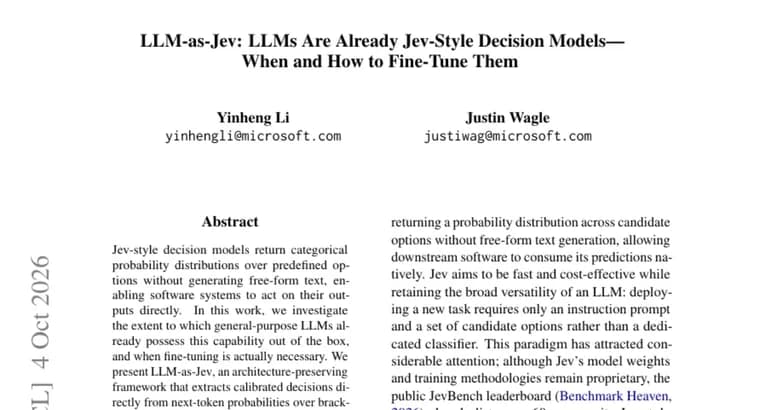
A paper on the Hugging Face papers page asks how far general-purpose LLMs can already go as "Jev-style" decision models, and when fine-tuning is really needed. The authors define such models as ones that return categorical probability distributions over predefined options without generating free-form text, so software systems can act on the outputs directly.
The paper presents LLM-as-Jev, an architecture-preserving framework. It extracts calibrated decisions directly from next-token probabilities over bracketed numeric identifiers. It comes in two parts: a training-free inference recipe, and a fine-tuning objective. The objective optimizes candidate selection through a tree-factorized listwise loss, and it anchors auxiliary predictions to the base model with KL divergence penalties.
The evaluation uses two models, Qwen3.5-4B and Qwen3-0.6B. The authors conclude that modern LLMs are inherently effective decision models. Without any training, the 4B model matches community Jev-style models built on the same backbone, outperforms letter-logit readouts, supports arbitrary option counts, and natively handles multimodal decisions over images.
On fine-tuning, the authors say the benefits are targeted rather than universal. It substantially improves weaker models and specific tasks, such as many-option intent routing, but offers diminishing returns for strong backbones. They also report that their KL anchors prevent behavioral degradation in conversational text generation, and that LoRA delivers the strongest performance on capable models.
Key facts
- LLM-as-Jev reads calibrated categorical decisions from next-token probabilities over bracketed numeric identifiers, with no change to the model architecture.
- Untrained, the 4B model matches community Jev-style models on the same backbone and outperforms letter-logit readouts.
- The approach supports arbitrary option counts and handles multimodal decisions over images natively.
- Fine-tuning helps weaker models and tasks such as many-option intent routing, with diminishing returns for strong backbones.
- KL anchors prevent behavioral degradation in conversational text generation; LoRA gives the strongest results on capable models.
Why it matters
Many software systems need a model to pick one option from a fixed list, not to write prose. The paper's claim is that a general-purpose LLM can already do this reliably out of the box, so a separate fine-tuning step may be unnecessary. It also says where fine-tuning does pay off: weaker models and specific tasks such as many-option intent routing.
Who it affects
Teams building systems that route requests, pick among candidates or otherwise act on a model's choice among predefined options. The authors' findings on weaker models and strong backbones bear on anyone deciding whether to fine-tune a small model or rely on a capable one as it is.
How to use it
The paper describes two routes. The training-free recipe reads next-token probabilities over bracketed numeric identifiers attached to the options. The fine-tuning route adds a tree-factorized listwise loss with KL divergence penalties; the authors report LoRA performing best on capable models. No code, model release or licence is mentioned in the source.
How solid is it
The source is the paper's abstract, and the findings are stated qualitatively: no numeric results (accuracy, calibration error, speedup or other metrics) are given. Only two models are named as evaluated, Qwen3.5-4B and Qwen3-0.6B. The datasets and benchmarks are not named, and the source does not say what "Jev" stands for or who the community Jev-style models are.
Risks and caveats
The conclusion that modern LLMs are inherently effective decision models rests on two named Qwen models. The abstract does not say which model counts as weaker or strong beyond those two, nor which one fine-tuning helped most. Claims such as matching community models and outperforming letter-logit readouts come without figures in the source, so their size cannot be judged from it.
“Fine-tuning provides targeted rather than universal benefits”
— LLM-as-Jev paper abstract