LLM test-time scaling's GPU cost swings up to 6x with batching
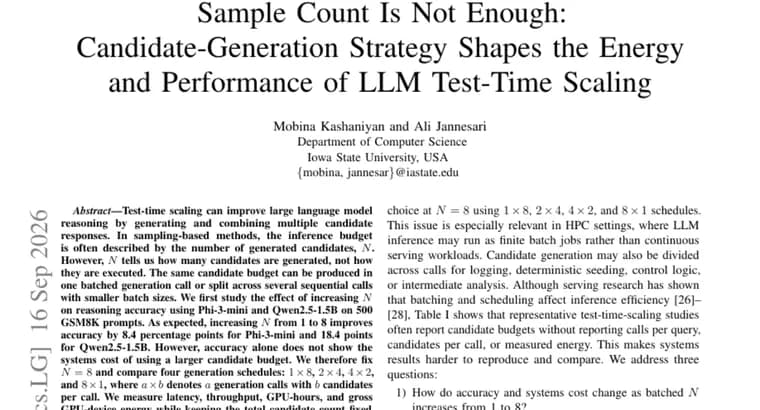
Test-time scaling boosts LLM reasoning accuracy by generating several candidate answers and combining them, and it is usually described only by N, the number of candidates. The paper argues N alone hides how those candidates are produced: the same budget can come from one batched generation call or from several smaller sequential calls. Using Phi-3-mini and Qwen2.5-1.5B on 500 GSM8K prompts, the authors first confirm that raising N from 1 to 8 helps: accuracy rises by 8.4 percentage points for Phi-3-mini and 18.4 points for Qwen2.5-1.5B. They then fix N at 8 and compare four generation schedules that produce the same eight candidates in different ways: 1x8 (one call of eight candidates), 2x4, 4x2 and 8x1 (eight separate calls of one candidate each). On A100 GPUs, the fully serial 8x1 schedule uses 4.64 to 4.86 times the gross GPU-device energy of the single batched 1x8 call, and has 5.77 to 6.12 times its P95 latency, for an identical candidate count and accuracy. The same pattern reproduces across three independently scheduled A100 nodes per model and in a separate short-output experiment on SciQ with V100 hardware. The authors conclude that candidate count alone cannot describe the systems cost of multi-candidate test-time scaling: when candidates are independent and memory allows it, fewer generation calls with larger batch sizes are more efficient, and they argue that evaluations should report the generation schedule and GPU-level systems metrics alongside candidate count and accuracy.
Key facts
- Raising the candidate count N from 1 to 8 improved accuracy by 8.4 percentage points for Phi-3-mini and 18.4 points for Qwen2.5-1.5B on 500 GSM8K prompts.
- With N fixed at 8, the study compared four generation schedules producing the same total candidates: 1x8, 2x4, 4x2 and 8x1, on A100 GPUs.
- The fully serial 8x1 schedule used 4.64 to 4.86 times the gross GPU-device energy of the single batched 1x8 call for the same candidate count and accuracy.
- The serial schedule also had 5.77 to 6.12 times the P95 latency of the batched one, a pattern reproduced across three independently scheduled A100 nodes per model and in a separate SciQ/V100 test.
- The authors conclude that test-time scaling evaluations should report generation schedule and GPU-level systems metrics, not just candidate count and accuracy.
Why it matters
Test-time scaling is normally reported by candidate count N alone, as if N fully described its cost. This paper shows that assumption is wrong: the same N can be produced as one batched call or as several sequential calls, and that choice changes GPU energy and latency by several times while accuracy and candidate count stay identical. It reframes test-time scaling cost as a systems question, not just a sampling one.
Who it affects
Anyone running LLM inference with sampling-based test-time scaling in production, teams sizing GPU capacity for reasoning workloads, and researchers who benchmark or report test-time scaling results.
How to use it
The practical takeaway is direct: when the candidates in a batch are independent and memory allows it, issuing fewer generation calls with larger batch sizes is more GPU-efficient than splitting the same total candidate budget across many smaller serial calls. That is a scheduling choice available at inference time without changing the model or the candidate count.
How solid is it
The accuracy experiment used two small models, Phi-3-mini and Qwen2.5-1.5B, on 500 GSM8K prompts. The systems-cost comparison ran on A100 GPUs and reproduced the same 4.64x to 6.12x pattern across three independently scheduled A100 nodes per model, plus a separate short-output test on SciQ with V100 hardware. The source names no institutions, funding sources, publication venue or date, and does not name the specific models used in the three-node or SciQ/V100 runs beyond the V100 hardware itself. It reports only ratios between schedules, with no absolute latency, throughput or GPU-hours figures.
Risks and caveats
The headline numbers are relative ratios between schedules, not absolute performance figures, so they do not by themselves say how expensive a given deployment is in real terms. The authors themselves scope the batching advantage to the case where candidates are independent and memory allows the larger batch; the source does not establish how the pattern behaves outside that condition or on larger models and other hardware.
“Candidate count alone is not enough to describe the systems cost of multi-candidate test-time scaling.”
— the paper's authors