Looped language models improve multi-step tool use, study finds
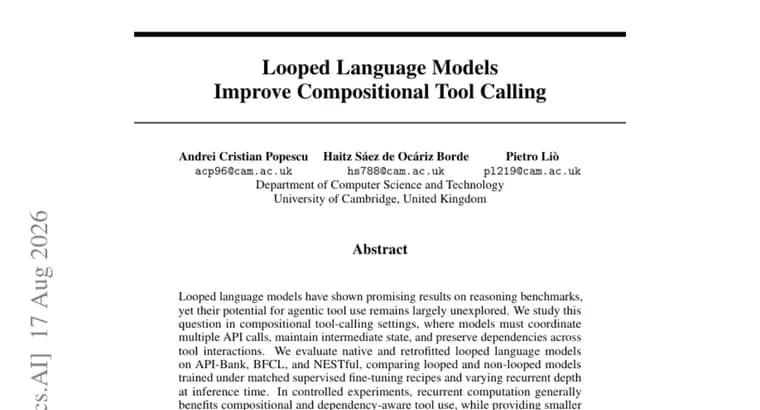
A study examines whether looped language models, architectures that repeat a shared block of layers several times to add computation without adding parameters, help with agentic tool use. Looped models had already shown gains on reasoning benchmarks, but the paper says their value for tool calling had not been explored before.
The researchers test both native looped language models and looped models retrofitted from standard ones, comparing them against non-looped models trained with matched supervised fine-tuning recipes. They vary the recurrent depth, meaning how many times the shared block of layers is repeated, at inference time. The comparison runs on three tool-use benchmarks: API-Bank, BFCL, and NESTful. These benchmarks test compositional tool calling, where a model has to coordinate multiple API calls, keep track of intermediate state, and respect dependencies between the calls, as opposed to a single isolated API call.
The controlled experiments show that recurrent computation generally helps with compositional and dependency-aware tool use, where several calls depend on each other, more than it helps with isolated API invocation, where the gains are smaller and vary more by model. Accuracy on multi-step tool use generally rises as recurrent depth increases. However, letting the model decide adaptively how much extra computation to spend, rather than fixing the recurrent depth in advance, gives a better trade-off between compute cost and performance, because computation is only added when it is actually needed.
The authors conclude that looped language models are a promising architecture for agentic systems that need reliable planning, coordination, and execution across compositional tool-use workflows. The paper does not report specific accuracy numbers, model names or sizes, the numeric range tested for recurrent depth, author names, institutional affiliations, or a publication date.
Key facts
- The study compares native and retrofitted looped language models against non-looped models trained under matched supervised fine-tuning recipes.
- Testing spans three tool-use benchmarks: API-Bank, BFCL, and NESTful.
- Recurrent computation benefits compositional and dependency-aware tool use more than isolated API invocation, where gains are smaller and model-dependent.
- Accuracy on multi-step tool use generally increases with recurrent depth.
- Adaptive inference, which spends extra computation only when needed, achieves a better compute-performance trade-off than simply fixing a higher recurrent depth.
Why it matters
Looped language models add computation by repeating a shared block of layers multiple times rather than by adding parameters. They had already shown promise on reasoning benchmarks, but whether that translates to agentic tool use, where a model has to string together multiple API calls with dependencies between them, was untested. This paper is a direct test of that question, and it finds the architecture does help specifically with the harder, compositional case rather than with single isolated calls.
Who it affects
The result is aimed at people building or evaluating agentic systems that chain together multiple tool or API calls, and at researchers choosing model architectures for that purpose. It speaks less to single-call tool use, where the paper reports the benefit as smaller and dependent on the specific model.
How to use it
The practical takeaway is about inference strategy rather than a product to adopt. Simply increasing the recurrent depth raises accuracy on multi-step tool use, but the paper finds that adaptive inference, where the model allocates extra computation only when a step needs it rather than at a fixed depth for every step, gives a more favorable trade-off between compute spent and performance gained.
How solid is it
The comparison is controlled: looped and non-looped models are trained under matched supervised fine-tuning recipes, and both native looped models and models retrofitted into a looped form are included, with recurrent depth varied at inference time. Testing covers three separate benchmarks, API-Bank, BFCL, and NESTful, rather than one. The source text does not give the specific accuracy numbers or score deltas produced in these experiments.
Risks and caveats
The available text does not name the models used, their sizes, the paper's authors, their institutions, the numeric range tested for recurrent depth, or a publication date, so those details cannot be verified here. The authors themselves describe the gain on isolated API invocation as smaller and model-dependent, meaning it does not hold uniformly across models tested.
“recurrent computation generally benefits compositional and dependency-aware tool use, while providing smaller and more model-dependent gains on isolated API invocation”
— the paper's authors