Macaron-V1 pairs Mixture-of-LoRA with recursive self-improvement
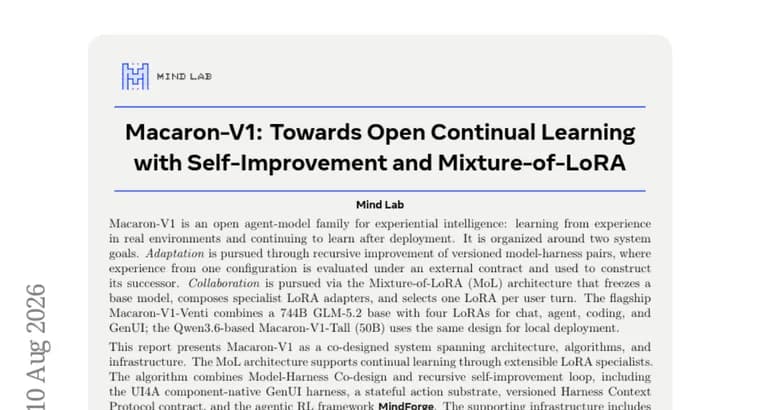
A paper presents Macaron-V1, an open agent-model family the authors describe as built for experiential intelligence: learning from real environments and continuing to learn after deployment. The system is organized around two goals. The first, adaptation, is pursued through recursive improvement of versioned model-harness pairs: experience from one configuration is evaluated under an external contract and used to build its successor. The second, collaboration, is pursued through a Mixture-of-LoRA (MoL) architecture that freezes a base model, composes specialist LoRA adapters on top of it, and selects one LoRA per user turn.
The flagship variant, Macaron-V1-Venti, combines a 744B-parameter GLM-5.2 base model with four LoRA specialists covering chat, agent, coding, and GenUI. A second, smaller variant, Macaron-V1-Tall, uses the same MoL design on a 50B-parameter Qwen3.6 base and is intended for local deployment.
The paper frames Macaron-V1 as a co-designed system spanning architecture, algorithms, and infrastructure rather than a single model. On the architecture side, the MoL design is meant to support continual learning by letting new LoRA specialists be added over time. On the algorithm side, the authors combine what they call Model-Harness Co-design with the recursive self-improvement loop, and list several supporting components: a component-native GenUI harness called UI4A, a stateful action substrate, a versioned HCP contract, and an agentic reinforcement-learning framework named MindForge. The supporting infrastructure includes a post-training platform called MinT, a long-context reinforcement-learning method called LongStraw, and unspecified stability techniques for sparse mixture-of-experts and DSA base models.
The authors report evaluating Macaron-V1 on Personal Intelligence, GenUI, and general capability benchmarks against frontier baselines, but the text does not give the actual scores. Their stated conclusion is that the results validate the current system, while compounding gains from continual learning and collective intelligence remain open questions. The text names no individual authors or institutions and gives no release date, licensing terms, or information on code or weight availability.
Key facts
- Macaron-V1-Venti, the flagship model, combines a 744B-parameter GLM-5.2 base with four LoRA specialists for chat, agent, coding, and GenUI.
- Macaron-V1-Tall is a 50B-parameter Qwen3.6-based variant using the same Mixture-of-LoRA design, aimed at local deployment.
- Adaptation comes from recursively improving versioned model-harness pairs; collaboration comes from the MoL architecture, which freezes the base model and selects one specialist LoRA per user turn.
- The system bundles several named components: the UI4A GenUI harness, a stateful action substrate, a versioned HCP contract, the MindForge agentic RL framework, the MinT post-training platform, and the LongStraw long-context RL method.
- The authors say Macaron-V1 was evaluated on Personal Intelligence, GenUI, and general capability benchmarks against frontier baselines, but no benchmark scores are given in the text, and compounding gains from continual learning are described as an open question.
Why it matters
Most deployed models are frozen after release. Macaron-V1 is pitched as a system designed to keep improving after deployment, pairing a Mixture-of-LoRA architecture that lets specialist skills be added incrementally with a recursive self-improvement loop that turns deployment experience into the next model version. That combination, rather than any single benchmark result, is the paper's core claim.
Who it affects
The paper is aimed at researchers and engineers building agent systems that need to keep learning from real usage, and at teams that need a smaller model for local deployment, which is what the 50B Macaron-V1-Tall variant targets. The GenUI-focused LoRA and the UI4A harness also point at teams building agent interfaces rather than plain chat.
How to use it
The text gives no information on licensing, code release, or availability of model weights for either Macaron-V1-Venti or Macaron-V1-Tall, so there is nothing here to confirm whether or how the system can currently be run outside the authors' own setup.
How solid is it
The authors state that Macaron-V1 was tested on Personal Intelligence, GenUI, and general capability benchmarks against frontier baselines, but the source text does not include the actual scores, so the strength of the results cannot be checked from this material alone. The paper also names no individual authors, institutions, or publication venue.
Risks and caveats
The authors themselves flag that compounding gains from continual learning and collective intelligence remain open questions, meaning the paper validates the system as currently built without yet demonstrating that the self-improvement loop keeps paying off over repeated cycles.
“Our results validate the current system, while compounding gains from continual learning and collective intelligence remain open questions.”
— the authors of the Macaron-V1 paper