Mage-VL cuts streaming video tokens by 75% while beating rivals
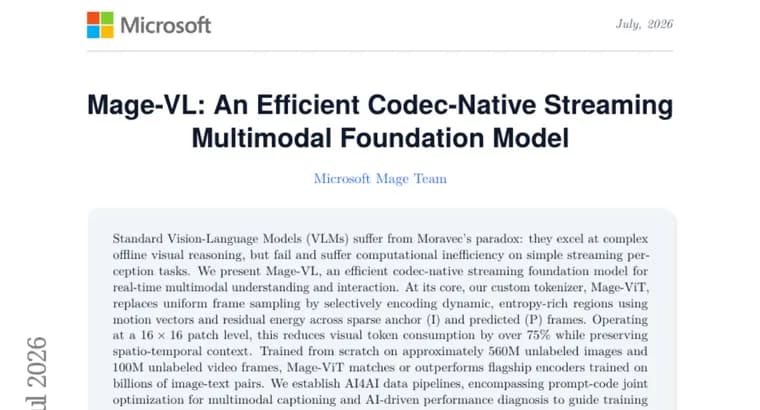
A team led by Senqiao Yang and co-authors present Mage-VL, described as an efficient codec-native streaming foundation model built for real-time multimodal understanding and interaction. Their starting point is what they call Moravec's paradox for vision-language models (VLMs): these systems handle complex offline visual reasoning well but struggle with simple, real-time streaming perception tasks and process them inefficiently.
The core of Mage-VL is a custom tokenizer called Mage-ViT. Instead of the usual approach of uniformly sampling frames, it selectively encodes dynamic, entropy-rich regions of video using motion vectors and residual energy, computed across sparse anchor (I) frames and predicted (P) frames, borrowing the anchor/predicted frame structure from video codecs. Working at a 16 by 16 patch level, this cuts visual token consumption by more than 75% while preserving spatiotemporal context. Mage-ViT was trained from scratch on about 560 million unlabeled images and 100 million unlabeled video frames, and the authors report it matches or outperforms flagship encoders trained on billions of image-text pairs.
Alongside the tokenizer, the authors describe what they call AI4AI data pipelines: prompt-code joint optimization for multimodal captioning, combined with AI-driven performance diagnosis used to guide training recipes.
For real-time behavior, Mage-VL uses a bio-inspired dual-system architecture: a lightweight System 1 event gate paired with a causal System 2 decoder, which together are meant to let the model perceive streaming input proactively rather than simply processing every frame on a fixed schedule.
On evaluation, Mage-VL-4B matches Qwen3-VL-4B on static image tasks while showing strong gains in video understanding and 2D/3D spatial reasoning, with inference up to 3.5 times faster by wall-clock time, and the authors say it comprehensively surpasses the 15-billion-parameter Phi-4-reasoning-vision baseline. Beyond the model itself, the paper reports seven empirical findings covering pre-training data efficiency, variable-resolution scaling, codec system acceleration, redundancy in VideoQA supervised fine-tuning, motion-spatial synergy, the AI4AI data pipelines, and a Zero-Vision SFT approach for multimodal reinforcement learning.
Key facts
- Mage-ViT tokenizer selectively encodes motion vectors and residual energy across I/P frames at 16x16 patch resolution, cutting visual token use by over 75%
- Trained from scratch on about 560M unlabeled images and 100M unlabeled video frames, it matches or outperforms flagship encoders trained on billions of image-text pairs
- Mage-VL-4B matches Qwen3-VL-4B on static tasks, gains on video and spatial reasoning, runs up to 3.5x faster, and surpasses the 15B Phi-4-reasoning-vision baseline
- A dual-system design, a lightweight System 1 event gate plus a causal System 2 decoder, is meant to enable proactive streaming perception
- The paper reports seven empirical findings, including pre-training data efficiency, variable-resolution scaling, and a Zero-Vision SFT method for multimodal RL
Why it matters
The paper names a specific gap: VLMs that are strong at complex offline visual reasoning tend to be weak and inefficient at simple, real-time streaming perception, the kind needed to understand a live video feed as it arrives rather than a fixed clip after the fact. Mage-VL targets that gap directly by rethinking how a model tokenizes video: encoding only the parts of a frame that actually change, using motion and residual signals borrowed from video codecs, instead of treating every frame as equally worth full attention.
Who it affects
The immediate audience is researchers and engineers building multimodal foundation models, particularly anyone working on real-time or streaming video understanding, where processing cost per frame limits what is practical. The comparisons drawn, against Qwen3-VL-4B and the larger Phi-4-reasoning-vision, position Mage-VL as a reference point for teams evaluating efficient alternatives to standard uniform-frame-sampling VLMs.
How to use it
The source text is the paper's abstract and does not state licensing terms, pricing, or whether model weights or code are being released. What it does specify is scale: the Mage-ViT tokenizer was trained from scratch on roughly 560 million unlabeled images and 100 million unlabeled video frames, and the resulting Mage-VL-4B model is benchmarked directly against Qwen3-VL-4B and the 15-billion-parameter Phi-4-reasoning-vision.
How solid is it
The figures come from the authors' own extensive evaluations as reported in the abstract: over 75% reduction in visual tokens, up to a 3.5x wall-clock inference speedup, and specific head-to-head results against Qwen3-VL-4B and Phi-4-reasoning-vision. These are the authors' self-reported benchmark comparisons rather than independently reproduced results, and the source available here is the abstract itself rather than the full paper, so the underlying methodology and full result tables are not covered in this account. The post drew 25 points and 2 comments on Hugging Face Papers, a modest engagement signal.
Risks and caveats
As with any single-paper claim, the benchmark wins are measured against baselines the authors chose (Qwen3-VL-4B, Phi-4-reasoning-vision) and reported by the same team that built Mage-VL, so independent verification is still pending. No information is given here on release plans, so it is not yet possible to say whether outside groups will be able to reproduce the token-reduction and speedup figures on their own workloads.
“Standard vision-language models (VLMs) suffer from Moravec's paradox: they excel at complex offline visual reasoning but struggle with simple streaming perception tasks and process them inefficiently.”
— Mage-VL paper abstract