Microsoft announces Maia 300 AI chip, rolling out in 2027 to cut reliance on Nvidia
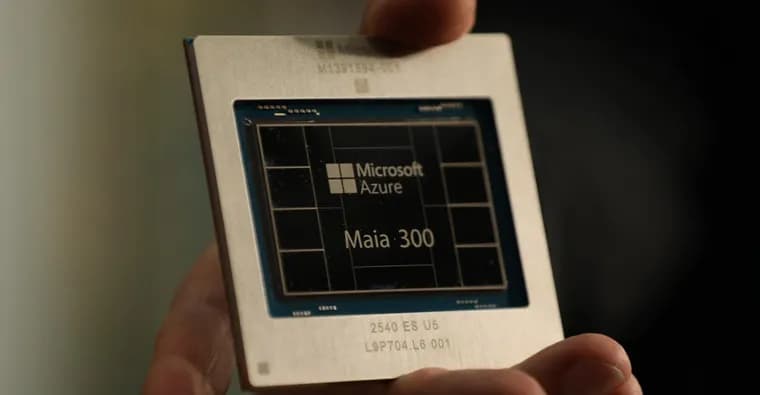
Microsoft announced Maia 300, the third generation of its in-house Maia AI chip. The company says it is designed to be the "primary AI inference system" for Microsoft's products and services. The Verge describes it as improving both the cost and efficiency of running AI workloads in the cloud and as better suited to the latest reasoning models and agentic tasks.
Maia 300 will start rolling out to production AI workloads in 2027. Scott Guthrie, executive vice president of Microsoft's cloud group, put numbers on the efficiency goal: "We expect Maia 300 to deliver 40 percent more tokens per megawatt compared to leading GPU-based systems." He added that in a full 96-accelerator configuration the chip delivers up to 7x the rack-scale token throughput of Maia 200.
The Verge reads those gains as letting Microsoft rely mainly on its own chips soon, instead of ones from Nvidia and AMD. Guthrie said: "We will scale our Azure Maia family to multi-gigawatt deployments starting in 2027, making Maia the primary AI inference system for Microsoft products and services."
Maia 300 succeeds Maia 200, which was only announced in January. Maia 200 is already running production AI workloads across Microsoft, including Microsoft Copilot, GitHub Copilot, Microsoft Foundry and Microsoft's own AI models. Guthrie called it "the best performing AI infrastructure in our fleet, measured in real world metrics for AI services", and described Maia 300 as "a complete AI system designed for the new types of AI workloads emerging today: Long-context reasoning, latency-sensitive conversational experiences, and sustained, multi-step agentic tasks."
The efficiency gains come from a new chiplet architecture. Built on TSMC's N2P process node, Maia 300 separates compute, memory controller and I/O functions. The Azure hardware and infrastructure team says this increases the silicon area dedicated to compute performance and lets each function use the technology best suited to its role.
The chip is also tied to Microsoft's own model work. The Verge says it could help the company catch up with Google DeepMind, OpenAI and Anthropic. Microsoft AI CEO Mustafa Suleyman said the company has to work across the full stack, all the way down to the silicon, and that at scale it needs a platform it owns and co-designs with its models. Running Microsoft AI models on Maia, he said, is a critical focus for his team.
Key facts
- Maia 300 is Microsoft's third-generation in-house AI chip, pitched as the primary AI inference system for its products and services, with production rollout starting in 2027.
- Scott Guthrie says Microsoft expects 40 percent more tokens per megawatt than leading GPU-based systems, and up to 7x the rack-scale token throughput of Maia 200 in a full 96-accelerator configuration.
- The chip is built on TSMC's N2P process node and uses a chiplet design that separates compute, memory controller and I/O functions.
- Microsoft says it will scale the Azure Maia family to multi-gigawatt deployments starting in 2027; The Verge reads this as less reliance on Nvidia and AMD.
- Maia 200, announced only in January, already runs Microsoft Copilot, GitHub Copilot, Microsoft Foundry and Microsoft's own AI models.
Why it matters
Inference, the work of actually running models for users, is where cloud providers spend their power and money, and Microsoft is saying it wants its own silicon to carry most of it. The Verge frames Maia 300 as a step toward relying mainly on in-house chips rather than ones from Nvidia and AMD. The pace is notable: Maia 300 follows Maia 200, which was announced only in January. Microsoft also links the chip to its own model ambitions, with Mustafa Suleyman describing a platform it owns and co-designs with its models.
Who it affects
Nvidia and AMD are the suppliers the source names as being displaced over time, though it does not say Microsoft will stop buying their chips. Within Microsoft, the chips serve Microsoft Copilot, GitHub Copilot, Microsoft Foundry and Microsoft's own AI models, so teams and customers of those products sit downstream of the hardware. Microsoft AI, led by CEO Mustafa Suleyman, is named as a direct beneficiary of running its models on Maia.
How to use it
Maia 300 is described as infrastructure for Microsoft's own products and services rather than a chip sold on its own. Its predecessor Maia 200 already runs production workloads behind Microsoft Copilot, GitHub Copilot, Microsoft Foundry and Microsoft's own AI models, and Maia 300 is slated to start rolling out to production workloads in 2027. The source does not say which workloads or products will move to Maia 300 first, and gives no chip prices.
How solid is it
The main performance claims come from Microsoft's own executive and are framed as expectations. Guthrie says "we expect" 40 percent more tokens per megawatt, and the 7x throughput figure is an "up to" number for a full 96-accelerator configuration, measured against Maia 200. The source does not name which leading GPU-based systems the 40 percent comparison uses, and gives no absolute throughput numbers. The claims about shifting away from Nvidia and AMD are The Verge's reading of the efficiency gains.
Risks and caveats
Rollout is not until 2027, and the source gives no exact timescale for the move away from Nvidia and AMD beyond "soon". The headline numbers are vendor expectations and upper bounds, with no independent testing or third-party reactions in the source. No power ratings, memory sizes, transistor counts or production volumes are given. The catching-up goal against Google DeepMind, OpenAI and Anthropic is described only as something Maia 300 "could" help with.
“We expect Maia 300 to deliver 40 percent more tokens per megawatt compared to leading GPU-based systems”
— Scott Guthrie, executive vice president of Microsoft's cloud group