Microsoft releases Orchard, an open framework for training AI agents
Microsoft Research has released Orchard, an open-source framework for building and training agentic AI systems. At its core is Orchard Env, a Kubernetes-based environment service that can spin up and tear down thousands of isolated sandboxes in parallel, reused across software-engineering, web-navigation and personal-assistant agents without modification. Unlike earlier open tools, Orchard can train agents inside the actual harnesses they will be deployed in, such as Codex, OpenClaw and ZeroClaw, rather than a simplified stand-in that then has to be redeployed into the real setting. Microsoft says this closes a gap where open training tools usually cannot handle these stateful, multi-process harnesses, forcing researchers onto a mismatched proxy.
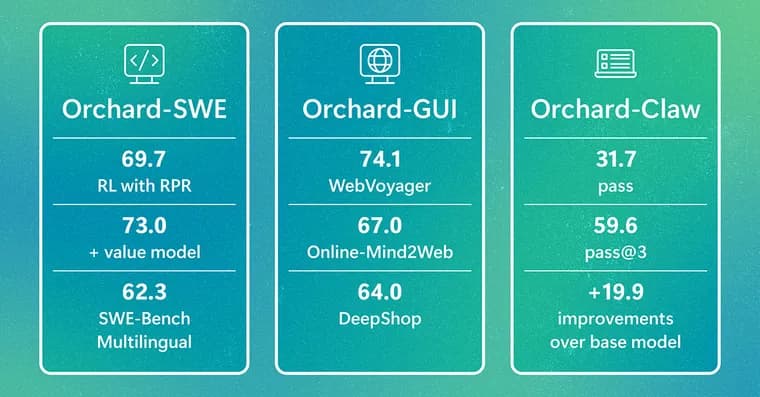
To demonstrate the approach, the team released three domain-specific recipes together with their training data and evaluation methods. Orchard-SWE, built on the Mini-SWE-Agent framework and trained on 107,000 agent interactions distilled from two open-weight models (MiniMax-M2.5 and Qwen3.5-397B), climbs from a 61.4% baseline on SWE-bench Verified to 69.1% after reinforcement learning with Balanced Adaptive Rollout, then to 69.7% once two dense-reward techniques (on-policy distillation and a process reward model) are added. A separate 4 billion-parameter value model, trained on trajectories from 20 prior experiments to rerank candidate solutions, pushes the final score to 73.0%, using only about 3 billion active parameters and approaching frontier systems more than 10 times larger. Orchard-GUI, a 4 billion-parameter vision-language browser agent trained on just 400 distilled demonstrations plus 2,200 open-ended tasks, scores 74.1% on WebVoyager, 67.0% on Online-Mind2Web and 64.0% on DeepShop, for an average of 68.4%. Orchard-Claw, a personal-assistant agent trained on only 200 synthetic tasks and evaluated on the Claw-Eval benchmark, completes 59.6% of tasks within three attempts, rising to 73.9% when paired with the ZeroClaw agent system; under the Codex harness specifically, training raises its success rate from 18.6% to 51.5%.
Microsoft frames the release as an argument that the environment layer, not just the model, is what has been holding back open agentic research, and says it plans to treat discarded reinforcement-learning trajectories as reusable assets, for example by distilling them into value models, so future agent generations can build on past training runs instead of starting over. The article does not name the individual researchers behind Orchard, give a release date, identify the frontier systems Orchard-SWE is compared against, or specify the organizations behind the two distillation source models.
Key facts
- Orchard is an open-source Kubernetes environment service that trains and evaluates agents across coding, web-navigation and personal-assistant tasks, and can train agents directly inside real harnesses such as Codex, OpenClaw and ZeroClaw.
- Orchard-SWE reaches 69.7% on SWE-bench Verified (73.0% with value-model reranking) using only about 3 billion active parameters, up from a 61.4% baseline, approaching frontier models more than 10 times larger.
- Orchard-GUI, a 4 billion-parameter vision-language browser agent trained on 400 demonstrations and 2,200 tasks, averages 68.4% across WebVoyager, Online-Mind2Web and DeepShop.
- Orchard-Claw, trained on 200 synthetic tasks, completes 59.6% of Claw-Eval tasks (73.9% with ZeroClaw); under the Codex harness, Orchard training lifts its success rate from 18.6% to 51.5%.
- Microsoft is releasing the full stack, environment service, training pipelines, training data and evaluation methods, for the research community to reuse.
Why it matters
Microsoft Research says state-of-the-art agentic AI has been bottlenecked by proprietary infrastructure: custom sandboxes, closed training pipelines and datasets that most researchers cannot access or reproduce. Orchard is pitched as a fix at the infrastructure layer rather than the model layer: a single reusable environment service that supports data collection, reinforcement-learning rollouts and evaluation across task domains without being rebuilt each time. Microsoft's own framing is that the environment layer, not the model, has been the constraint.
Who it affects
The release targets AI researchers and practitioners building agentic systems, particularly those without access to proprietary training infrastructure. It also speaks to teams building software-engineering, web-browsing or personal-assistant agents, since the same Orchard Env service is designed to serve all three domains without modification, and to teams working with agent harnesses like Codex, OpenClaw and ZeroClaw specifically.
How to use it
Microsoft is releasing the complete Orchard stack: the Orchard Env service itself, the three training recipes (Orchard-SWE, Orchard-GUI, Orchard-Claw), their training data, and their evaluation methods. Because Orchard Env works across harnesses, teams can train agents directly inside the harness they intend to deploy, among them Codex, OpenClaw and ZeroClaw, rather than training on a simplified proxy and redeploying separately. The article does not state a release date, license terms or pricing.
How solid is it
The claims are backed by specific benchmark numbers reported by Microsoft Research itself: SWE-bench Verified scores rising step by step from a 61.4% baseline to 73.0% as each technique (Balanced Adaptive Rollout, dense-reward distillation, a process reward model, value-model reranking) is added; WebVoyager, Online-Mind2Web and DeepShop scores for Orchard-GUI; and Claw-Eval completion rates for Orchard-Claw, including a harness-specific before/after comparison (18.6% to 51.5% under Codex). The article does not name the frontier systems Orchard-SWE is compared against or give their exact parameter counts, so the '10 times larger' claim cannot be checked against a named baseline.
Risks and caveats
The source is Microsoft's own research blog, and all benchmark figures are self-reported with no independent replication cited. The article gives no individual author names, no publication or release date beyond stating the components 'are' being released, and does not identify the organizations behind the two open-weight models (MiniMax-M2.5 and Qwen3.5-397B) used to distill Orchard-SWE's training data. Readers should treat the comparison to unnamed frontier systems as directional rather than a precise, checkable benchmark.
“Orchard's results reinforce a broader point: the environment layer matters.”
— Microsoft Research