Mimir v1 matches larger models at 1B parameters using only permissible post-training data
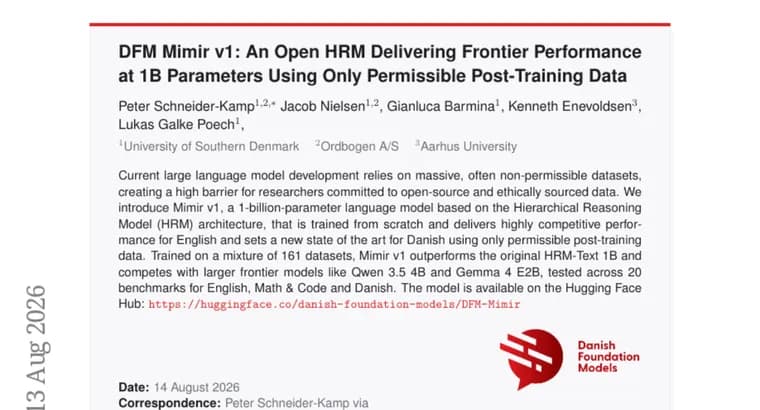
A new 1-billion-parameter language model called Mimir v1 has been released on the Hugging Face Hub, built on the Hierarchical Reasoning Model (HRM) architecture and trained from scratch. Its authors say current large language model development relies on massive, often non-permissible datasets, creating a high barrier for researchers committed to open-source and ethically sourced data. Mimir v1 was trained instead on a mixture of 161 datasets, all permissible post-training data.
The model was tested across 20 benchmarks covering English, math and code, and Danish. The authors report that it delivers highly competitive performance in English and sets a new state of the art for Danish. It also outperforms the original HRM-Text 1B and competes with larger frontier models, including Qwen 3.5 4B and Gemma 4 E2B, despite having a fraction of their parameter count. The model is available on the Hugging Face Hub under the danish-foundation-models organization.
Key facts
- Mimir v1 is a 1-billion-parameter language model built on the Hierarchical Reasoning Model (HRM) architecture, trained from scratch.
- It was trained on a mixture of 161 datasets, all permissible post-training data, rather than the massive, often non-permissible datasets typical of current LLM development.
- Tested across 20 benchmarks spanning English, math and code, and Danish.
- The authors report it sets a new state of the art for Danish and delivers highly competitive English performance.
- It reportedly outperforms the original HRM-Text 1B and competes with larger models such as Qwen 3.5 4B and Gemma 4 E2B.
Why it matters
Building a competitive language model has usually meant training on massive datasets whose provenance and licensing are murky, which the authors say creates a high barrier for researchers who want to stick to open-source and ethically sourced data. Mimir v1 is offered as a counterexample: a model trained end to end on a mixture of 161 datasets chosen for being permissible, that its authors say still competes with, and in the case of Danish beats, models several times its size.
Who it affects
Researchers and teams building open or ethically sourced language models get a concrete data point that a permissible-only training mixture does not have to mean a weak model. The claim of a new state of the art for Danish also makes this relevant to Danish-language NLP work specifically, an area with far fewer dedicated open models than English.
How to use it
The model is published on the Hugging Face Hub under the danish-foundation-models organization (DFM-Mimir). The source does not state a license, pricing or release date, so nothing further can be said about terms of use.
How solid is it
The claims come from the paper's own abstract: competitive English performance, a new state of the art for Danish, and wins over the original HRM-Text 1B plus larger models like Qwen 3.5 4B and Gemma 4 E2B across 20 benchmarks. The abstract does not include the actual benchmark scores or numeric margins behind these comparisons, so the size of the advantage cannot be quantified from this source alone.
Risks and caveats
The abstract does not name individual authors or institutional affiliations, give a release date or license terms, list the 161 training datasets, or explain how the HRM architecture differs from a standard transformer. The performance claims are the authors' own characterization of their results rather than independently reported figures.
“Current large language model development relies on massive, often non-permissible datasets, creating a high barrier for researchers committed to open-source and ethically sourced data.”
— Mimir v1 paper abstract