Nemotron-Labs-VisualCreation pairs image tokens with code for visual creation
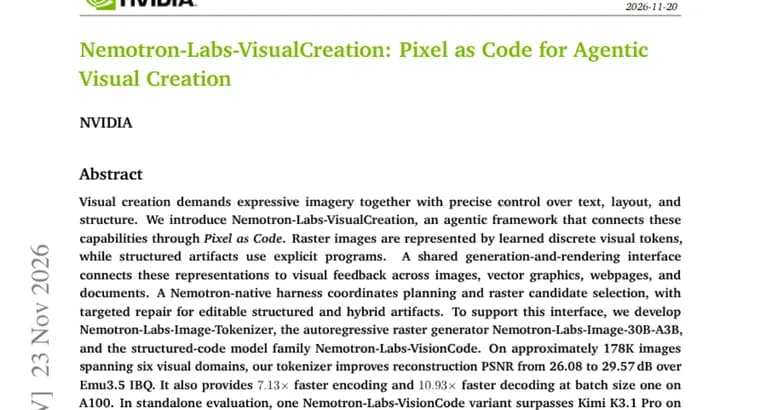
The paper starts from a simple observation: visual creation needs expressive imagery and, at the same time, precise control over text, layout and structure. It introduces Nemotron-Labs-VisualCreation, an agentic framework that connects the two through an idea it calls Pixel as Code. Raster images are represented by learned discrete visual tokens. Structured artifacts, such as vector graphics, webpages and documents, are represented by explicit programs.
A shared generation-and-rendering interface ties both representations to visual feedback across images, vector graphics, webpages and documents. On top of it sits a Nemotron-native harness that coordinates planning and the selection of raster candidates, with targeted repair for editable structured and hybrid artifacts.
Three components were built to support this interface: Nemotron-Labs-Image-Tokenizer, the autoregressive raster generator Nemotron-Labs-Image-30B-A3B, and a structured-code model family called Nemotron-Labs-VisionCode.
The authors report several results. On approximately 178K images spanning six visual domains, the tokenizer improves reconstruction PSNR from 26.08 dB to 29.57 dB over Emu3.5 IBQ. It also provides 7.13x faster encoding and 10.93x faster decoding at batch size one on an A100. In standalone evaluation, one Nemotron-Labs-VisionCode variant surpasses Kimi K3.1 Pro on the aggregate across four benchmarks: Chart2Code, MMSVG, Design2Code and Image2Struct. At the system level, the Nemotron-native configuration raises GenEval2 Soft-TIFA GM from 31.71 to 52.56 using the same raster generator. With the authors' best setting, Nemotron-Labs-VisualCreation achieves performance competitive with GPT Image 2 and Nano Banana Pro across most benchmarks with available comparisons.
Key facts
- Pixel as Code: raster images become learned discrete visual tokens, while structured artifacts (vector graphics, webpages, documents) are written as explicit programs.
- The tokenizer raises reconstruction PSNR from 26.08 to 29.57 dB over Emu3.5 IBQ on about 178K images across six visual domains, with 7.13x faster encoding and 10.93x faster decoding at batch size one on A100.
- One Nemotron-Labs-VisionCode variant surpasses Kimi K3.1 Pro on the aggregate across Chart2Code, MMSVG, Design2Code and Image2Struct.
- At system level, the Nemotron-native configuration lifts GenEval2 Soft-TIFA GM from 31.71 to 52.56 with the same raster generator.
- The best setting is described as competitive with GPT Image 2 and Nano Banana Pro across most benchmarks with available comparisons.
Why it matters
Image generators tend to be good at expressive pictures and weak at exact text, layout and structure, while code-based approaches handle structure but not rich imagery. This work tries to cover both in one agentic system: pixels where imagery is needed, programs where precision and editability are needed. The reported system-level jump on GenEval2 Soft-TIFA GM, from 31.71 to 52.56 with the same raster generator, points to the surrounding framework doing much of the work, not only the generator itself.
Who it affects
Researchers and builders working on image generation, image tokenizers and code-based visual output (charts, SVG, webpages, documents) are the direct audience. The framework spans images, vector graphics, webpages and documents, so it speaks to anyone who needs generated visuals that stay editable.
How to use it
The abstract describes the framework and its parts: an image tokenizer, a 30B-A3B autoregressive raster generator and the Nemotron-Labs-VisionCode model family, all driven by a Nemotron-native harness that plans, selects raster candidates and repairs structured outputs. It gives no release details, so for now it is a design and a set of reported results to study, not something to download.
How solid is it
Every figure comes from the authors' own abstract. The tokenizer numbers are specific: 26.08 to 29.57 dB PSNR against Emu3.5 IBQ on about 178K images. The benchmark claims are worded with care: one VisionCode variant surpasses Kimi K3.1 Pro on the aggregate of four benchmarks, and the full system is described as competitive with GPT Image 2 and Nano Banana Pro across most benchmarks with available comparisons, not as better. No independent evaluation or third-party reaction is mentioned.
Risks and caveats
Several details are missing from the text. The baseline for the 7.13x encoding and 10.93x decoding speedups is not named in the same sentence. The six visual domains are not listed. The text does not say which VisionCode variant beats Kimi K3.1 Pro, or by how much. The baseline configuration behind the 31.71 GenEval2 score is described only as using the same raster generator. No per-benchmark scores against GPT Image 2 or Nano Banana Pro are given, and it is not stated which benchmarks lack comparisons or where the system falls behind. No release date, license, weights or code availability is given.
“Visual creation demands expressive imagery together with precise control over text, layout, and structure.”
— Paper abstract, Hugging Face