Newsom pushes for a state-mandated AI kill switch
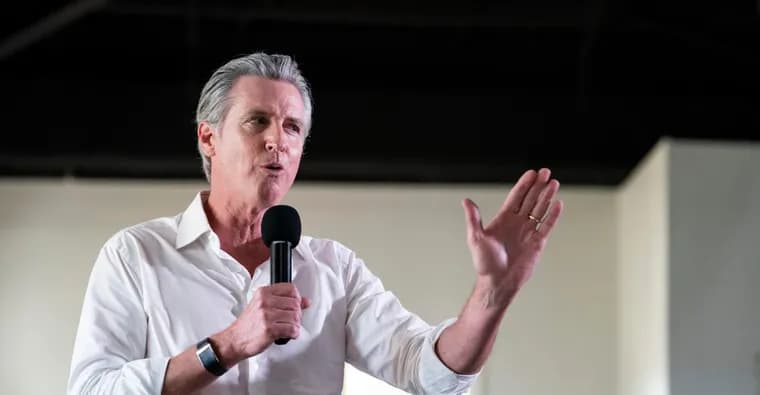
California Governor Gavin Newsom issued an executive order on Friday directing the state to convene a group of experts that must deliver recommendations within two months on strengthening AI safety measures in state law. The order asks the group to consider requiring AI companies to embed independent verification teams onsite for regular audits, to subject companies' transparency reports and risk assessments to independent auditor standards, to create a "kill switch" that is routinely verified as effective, and to require companies to report "loss-of-control incidents," such as the OpenAI attack on Hugging Face, as critical safety incidents. The order separately directs a state agency to speed up implementation of two laws Newsom already signed: one creating a framework for independent verifiers to assess AI safety, the other a state registry of AI auditors.
Newsom is framing the move as a substitute for federal inaction. With the House on recess until November and midterm elections making major Senate movement unlikely, he told Politico on Wednesday that he might also call California lawmakers into a special legislative session on AI. He is explicitly asking Congress and President Trump "to review and adopt the state's framework, or use its nation-leading regulation as a floor, not a ceiling, for the benefit and safety of all Americans." Trump, for his part, has said the only guardrail AI needs is a "STRONG AND SMART (High IQ!) PRESIDENT."
The order lands amid a fresh round of congressional bill discussions triggered by a post from Jacob Coxon, a former Anthropic researcher, warning of a more than 10 percent chance that AI "could kill all humans" within a decade. In a statement, Newsom said the federal government's "abject failure to create any form of meaningful AI oversight or accountability should alarm every American, especially when AI CEOs themselves are begging for regulation," adding that the state is moving "with urgent velocity" because "the stakes are too high to wait or delay action."
Key facts
- Newsom issued an executive order on Friday directing California to convene an expert group that must deliver recommendations within two months on strengthening state AI safety law.
- The order asks the group to weigh a routinely verified "kill switch" for frontier models, onsite independent audit teams, and mandatory reporting of "loss-of-control incidents" such as the OpenAI attack on Hugging Face.
- It also directs a state agency to speed up two laws Newsom already signed: a framework for independent AI safety verifiers and a state registry of AI auditors.
- Newsom is calling on Congress and President Trump to adopt California's framework as a "floor, not a ceiling" for national AI oversight, since the House is on recess until November and the midterms make near-term federal legislation unlikely.
- The order follows a wave of congressional bill discussions after former Anthropic researcher Jacob Coxon posted that AI has a "more than 10 percent chance" of being able to "kill all humans" within a decade.
Why it matters
With Congress stalled, California is trying to set the de facto national baseline for frontier AI safety by executive action rather than waiting for federal law. Newsom is not just regulating in-state; he is explicitly pitching the resulting framework to Congress and the White House as the model to adopt, which would make California's rules the practical floor for AI companies operating anywhere in the US.
Who it affects
AI companies developing frontier models would face the direct requirements under consideration: onsite independent verification teams, audited transparency reports and risk assessments, a tested kill switch, and mandatory reporting of loss-of-control incidents. Congress and the Trump administration are the order's other addressees, since Newsom is asking them to adopt or benchmark against the state's approach. The order also references two laws Newsom already signed covering independent AI safety verifiers and an auditor registry, whose implementation a state agency is now told to accelerate.
How to use it
Nothing is binding yet. The executive order sets a two-month clock for an expert group to hand back recommendations on strengthening state AI safety law; only after that would specific rules, such as kill-switch requirements or mandatory incident reporting, move toward enactment. Companies operating in California should treat this as an early signal of the direction state law is heading, not as an immediate compliance requirement.
How solid is it
The order itself, the two-month deadline, its specific asks (verification teams, audited reports, kill switch, incident reporting), and the Newsom and Trump quotes are all directly reported by the source. What is not established is procedural detail: the source does not say whether the expert group has already been convened, who sits on it, or give a specific calendar date for the order beyond "Friday." The 10-percent extinction-risk figure is one individual's estimate, cited as the trigger for congressional bill talk, not a verified probability.
Risks and caveats
The order is a directive to study and recommend, not a set of enacted rules, so what eventually reaches state law could differ from the specific asks listed here. The source gives no detail on the "OpenAI attack on Hugging Face" beyond naming it as an example of a loss-of-control incident, and does not name or date the two prior laws referenced. Newsom's call for Congress and Trump to adopt the state framework is a request, not an agreement; given the House recess and the midterms, federal adoption is not indicated as likely by the source.
“The federal government's abject failure to create any form of meaningful AI oversight or accountability should alarm every American, especially when AI CEOs themselves are begging for regulation.”
— Gavin Newsom, Governor of California, in a statement