Nvidia launches PAIR, a free tool that links idle PCs into a home AI cluster
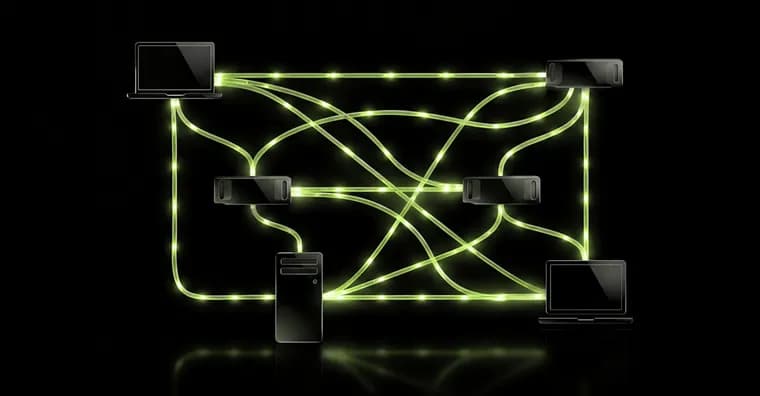
Nvidia has released PAIR (Personal AI Router), a free tool that links the computers inside one household into a shared pool for local AI inference, working alongside existing tools such as Ollama and LM Studio. Despite the name, PAIR is not a hardware router: it is open-source software that discovers compatible PCs on a network, connects them, and prepares them to work together on agentic workflows. The beta is available today for Windows, Linux, and macOS.
Compatibility centers on Nvidia's own hardware but is not limited to it. PAIR works with Nvidia GeForce RTX 20-series cards and newer, as well as RTX Pro GPUs and DGX Spark systems; Apple Macs with M4 chips or newer are also supported. PAIR draws on these machines only while they sit idle, so it does not interfere with whatever else a device is doing. Nvidia says the resulting network of computers can work in parallel to get through many processing requests at once, which the company says should help agentic workflows that split a complex task into smaller jobs and should keep the load from bottlenecking on a single GPU. The system is also meant to adapt as devices join or leave the network, including when someone starts a game on a desktop PC that had been contributing spare capacity.
Security runs through a six-digit pairing code, after which the connection between devices is secured with mTLS (Mutual Transport Layer Security), creating an encrypted channel that both sides trust.
In a media briefing, Nvidia product manager Seth Schneider illustrated the idea with a household of five devices: a dad with both an RTX Spark laptop and a DGX Spark desktop, a mom with an RTX 5090 laptop, a daughter with a gaming desktop, and a son with a MacBook Pro. By his own estimate, this deliberately extreme example household holds about 165 teraflops of underused compute. "It's truly a treasure trove of free tokens just sitting in homes today," Schneider said, adding that this holds even after accounting for the electricity cost of running an average American home. Asked who PAIR is really built for, Schneider said Nvidia expects most users to have a far simpler setup: something like one MacBook or Windows laptop paired with one gaming PC.
Alongside PAIR, Nvidia announced that three AI agent apps, Perplexity Portable Computer, Hermes Agent, and OpenClaw, will get simplified local setup with Nvidia GPUs on Windows, meant to get local agents running in a few clicks instead of the manual configuration this normally takes.
Key facts
- PAIR (Personal AI Router) is a free, open-source tool from Nvidia that links idle household computers for local AI inference tasks alongside tools like Ollama and LM Studio; the beta is available today for Windows, Linux, and macOS.
- It supports Nvidia GeForce RTX 20-series GPUs and newer, RTX Pro GPUs, and DGX Spark systems, plus Apple Macs with M4 chips or newer; it draws on devices only while they are idle and adapts as machines join or leave the network.
- Devices pair through a six-digit code and then communicate over a channel secured with mTLS (Mutual Transport Layer Security).
- Nvidia product manager Seth Schneider illustrated PAIR with a hypothetical five-device household holding about 165 teraflops of underused compute, calling it "a treasure trove of free tokens," but said Nvidia expects most real users to have just one laptop and one gaming PC.
- Alongside PAIR, Nvidia announced that three AI agent apps, Perplexity Portable Computer, Hermes Agent, and OpenClaw, will get simplified local setup with Nvidia GPUs on Windows.
Why it matters
Local AI inference is usually limited by whatever GPU a single machine has. PAIR lets a household turn all its Nvidia and Apple hardware, spread across several devices, into one shared pool for agentic AI workloads, without buying new hardware or relying on the cloud. Nvidia paired the release with simplified Windows setup for three AI agent apps, Perplexity Portable Computer, Hermes Agent, and OpenClaw, extending the same push toward easier local AI on Nvidia GPUs.
Who it affects
People who already own more than one compatible device, an Nvidia GeForce RTX 20-series-or-newer card, an RTX Pro GPU, a DGX Spark system, or a Mac with an M4 chip or newer, and want to combine them for local AI rather than run each machine on its own. Nvidia's own framing points to a simple case: one MacBook or Windows laptop plus one gaming PC, rather than the elaborate five-device household Schneider used as an illustration. It also affects developers of local-inference tools such as Ollama and LM Studio, and of the three agent apps gaining simplified Nvidia GPU setup on Windows: Perplexity Portable Computer, Hermes Agent, and OpenClaw.
How to use it
The beta is free and available today for Windows, Linux, and macOS. Setup pairs devices with a six-digit code, after which PAIR secures the connection with mTLS. It is meant to work alongside existing local-inference tools such as Ollama and LM Studio, drawing on a device only while that device sits idle, and stepping back automatically when, for instance, someone starts a game on a machine that had been contributing spare capacity.
How solid is it
Every claim here traces to Nvidia itself, via a media briefing with product manager Seth Schneider and the company's own statements, as reported by a single outlet. The 165-teraflops figure is Schneider's own estimate for a household the article calls "incredibly extreme," not a measured benchmark or a typical case, and the source gives no performance numbers, such as inference speed or throughput, for real-world use of PAIR.
Risks and caveats
No pricing or cost detail is given beyond PAIR itself being free, and the source does not say whether the compatible agent apps or future PAIR features will carry a cost. There is no release timeline for moving PAIR out of beta. The security model rests on a six-digit pairing code plus mTLS, but the source does not detail how that code is generated or exchanged, and no Nvidia spokesperson besides Schneider is quoted to back up the plans.
“It's truly a treasure trove of free tokens just sitting in homes today”
— Seth Schneider, Nvidia product manager