NVIDIA releases data and tuning recipe for Nemotron 3.5 Parse
NVIDIA has published a follow-up on the Hugging Face blog to its recently released Nemotron 3.5 Parse, a compact document model that turns page images into structured data for retrieval-augmented generation (RAG) and agents. Parse pulls page content out in reading order, labels it as headings, paragraphs, tables, charts and other classes, and returns bounding boxes that locate it. The new additions are synthetic training datasets, a fine-tuning recipe and a DFlash2 speculator for faster inference, along with an account of how the model was trained.
NVIDIA says this version is much better at reading hard or ambiguous charts and tables. On a bar chart with no marked values, for example, it can infer the numbers from the axes and bar heights. The company credits this largely to synthetic data: render variations of charts and tables with known ground truth, then train the model to reverse the process. It is open-sourcing three datasets used in training: Synthetic Charts V1 (9.98M examples of rendered charts with structured annotations), Synthetic Tables V1 (1M rendered HTML tables with targets that preserve rows, columns, headers and cell relationships) and OCR Synthetic Multilingual v2 (7.9M synthetic document pages across varied fonts and layouts). Each comes with images, annotations, generation documentation and the training format.
Training ran in two phases. Supervised fine-tuning (SFT) on text, layout, tables, charts and multilingual documents established the basic ability to read a page. Reinforcement learning with verifiable rewards (RLVR), using Group Relative Policy Optimization (GRPO), then scored sampled extractions, rewarding correct series and values, usable structure and output that finishes without repeating itself. In a matched comparison of development checkpoints, separate from the final released model, pages flagged for loops fell from 126 to 29 (about 77% fewer), outputs hitting the 9,000-token limit fell from 185 to 35, and the overall score rose from 66.24 to 71.38, including 5.18 more points on tables and 4.15 on charts.
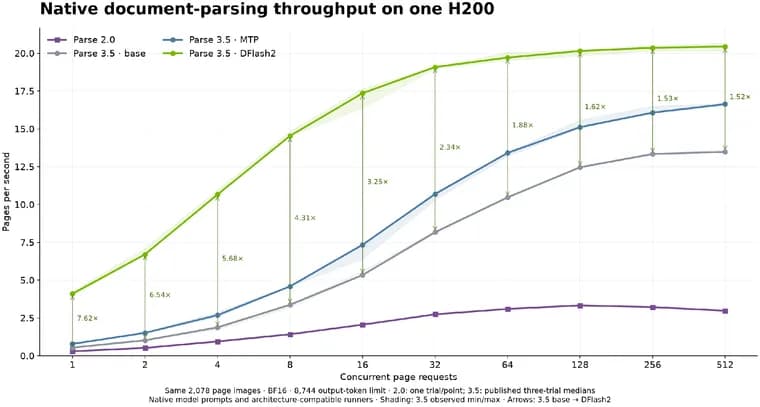
On speed, NaViT preprocessing adapts the input shape to the page, a visual adapter compresses the image sequence for the text decoder to consume as a prefix (replacing encoder-decoder cross-attention), and grouped-query attention with eight key/value heads cuts the decoder's attention-cache memory. With DFlash2, a small draft model proposes up to 32 tokens ahead and Parse verifies them together. In the measured 32-token setup it averages about 14 accepted draft tokens, or roughly 15 output tokens per verification step including the target token. In a native single-pass benchmark on one H200 in BF16, using 2,078 pages, DFlash2 raised throughput 7.62× at concurrency 1 and 1.52× at concurrency 512 over Parse 3.5 without speculative decoding. At 512, Parse 3.5 reached 13.48 pages per second without it and 20.44 with it, against 2.98 for Parse 2.0.
For difficult pages, a double pass crops detected table and chart regions, re-parses them at higher detail and merges the results. A triple pass adds a detection-mode run to check that no boxes or text were missed, then re-extracts charts and tables. In the published reference evaluation they add 2.18 and 2.46 ParseBench points over a single pass, trading some throughput for better extraction.
The fine-tuning recipe covers paired data generation, SFT in NeMo Automodel and GRPO in NeMo RL, with vLLM generating candidate answers. Its worked example is a synthetic dental form with an odontogram, a chart of teeth, planned procedures and affected tooth surfaces. In the reference run, the estimated first-attempt success rate (sampled pass@1) went from 0.00% for the base model to 95.85% after SFT and 96.58% after RLVR.
Key facts
- Three synthetic training datasets are being open-sourced: charts (9.98M examples), tables (1M) and multilingual OCR pages (7.9M).
- GRPO versus SFT development checkpoints: loop-flagged pages fell from 126 to 29 and the overall score rose from 66.24 to 71.38.
- On one H200 in BF16, DFlash2 raised throughput 7.62× at concurrency 1 and 1.52× at concurrency 512 over Parse 3.5 without speculative decoding.
- Double and triple pass add 2.18 and 2.46 ParseBench points over single pass, at some cost in throughput.
- In the dental form example, sampled pass@1 rose from 0.00% (base) to 95.85% after SFT and 96.58% after RLVR.
Why it matters
A parser feeding RAG pipelines and agents has to get structure right: one shifted row or column can change what a table means. NVIDIA is now sharing part of what went into the model, including three training datasets and a recipe that applies the same two-stage SFT and RLVR approach to new document types. The reinforcement learning stage targets a practical failure, output that loops or never finishes. The company says the community has already extended and improved Parse for Thai, Persian/Farsi and Arabic, and it hopes the new data and recipes will encourage more such work.
Who it affects
Developers who turn page images into structured data for retrieval or agent systems are the main audience. Teams with specialised forms or documents can use the recipe to adapt the model, as the dental example shows. People training document models of their own can use the paired data to fine-tune them or create variations for a target document type or language. Those serving Parse at volume have a new speculator to test.
How to use it
Start with the datasets: each release includes images, annotations, generation documentation and the training format. To adapt the recipe, supply your own image and label pairs plus a verifier, meaning checks that decide whether an extraction is correct. The included document reward components cover text fidelity, bounding boxes, tables, chart facts and completion. NVIDIA suggests combining the ones relevant to your task, adding schema checks, and using completion and repetition checks to discourage looping.
At inference time, parse the full page once by default. Use a double pass for dense tables and small chart details, or a triple pass when you also want to verify that boxes and text were not missed. DFlash2 is the option for higher throughput.
How solid is it
This is a first-party account from NVIDIA about its own model. The training comparison is matched and controlled, but it uses development checkpoints and not the final released model. The speed figures come from one hardware setup, an H200 in BF16. Parse 3.5 results are medians of three trials, while Parse 2.0 uses one trial per point. At concurrency 512, Parse 3.5 delivers 4.53× the throughput of Parse 2.0 without speculation and 6.86× with DFlash2. The dental result was measured on 256 held-out synthetic forms from the same generator, with eight samples per page; success required natural completion, exact chart content and error-free normalized page text. The post thanks Denis Ovchinnikov for vLLM integration and independent performance validation.
Risks and caveats
No license terms are stated in the post for the datasets, recipe, speculator or model, so check them before building on any of these. The DFlash2 gain shrinks sharply under load, from 7.62× at concurrency 1 to 1.52× at 512, and no figures for other hardware are given. The post gives no throughput numbers for double or triple pass, and multiple crops can require multiple requests. The dental scores say how the model does on synthetic forms like its training data; no results on real dental documents are reported.
“These advancements have been largely powered by synthetic data generation, rendering variations of charts and tables with known ground truth and then training our model to reverse this process.”
— NVIDIA, in its post on the Hugging Face blog