OpenAI starts rolling out GPT-6 in ChatGPT with Intelligent UI
OpenAI announced that a new GPT-6 model is coming to ChatGPT for a much wider audience. Last month the company introduced the first GPT-6 models for paid customers; now it says it is bringing that generation to the more than 1.2 billion people who use ChatGPT each week. The rollout begins on the day of the announcement for Plus, Pro, Business and Enterprise users in the Chat tab, and expands to Free and Go users starting the next day. Enterprise availability depends on workplace admin settings. Plus, Pro, Business and Enterprise get GPT-6 Sol; Free and Go get GPT-6 Luna. OpenAI says both are tuned for everyday conversation.
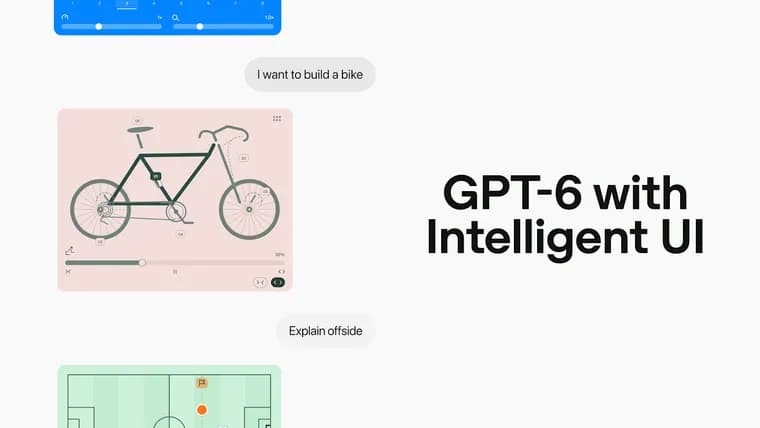
The headline feature is Intelligent UI. OpenAI says GPT-6 was trained to compose a response from text, visuals and interactive elements, choosing how they fit together based on the question. Answers can include graphics, tappable buttons, forms, charts and interactive experiences usable directly in the conversation. A comparison might be laid out side by side, an explanation might become an interactive diagram, and when plain text is the most useful answer, ChatGPT can still give plain text. OpenAI's examples: the timing for a Sunday roast shown alongside the recipe, or road-trip stops on a map with notes on what is worth a detour. Users can also ask ChatGPT to build a tool for the task at hand, such as a calculator for exploring how savings could grow, a bill splitter for dinner with friends, or a game to play in the conversation.
On the engineering side, OpenAI describes a library of native, streamable components plus a compiler that processes the interface as the model generates it. The library gives each response a familiar design foundation while leaving the model room to decide how the pieces fit; the compiler lets the interface appear progressively instead of waiting for the full response. OpenAI says it expanded its training methods so the model makes decisions about content, layout, visuals and interaction, including evaluating the interfaces it creates for clarity, usefulness and completeness. It adds that there is still work ahead on the model's design judgment and on what it can create.
The second change is that ChatGPT can begin answering while it continues to think. OpenAI notes that reasoning models handle harder problems but made users wait for the thinking to finish. GPT-6 was trained to take the user's waiting time into account and compose an answer progressively across multiple partial responses, each adding useful information without filler, while keeping the full answer as cohesive and factual as one written all at once. In an internal evaluation of high-value, everyday agentic tasks, GPT-6 Extra High begins answering in the same time as GPT-5.6 Medium while scoring better overall than GPT-5.6 Extra High. For questions that need web search, GPT-6 Instant starts answering 44% sooner, on average, than GPT-5.6 Instant. OpenAI also says GPT-6 decides better when to look something up and more reliably finds information supporting its answer; in an internal evaluation of difficult problems it correctly addressed the key aspect of the user's question more often than GPT-5.6. No figures are given for these last two evaluations.
On safety, OpenAI says GPT-6 improves on recognising real-world risks, honesty and respecting limits that people set, building on several of Astra's safety advances relative to GPT-5.6 Sol. Safety training was updated using lessons from real-world use to strengthen protections against high-risk misuse involving cyberattacks, biological threats and violence. In adversarial testing GPT-6 showed stronger resistance to attempts to bypass its safety training, particularly attacks that adapt across multiple turns. It is also trained to respond safely in higher-risk scenarios while avoiding unnecessary refusals of harmless requests, using conversation history and context to spot risks not apparent from a single prompt. Alignment evaluations were run throughout training, and GPT-6 is said to be better at communicating the limits of its own capabilities, including when it lacks the information or tools to answer. More detail is in the system card.
The update covers the Chat experience only. The models powering Work and Codex are not changing in this release. OpenAI closes with a statement of direction: over time it wants ChatGPT to create more of the interfaces people need for everyday tasks, and it believes that instead of people adapting to software, software will adapt to people.
Key facts
- GPT-6 starts rolling out in the ChatGPT Chat tab on the day of the announcement for Plus, Pro, Business and Enterprise, and from the next day for Free and Go; OpenAI cites more than 1.2 billion weekly users.
- Plus, Pro, Business and Enterprise run on GPT-6 Sol; Free and Go run on GPT-6 Luna.
- Intelligent UI lets ChatGPT answer with graphics, tappable buttons, forms, charts and interactive tools such as a calculator, a bill splitter or a game, streamed progressively by a component library and compiler.
- ChatGPT can now begin answering while it keeps thinking; for web-search questions GPT-6 Instant starts answering 44% sooner, on average, than GPT-5.6 Instant (OpenAI's figure).
- The release covers Chat only; the models behind Work and Codex are unchanged.
Why it matters
This moves GPT-6 from paid customers to the mass ChatGPT audience, which OpenAI puts at more than 1.2 billion people a week. The notable change is in the shape of the answer. Instead of fitting every question into the same conversational format, ChatGPT can combine UI, data and actions, producing charts, forms, diagrams or a small working tool inside the chat. The second change is that thinking and answering are interleaved, so users need not wait for a reasoning model to finish before seeing something useful. OpenAI frames both as a step toward software that adapts to people rather than the reverse.
Who it affects
Everyone who uses ChatGPT's Chat tab. Plus, Pro, Business and Enterprise users get GPT-6 Sol first; Free and Go users get GPT-6 Luna starting the day after. Enterprise availability depends on workplace admin settings, so admins decide whether their staff see it. People who use ChatGPT's Work or Codex are not affected by this release, since the models behind them are not changing.
How to use it
No setup is described: GPT-6 with Intelligent UI appears in the Chat tab as the rollout reaches an account, on web and mobile. ChatGPT chooses the format itself, so a question may come back as text, a side-by-side comparison, an interactive diagram or a map. You can also ask directly for a tool, for example a calculator to explore how savings could grow, a bill splitter for a dinner, or a game to play in the conversation. Interactive explanations let you change an input to see what happens or work through a problem step by step.
How solid is it
This is OpenAI's own announcement, so every claim is first-party. The performance statements rest on internal evaluations: GPT-6 Extra High starts answering in the time GPT-5.6 Medium takes while scoring better than GPT-5.6 Extra High, and GPT-6 addressed the key aspect of difficult questions more often than GPT-5.6. The only number given is the 44% faster start for GPT-6 Instant versus GPT-5.6 Instant on web-search questions, an average. OpenAI points to a system card for the safety and alignment results. No third-party reactions or independent evaluations are cited in the source.
Risks and caveats
OpenAI itself says there is still work ahead on the model's design judgment and on what Intelligent UI can create, so the generated interfaces will not always be well designed. Most quality claims come without figures, and the 44% number applies only to GPT-6 Instant on web-search questions, not to all queries. Free and Go users get GPT-6 Luna rather than Sol, and the rollout is staged, so not every account will see the change on the first day. The source gives no pricing, usage limits or API availability. On safety, OpenAI reports stronger resistance to jailbreaks, especially multi-turn attacks, but this is from its own adversarial testing.
“Instead of people adapting to software, software will adapt to people.”
— OpenAI, GPT-6 announcement post