Ox Alpha, an anonymous stealth model for coding, debuts free on OpenRouter
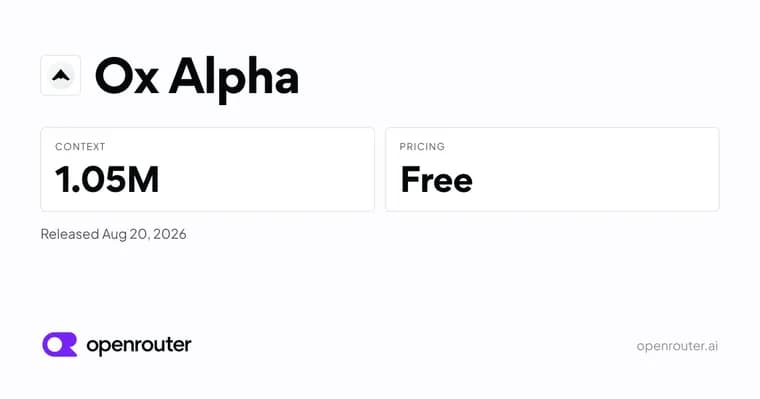
OpenRouter has begun listing Ox Alpha, a new reasoning model built for coding, sustained agentic work and production workloads, with the listing describing it as suited to long-horizon software engineering, complex reasoning, and workflows that combine text with visual context. Ox Alpha is a stealth model: it is developed and operated by a third-party provider who has chosen to stay anonymous during this preview, and OpenRouter states plainly that it routes requests to the model but is not its developer, owner or provider. The model was released on August 20, 2026.
During the preview, Ox Alpha is free: OpenRouter charges nothing for either prompt or completion tokens. It has a 1,048,576-token context window, shown on the page in rounded form as 1M, and supports up to 131,072 completion tokens. It is hosted by a single provider, so OpenRouter forwards every request straight to that provider with no routing decisions to make. Ox Alpha accepts text, images and video as input and returns text; it also accepts tools and tool_choice for function calling, and supports the response_format parameter for JSON output, though without JSON-schema enforcement. Developers can call it through OpenRouter's OpenAI-compatible API, swapping in Ox Alpha's own model slug as they would for any other listed model.
OpenRouter's listing gives Ox Alpha a median (P50) throughput of 57 tokens per second, described as the best figure across providers, and a median latency of 1.78 seconds, described as the best among providers, even though the same page states the model is hosted by only one provider. Two reliability percentages also appear on the page, 99.99% and 99.94%, but the text does not say which one is Uptime, the share of the past three days that at least one provider was responding, and which is Availability, the share of time inference was successfully served; those are the two metrics the page defines elsewhere, without attaching either label to these specific numbers.
Beyond describing it as developed and operated by an anonymous third-party provider, the listing does not name who is actually behind Ox Alpha. It states that prompts and completions are retained by that provider and are not used for training, with all other use governed by OpenRouter's Stealth Model Terms, but gives no further detail on those terms, no end date for the preview period, and no indication of what Ox Alpha will cost once the preview ends. The listing also includes no benchmark scores or comparisons against any other named model.
Key facts
- Ox Alpha is a new stealth reasoning model listed on OpenRouter, aimed at coding, sustained agentic work and production workloads, and built to handle long-horizon software engineering, complex reasoning and workflows that combine text with visual context.
- It is developed and operated by a third-party provider who has chosen to remain anonymous during this preview; OpenRouter states it only routes requests to Ox Alpha and is not its developer, owner or provider.
- During the preview it is free, with no charge for prompt or completion tokens, has a 1,048,576-token (about 1M) context window, and supports up to 131,072 completion tokens.
- It posts a median throughput of 57 tokens per second and a median latency of 1.78 seconds, both described as the best figures across providers, plus two unlabeled reliability percentages, 99.99% and 99.94%, that the page never ties to its own defined Uptime and Availability metrics.
- It accepts text, images and video as input, returns text, and supports tool calling plus JSON-style output; it was released on August 20, 2026, and the listing gives no benchmark comparisons to other models and no pricing or timeline for after the preview.
Why it matters
Ox Alpha packages several things developers care about into one free listing: a reasoning model aimed squarely at coding and long-horizon software engineering, a context window of 1,048,576 tokens, support for tool calling and JSON-style output, and multimodal input covering text, images and video, all available at zero cost during the preview. What sets this apart from an ordinary model launch is the anonymity. OpenRouter's own listing says the model is developed and operated by a third-party provider who has chosen to stay unnamed, and that OpenRouter itself is only the router, not the developer, owner or provider. That means the specific claims on the page, that Ox Alpha suits long-horizon software engineering and complex reasoning, come from an anonymous source, with no company name attached to stand behind them.
Who it affects
Developers building coding assistants or agentic workflows are the direct audience: free pricing and a roughly million-token context window let them run long sessions or multimodal tasks without a bill during the preview, and support for tools, tool_choice and response_format matters specifically for building agents that call functions and expect structured output. Anyone who adopts Ox Alpha for production workloads, which the listing explicitly says it is suited for, is doing so while the identity of the model's maker stays undisclosed, and without knowing how long the free preview will last or what the model will cost afterward. OpenRouter itself is also a party here, since it hosts the listing and forwards traffic to the anonymous provider without naming them.
How to use it
Ox Alpha is available now on OpenRouter, free of charge for both prompt and completion tokens during this preview. It supports a 1,048,576-token context window and up to 131,072 completion tokens, and it can be called through OpenRouter's OpenAI-compatible API by swapping in the model's own slug, the same pattern used for other OpenRouter listings. It takes text, images and video as input and returns text, and it supports tools and tool_choice for function calling plus response_format for JSON-style output, though without JSON-schema enforcement, so agent builders can call functions and request structured responses without a strict schema guarantee.
How solid is it
The listing comes directly from OpenRouter's own model page, not from a third party's report, so the specifications themselves (context length, completion limit, pricing) are as solid as any vendor listing gets. The descriptive claims are softer. Phrases like 'suited for long-horizon software engineering' and 'complex reasoning' are OpenRouter's or the anonymous provider's own characterization, with no benchmark scores or comparison to any other named model anywhere on the page. The performance figures carry a similar gap: throughput and latency are each labeled the best figure across providers or the best provider, language that sits oddly next to the page's own statement that Ox Alpha is hosted by a single provider. And the two percentages shown alongside those figures, 99.99% and 99.94%, are never tied to the page's own definitions of Uptime and Availability, so it is not clear which number measures which.
Risks and caveats
The most basic risk is that nobody using Ox Alpha knows who built it. The page states that prompts and completions are retained by the unnamed provider and are not used for training, with everything else governed by a Stealth Model Terms document that the listing does not otherwise describe. No end date is given for the preview, so there is no way to know from this listing how long free access will last or what pricing will look like once it ends. And because no benchmark results or comparisons appear anywhere on the page, anyone evaluating Ox Alpha for the production workloads it claims to suit has only the anonymous provider's own description to go on, not an independent measurement.