Paper finds top reasoning effort costs up to 42x more on easy tasks
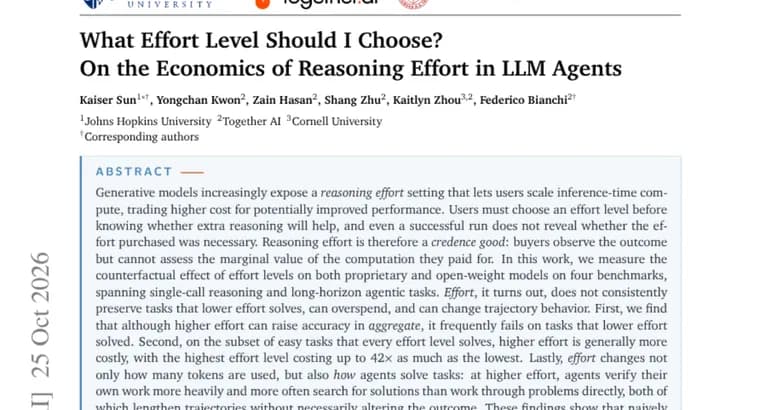
Many generative models now expose a reasoning effort setting that lets users scale inference-time compute, paying more for potentially better results. A new paper listed on Hugging Face Papers asks whether that choice is a good one. Its starting point is that users must pick a level before knowing whether extra reasoning will help, and even a successful run does not show whether the effort bought was necessary. The authors call reasoning effort a credence good: buyers see the outcome but cannot judge the marginal value of the computation they paid for.
The paper measures the counterfactual effect of effort levels on both proprietary and open-weight models across four benchmarks, spanning single-call reasoning and long-horizon agentic tasks. Its summary of the result is that effort does not consistently preserve tasks that lower effort solves, can overspend, and can change trajectory behavior.
There are three findings. First, higher effort can raise accuracy in aggregate, but it frequently fails on tasks that lower effort solved. Second, on the subset of easy tasks that every effort level solves, higher effort is generally more costly, with the highest level costing up to 42x as much as the lowest. Third, effort changes not only how many tokens are used but also how agents work: at higher effort, agents verify their own work more heavily and more often search for solutions rather than work through problems directly. Both habits lengthen trajectories without necessarily altering the outcome.
From this the authors conclude that naively choosing the highest level is cost-inefficient and offers no guarantee of the best instance-level performance. They propose a simple alternative: start at the lowest effort and escalate only after a verified failure. According to the paper, this matches or improves on fixed top effort across all models and benchmarks, at lower cost for most proprietary models.
Key facts
- The paper tests reasoning effort levels on proprietary and open-weight models across four benchmarks, from single-call reasoning to long-horizon agentic tasks.
- Higher effort can raise accuracy in aggregate, but it frequently fails on tasks that lower effort solved.
- On easy tasks that every effort level solves, the highest level costs up to 42x as much as the lowest.
- At higher effort, agents verify their work more and search for solutions more often, which lengthens trajectories without necessarily changing the outcome.
- Starting at the lowest effort and escalating only after a verified failure matches or improves on fixed top effort across all models and benchmarks, at lower cost for most proprietary models.
Why it matters
Reasoning effort settings sell extra compute on the assumption that more is safer. This paper challenges that: the authors say effort is a credence good, so buyers cannot tell whether the extra computation was worth paying for. Their measurements suggest that the top setting is not a safe default, since it can fail on tasks a lower setting solved and can cost up to 42x more on easy tasks.
Who it affects
Anyone who picks a reasoning effort level for a model, whether through an API or inside an agent, and anyone paying for long agentic runs. The findings cover both proprietary and open-weight models.
How to use it
The paper's practical suggestion is an escalation policy: run at the lowest effort first, check the result, and move to a higher effort only after a verified failure. The abstract does not describe how the verification is implemented, so the practical details would have to come from the full paper.
How solid is it
The claims come from the authors' own measurements on four benchmarks, and the results are described as holding across all models and benchmarks for the escalation strategy. The listing is the abstract only, so the specific models, benchmarks and accuracy figures are not available here. The 42x figure is a maximum on the easy-task subset, not an overall cost ratio.
Risks and caveats
The lower cost of the escalation strategy is stated only for most proprietary models, not for open-weight ones, and no size of the saving is given. The strategy depends on being able to verify a failure, which not every task allows. The cost multiple applies to easy tasks that every level solves, so it should not be read as the typical cost gap.