PCSD boosts LLM agent reinforcement learning on ALFWorld
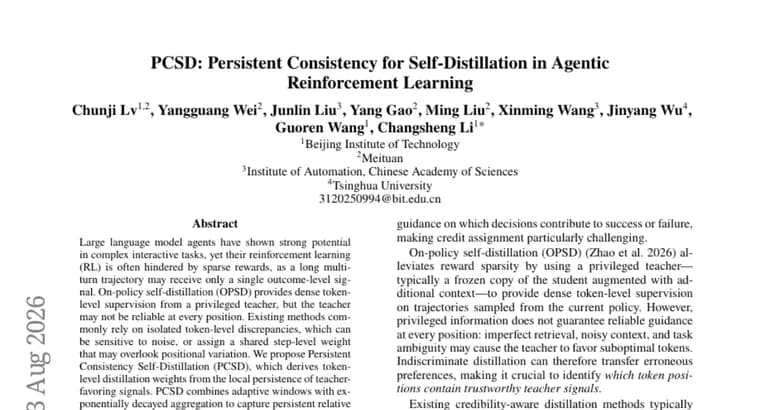
Researchers propose Persistent Consistency Self-Distillation (PCSD), a new training technique for reinforcement learning (RL) of large language model agents. The problem it targets: RL for LLM agents is often hindered by sparse rewards, since a long multi-turn trajectory may yield only a single outcome-level signal at the end. A prior technique called on-policy self-distillation (OPSD) tries to fix this by having a privileged teacher model supply dense, token-level supervision, but that teacher is not reliable at every position in a trajectory. Existing self-distillation methods either lean on isolated token-level discrepancies, which are sensitive to noise, or assign one shared weight per step, which overlooks positional variation within that step.
PCSD instead derives its token-level distillation weights from how persistently the teacher's guidance favors particular tokens over time. It combines adaptive windows with exponentially decayed aggregation to capture that persistent teacher support, applies trend-aware modulation to attenuate locally declining support, and turns the result into continuous weights through sigmoid gating. This distillation objective is then jointly optimized with GRPO (Group Relative Policy Optimization), pairing dense teacher guidance with the sparse environmental reward signal.
Tested without any inference-time skills, PCSD achieves the best ALFWorld Overall results among all baselines on both backbones the authors tested, exceeding plain GRPO by 15.6 and 13.3 points across the two backbones, and beating SDAR by 6.2 and 5.5 points. On the unseen ALFWorld split, PCSD gains 15.8 points over GRPO. The method also remains competitive on the WebShop benchmark. The abstract does not name the two backbone models, give absolute success-rate numbers for any method, disclose PCSD's window size or decay-rate parameters, or mention a code or model release.
Key facts
- PCSD derives token-level distillation weights from the persistence of teacher-favoring signals, combining adaptive windows, exponentially decayed aggregation, trend-aware modulation, and sigmoid gating.
- The PCSD objective is jointly optimized with GRPO, pairing dense teacher guidance with sparse environmental reward.
- On ALFWorld Overall results, PCSD beats GRPO by 15.6 and 13.3 points, and beats SDAR by 6.2 and 5.5 points, across two backbones.
- On the unseen ALFWorld split, PCSD gains 15.8 points over GRPO.
- PCSD remains competitive on the WebShop benchmark and works without inference-time skills.
Why it matters
Reinforcement learning for LLM agents struggles with sparse rewards: a long multi-turn trajectory often produces just one outcome signal at its end, which makes training slow and noisy. Distilling denser, token-level guidance from a privileged teacher model can help, but only if the per-token weighting given to that guidance is trustworthy. PCSD's contribution is a steadier way to compute that weighting, based on how persistently a teacher favors given tokens over a window of time, rather than on isolated, noise-prone per-token gaps or a single flat weight applied across a whole step.
Who it affects
The direct audience is researchers and engineers building RL training pipelines for LLM agents that act over long multi-turn trajectories, such as agents operating in the ALFWorld embodied-task simulator or the WebShop e-commerce environment. Anyone already using GRPO-style RL with a teacher-distillation component is the closest fit; agent developers more broadly stand to benefit if the technique or its ideas make their way into open training frameworks.
How to use it
The abstract gives no code repository, model weights, or release timeline, and no pricing or licensing terms. As described, PCSD is a training technique documented in a paper, not a released tool, library, or product that can be adopted directly today.
How solid is it
The reported gains are the paper's own benchmark results, not an independent replication. They are expressed as point-margin differences on ALFWorld Overall results and on WebShop, measured against a GRPO baseline and SDAR; the abstract does not give absolute accuracy or success-rate numbers for any method, so there is no way to gauge the base performance level being improved on, and the two backbone models used are not named.
Risks and caveats
The abstract omits the identity of the two backbone models being compared, absolute scores for any method on either benchmark, and details of PCSD's adaptive-window size, decay rate, or sigmoid-gating parameters. Results are self-reported by the paper's authors on two benchmarks (ALFWorld, WebShop), with no mention of third-party verification or a code release, so reproducibility outside the paper remains untested.