Register tokens lift diffusion LLM scores on math and code
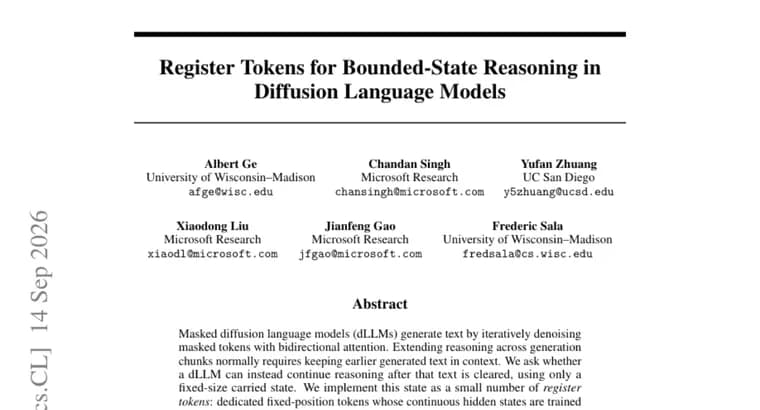
Masked diffusion language models (dLLMs) write text by repeatedly denoising masked tokens with bidirectional attention, working chunk by chunk. Normally, carrying reasoning from one chunk to the next means keeping all the earlier generated text in context, which grows expensive as generation gets longer. A new paper asks whether a dLLM can instead throw that text away and keep going, using only a small, fixed-size carried state.
The authors implement that state as register tokens: a small number of tokens at dedicated fixed positions whose continuous hidden states are trained to carry reasoning progress from one chunk to the next. Models are post-trained to decode a chunk of text, clear it while keeping the register values intact, and continue decoding from the prompt plus the carried state alone, without the discarded text.
In the paper's main comparisons, run on the LLaDA and Dream diffusion language models, register tokens beat carrying the discarded text forward as plain text on every benchmark tested, with gains reaching 8.5 points on math benchmarks and 19.5 points on code benchmarks. The authors report registers work especially well for bounded code generation, where a correct program typically spans several chunks and needs the earlier structure remembered without needing the earlier text verbatim. They also note the register mechanism can be refined further with reinforcement learning on long-horizon reasoning tasks.
Key facts
- Register tokens are a small number of fixed-position tokens whose continuous hidden states are trained to carry reasoning progress across generation chunks in diffusion language models.
- Models are post-trained to decode a chunk, clear it while keeping the register values, then continue decoding from the prompt and the carried state alone.
- On the main LLaDA and Dream comparisons, registers beat carrying the discarded text forward as plain text on every benchmark tested.
- Gains reach up to 8.5 points on math benchmarks and up to 19.5 points on code benchmarks.
- Registers are reported to work especially well for bounded code generation, where a correct program usually spans several chunks; the mechanism can also be refined with reinforcement learning on long-horizon reasoning tasks.
Why it matters
Diffusion language models generate in chunks, and until now the only way to keep a chain of reasoning alive across chunks was to keep every earlier chunk of generated text sitting in context. That gets expensive as output grows. Register tokens replace that growing text history with a fixed-size carried state, so a model can drop the earlier text and keep only a small set of trained tokens that summarize where the reasoning stands.
Who it affects
This is aimed at researchers and engineers building or extending diffusion language models such as LLaDA and Dream, particularly for tasks that need reasoning or code to hold together across a long, multi-chunk generation. It is not a consumer-facing release; nothing in the source describes a product, an API or a public model checkpoint built on this method.
How to use it
The method is a post-training procedure: an existing dLLM is trained to decode a chunk, clear that chunk from context while preserving the register token states, and continue generating from the prompt plus those carried states. The source gives no pricing, licence or release details, and none should be assumed; it describes a research technique, not a shipped tool.
How solid is it
The comparisons are run on two named diffusion language models, LLaDA and Dream, and registers reportedly beat the discrete-text-carry baseline on every benchmark in those comparisons, with gains of up to 8.5 points on math and 19.5 points on code. The source does not name the specific benchmarks beyond the broad 'math' and 'code' categories, nor does it give absolute accuracy scores, only these point gains over the baseline, so the headline numbers describe relative improvement rather than an absolute performance level.
Risks and caveats
The reported figures are gains over a discrete-text-carry baseline, not standalone accuracy numbers, and the source names no specific benchmark suites, dates, author affiliations, or the exact number of register tokens used. The evaluation covers two model families, LLaDA and Dream; how the approach generalizes beyond them is not addressed in the available text.