Repo0 framework lifts code-generation pass rate by up to 29.74 points
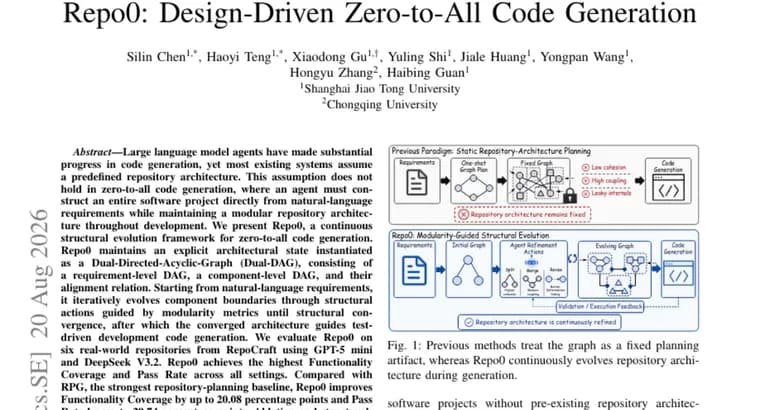
Researchers present Repo0, a framework for what they call zero-to-all code generation: building an entire software repository directly from natural-language requirements while keeping the codebase's modular structure coherent throughout development. Most existing code-generation agents assume a repository architecture is already fixed before they start writing code. Repo0 does not make that assumption. It maintains an explicit, evolving model of the architecture, called a Dual-Directed-Acyclic-Graph (Dual-DAG), which tracks two linked graphs at once: one describing the requirements and one describing the software components meant to satisfy them, plus the alignment between the two. Starting from the requirements, Repo0 repeatedly reshapes component boundaries through structural actions guided by modularity metrics until the architecture stops changing, a point the authors call structural convergence. Only after convergence does the system move to generating the actual code, using a test-driven development approach guided by the now-settled architecture. The authors evaluated Repo0 on six real-world repositories from a benchmark called RepoCraft, running it with two different underlying models, GPT-5 mini and DeepSeek V3.2. Across all tested settings, Repo0 achieved the highest scores on two metrics: Functionality Coverage, which measures how much of the required functionality is actually implemented, and Pass Rate, which measures how much of the generated code passes tests. Against RPG, described as the strongest existing repository-planning baseline, Repo0 improved Functionality Coverage by up to 20.08 percentage points and Pass Rate by up to 29.74 percentage points. The paper does not state the absolute Functionality Coverage or Pass Rate values, only these point gains over RPG. Ablation experiments and analysis of the structural-evolution process, according to the authors, show that three elements each matter for the result: the Dual-DAG architectural state itself, the modularity-guided process that evolves component boundaries, and the explicit convergence step before code generation begins.
Key facts
- Repo0 is a framework for zero-to-all code generation: building a complete software repository from natural-language requirements while maintaining a modular architecture throughout.
- It tracks an explicit architectural state, a Dual-Directed-Acyclic-Graph linking a requirements-level graph to a component-level graph, evolving it until structural convergence before writing code.
- Tested on six real-world repositories from the RepoCraft benchmark using GPT-5 mini and DeepSeek V3.2, Repo0 scored highest on Functionality Coverage and Pass Rate in every setting.
- Against the RPG baseline, Repo0 improved Functionality Coverage by up to 20.08 percentage points and Pass Rate by up to 29.74 percentage points.
- Ablation and structural-evolution analyses point to the Dual-DAG state, modularity-guided evolution, and explicit convergence as each contributing to the result.
Why it matters
Code-generation agents have gotten good at writing functions and patches inside an existing codebase, but building a whole project from a text description is a different problem: the agent has to invent a workable architecture and keep it coherent as requirements get translated into components. Repo0 treats that architecture as something to be explicitly modeled and evolved, rather than assumed, which is what most prior systems in this space do not do.
Who it affects
The result is aimed at researchers and toolmakers working on autonomous code-generation agents, particularly anyone building systems that go from a specification straight to a full repository rather than editing inside one that already exists.
How to use it
The paper describes a research framework evaluated on a benchmark, not a released product or service; no pricing, license or public tool is mentioned in the source.
How solid is it
The claims rest on a benchmark of six real-world repositories from RepoCraft, tested with two different backend models, GPT-5 mini and DeepSeek V3.2, and compared against RPG, which the authors call the strongest existing repository-planning baseline. The paper reports only the point-improvement gaps over RPG, not the absolute Functionality Coverage or Pass Rate scores, and does not name the paper's authors, institutions, publication venue or date, nor does it describe what RPG is beyond calling it the strongest baseline.
Risks and caveats
The reported 20.08 and 29.74 percentage-point gains are described as maximums ("up to"), so they may not represent the typical improvement across all six repositories and both models. Without the absolute scores or more detail on the RPG baseline, it is hard to judge from the source alone how large the underlying task-completion numbers are in absolute terms.