Robotic hand teaches itself to walk on its own fingers
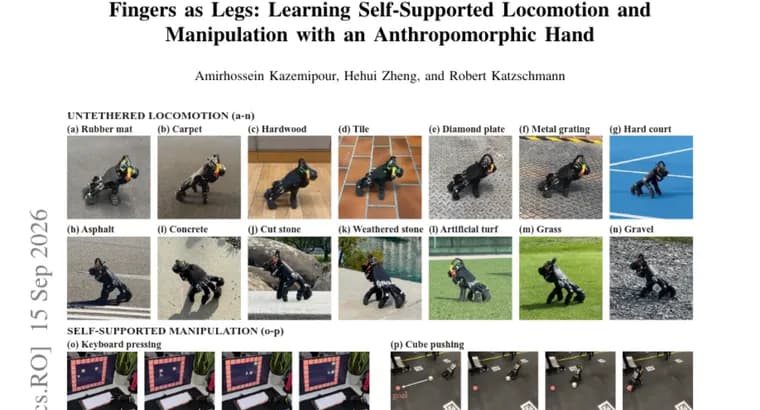
A robotic hand built for grasping normally does nothing else: it stays bolted to an arm or a base, and any robot that needs to move around gets a separate set of legs or wheels for the job. A new paper reframes the fingers themselves as that missing locomotion system. The authors present a reinforcement learning approach that lets an anthropomorphic hand use its own fingers both to move its body and to manipulate objects, while keeping the hand's original finger design and position controller unchanged. The platform is self-contained, carrying its own power and computation onboard rather than relying on a tether or an external computer. Training happens in a simulator calibrated from measurements taken on the physical hardware, and the reinforcement learning method is built to account for the hand's fingers being unequal in length and shape rather than treating them as identical limbs. The authors report that, in simulation, their reward formulation lets the hand move faster than it does with reward setups that were originally tuned for quadruped robots and simply carried over; no numeric comparison of the speeds is given. On the physical hand, task-specific policies proved capable of untethered crawling, steering and recovering after a fall. The same hand can also work while supporting its full weight: it types out sequences of keyboard commands without using any vision, and in a separate task pushes an object toward target locations using an overhead camera for visual feedback. Taken together, the authors present this as a compact mobile manipulator that reuses one set of fingers for both walking and interacting with the world, with no dedicated locomotion hardware attached.
Key facts
- The hand uses its own fingers for both walking and manipulation, with no separate legs or locomotion mechanism, while keeping its original finger design and position controller.
- It is fully self-contained, with power and computation carried onboard.
- The reinforcement learning method is built specifically to handle the hand's unequal fingers, and trains in a simulator calibrated from real hardware measurements.
- On physical hardware, task-specific policies let the hand crawl, steer and recover from falls, all untethered.
- While supporting its own weight, the hand types keyboard command sequences without vision, and separately pushes an object to target locations using overhead visual feedback.
Why it matters
Robots that manipulate objects and robots that move around are usually built as two different machines, or at least two different limb systems bolted to one body. This work collapses that split for one class of hardware: an anthropomorphic hand that keeps its grasping design unchanged but learns, through reinforcement learning, to also carry and move its own body. The reward formulation is trained specifically for the hand's unequal fingers rather than borrowed wholesale from legged-robot research, which the authors say lets it move faster in simulation than transplanted quadruped rewards do.
Who it affects
The result speaks most directly to robotics researchers working on manipulation and legged locomotion, particularly anyone building compact or multi-purpose robots where adding a dedicated leg system is impractical. It is a research demonstration rather than a shipped product, so there is no direct effect on non-specialists yet.
How to use it
The source is a research paper describing methods and hardware demonstrations, not a released product, dataset or code package; no pricing, license or availability details are given. Its value for other researchers is the approach itself: training a simulator calibrated from hardware measurements, and shaping rewards around the hand's specific, unequal finger geometry rather than reusing quadruped defaults.
How solid is it
The claims are backed by demonstrations on real, untethered hardware, not simulation alone: the hand crawls, steers and recovers from falls physically, and separately performs a no-vision keyboard-typing task and a vision-guided object-pushing task while bearing its own weight. The abstract does not give numeric results, such as speed figures or success rates, or name the specific quadruped reward baseline it is compared against, so the size of the reported simulation speed advantage cannot be independently judged from the text alone.
Risks and caveats
The source available here is the paper's abstract, which does not name the authors, their institution, a publication venue, or any code or dataset release, and gives no quantitative results to check the qualitative claims against. The no-vision and vision-guided tasks described are two separate demonstrations under different sensing conditions, not evidence that the hand operates without vision in general.
“These results demonstrate a compact mobile manipulator that reuses its fingers for locomotion and interaction, without a separate locomotion mechanism.”
— the paper's abstract