Rollback trains robot policies by rewinding world models to past decisions
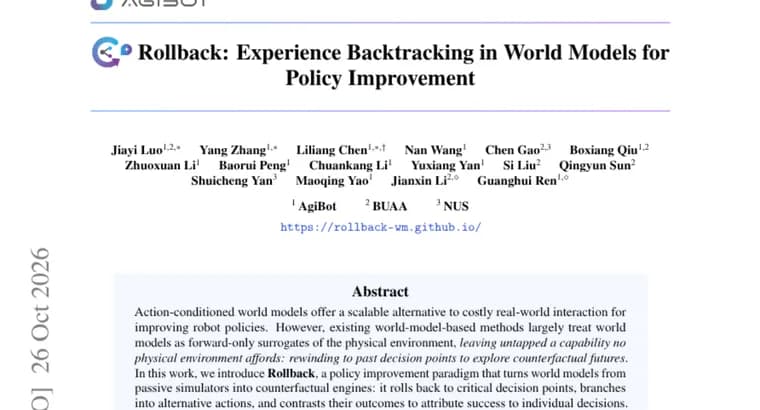
A paper on Hugging Face introduces Rollback, a way to improve robot policies using action-conditioned world models. The authors start from a complaint about existing world-model-based methods: they largely treat the world model as a forward-only stand-in for the physical environment. That leaves unused something a real environment cannot offer, which is the ability to rewind to a past decision point and explore counterfactual futures.
Rollback turns the world model from a passive simulator into what the authors call a counterfactual engine. It rolls back to critical decision points, branches into alternative actions, and contrasts their outcomes to attribute success to individual decisions. According to the authors, this concentrates imagination where it matters most, and it distills the counterfactual outcomes into fine-grained, action-level supervision without a separately learned value model.
The authors also describe a scalable training system. It unifies distributed world-model search with asynchronous real-robot execution and forms a self-reinforcing cycle: real-world experience sharpens the world model, and a sharper world model drives further policy improvement. They call the world-model side of this cycle test-time physics grounding, a capability they say hand-built physics simulators lack. While the world model serves as the training environment, real transitions from the policy it trains correct its dynamics through a lightweight LoRA pipeline.
The experiments cover three real-world tasks: block extraction, ball tossing and tabletop curling. Rollback improves success rate over the strongest baseline by an absolute 10.67%, 11.11% and 11.85% respectively, and the authors say it also improves more stably throughout training. Although the policy is initialized from teleoperated demonstrations far below human level, Rollback surpasses the average success rate of human players on both ball tossing and tabletop curling within 8 hours of training.
Key facts
- Rollback rewinds an action-conditioned world model to critical decision points, branches into alternative actions and compares outcomes to credit individual decisions.
- Counterfactual outcomes become action-level supervision without a separately learned value model.
- Real robot transitions correct the world model's dynamics through a lightweight LoRA pipeline, which the authors call test-time physics grounding.
- Over the strongest baseline, success rate rises by an absolute 10.67% (block extraction), 11.11% (ball tossing) and 11.85% (tabletop curling).
- Starting from teleoperated demonstrations far below human level, it passes the average human-player success rate on ball tossing and tabletop curling within 8 hours of training.
Why it matters
Most world-model approaches to robot learning use the model only to simulate forward. Rollback's pitch is that a learned world model can do something a physical environment cannot: rewind and try a different action from the same state. That gives the learner a way to say which individual decision made the difference, and the authors say it does this without training a separate value model. The reported gains of roughly 11 points of absolute success rate on three real tasks make the idea worth watching, though it is one preprint.
Who it affects
Robotics researchers working on policy improvement and on world models as training environments are the direct audience. Teams that rely on hand-built physics simulators are the contrast the authors draw, claiming that such simulators lack test-time physics grounding.
How to use it
The abstract gives no code or data release, so there is nothing to run yet. Conceptually, the recipe is: train an action-conditioned world model, search from critical decision points by branching alternative actions, turn the outcome differences into action-level supervision, and keep correcting the world model with real-robot transitions via a lightweight LoRA pipeline while robot execution runs asynchronously.
How solid is it
The results come from the authors' own experiments on three real-world tasks, reported in the abstract. Only the absolute gaps over the strongest baseline are given: 10.67%, 11.11% and 11.85%. The absolute success rates of Rollback and the baselines are not stated, and the strongest baseline is not named. No human-player success figure is given, nor how many players were measured or how. The abstract does not say whether the work has been peer reviewed.
Risks and caveats
The human-level claim covers ball tossing and tabletop curling only; nothing is stated for block extraction. The robot platform, world-model architecture and size are not stated, so how well the approach transfers to other setups is unknown. Three tasks is a narrow test, and the stronger claims, such as more stable improvement and surpassing average human players, rest on the authors' own reporting.