rvoip puts SIP, WebRTC and voice AI agents in one Rust library
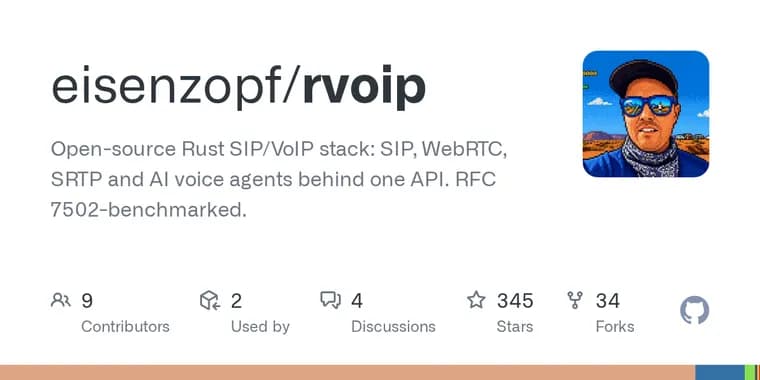
rvoip, a project hosted on GitHub under the eisenzopf account, is a Rust library for building communications applications. SIP, RTP, WebRTC, QUIC/WebTransport/WebSocket conversations, Media over QUIC and voice-AI agents share one call model. The project says no external SIP server, media server or RTP engine has to be installed and wired together: signaling, media, codecs, NAT traversal, security and the conversation model are all Rust crates in its workspace. In its words, rvoip is a library, not a server deployed next to your application.
The workspace holds 47 crates, but a developer imports one, which pulls in what it needs. rvoip-sip is the release-gated product, recommended for telephony applications, and the only crate with a signed interoperability attestation. The rvoip crate is a facade that re-exports rvoip-sip as rvoip::sip and adds a shared Orchestrator, with optional transports and extensions behind Cargo features. Backends such as Keycloak, LDAP, Redis, Postgres vCon storage, SAML, SCIM, WebAuthn, STIR/SHAKEN and IMS AKA are separate extension crates, added only by those who operate them. The project also cites release-gated interoperability evidence against Asterisk, FreeSWITCH, Jambonz, Kamailio and OpenSIPS.
The quick start adds rvoip-sip 0.5.1 and tokio, then runs a call on loopback: Bob answers, Alice dials and hangs up, with no PBX, account or network setup. Further examples cover microphone audio, PBX registration, hold and DTMF, transfers, SRTP and TLS, an IVR, a B2BUA, and browser and voice-AI gateways. A higher-level RvoipApp builder declares transports, roles and routing, and runs SIP, WebRTC and UCTP listeners on the shared Orchestrator. One example escalates a browser chat to a SIP agent's phone; another sends SIP calls into Amazon Connect.
For AI agents there are two routes. The rvoip-vapi crate speaks Vapi's bidirectional raw-audio WebSocket and bridges a SIP or WebRTC caller to a hosted agent, which joins as its own AI participant. Teams building their own pipeline get provider traits for speech recognition, text to speech, dialog and recording from rvoip-harness, while rvoip-vcon emits signed vCon records of the conversation.
The project's benchmark ran a single rvoip process on one AWS c8i.4xlarge cloud VM (16 vCPU, 8 cores, Intel Xeon 6, 32 GiB) using the RFC 7501/7502 method. It says that at twice capacity, rvoip keeps admitting calls at its maximum rate, rejects the excess with fast 503 responses and recovers cleanly when load drops. The test covered a terminating endpoint echoing G.711 audio without transcoding. Relay mode, registrations, transcoding, WebRTC and failover have not yet been measured.
Key facts
- rvoip is a Rust library that puts SIP, RTP, WebRTC, QUIC-based conversations, Media over QUIC and voice-AI agents under one call model, with no external SIP or media server required.
- The workspace has 47 crates; rvoip-sip, shown at version 0.5.1 in the quick start, is the release-gated product and the only crate with a signed interoperability attestation.
- The project cites interoperability evidence against Asterisk, FreeSWITCH, Jambonz, Kamailio and OpenSIPS.
- Voice AI works through rvoip-vapi for Vapi-hosted agents, or through rvoip-harness traits for a custom speech and dialog pipeline.
- The self-run benchmark used one 16 vCPU AWS c8i.4xlarge VM; relay mode, transcoding, WebRTC, registrations and failover are still unmeasured.
Why it matters
The pitch is consolidation. Every transport turns into the same objects (Conversation, Session, Participant, Connection and Stream), so an application written against that model does not care whether a leg arrived over SIP, a browser or QUIC. That lets one Orchestrator bridge them, with bridges transcoding when codecs differ. A Participant can be a human or an AI agent, and roles can change without moving connections. The core never imports a transport; adapters depend on a shared ConnectionAdapter trait.
Who it affects
Rust developers building softphones, PBXs, contact centers, browser gateways or AI agents are the intended users. Those doing pure telephony are told to start with rvoip-sip and stay there. The project points carriers evaluating standards coverage, performance and reliability to a dedicated section. Teams that want a caller handed to a voice agent can look at the Vapi and AI harness routes.
How to use it
Add rvoip-sip = "0.5.1" and tokio to your dependencies, or clone the repository and run cargo run -p rvoip-sip --example endpoint_local_call. The examples need nothing installed but Rust on a laptop. There are four API surfaces, ordered from simplest to most control, and the project says most applications use the first. DTLS-SRTP, G.729, AMR-NB/WB and Opus sit behind Cargo features. For the facade crate, deployment bundles such as bundle-sip-endpoint, bundle-carrier-sip and bundle-ai-conversation group the features. The Vapi examples use a Vapi API key. Applications still on 0.3 have a 0.4 migration guide with before and after code for each breaking change.
How solid is it
The evidence here is the project's own. Maximum calls per second means the highest rate with zero failed calls over a trial of at least 180 seconds and 50,000 call attempts. Setup delay (p50 and p99) was measured at 90% of that maximum and recorded in whole milliseconds. The UDP plus RTP maximum was confirmed twice, not three times. The release check also passed 5% above the TLS and UDP signaling maximums, so the project says those two figures may be slightly understated. Result figures are not reproduced here; the project refers readers to its RFC 7501/7502 benchmark report for the full method and per-trial data.
Risks and caveats
Read capacity numbers narrowly. rvoip was tested as an endpoint that answers calls and echoes media, while a relaying B2BUA or SBC handles two call legs per session. The concurrent calls figure is calls per second multiplied by a 10-second call length, not a measured maximum, and long-call capacity has not been measured. The server was a cloud VM, not an appliance. B2BUA or relay mode, registrations, transcoding, WebRTC with DTLS-SRTP and failover are all untested in the benchmark. The browser and Node client for JavaScript UCTP control is experimental, offered as source with TypeScript declarations and not yet published to npm.
“rvoip is a library, not a server you deploy next to your application.”
— rvoip project README