S-Mind adds spatial tokens to Qwen3.5 for multi-view 3D reasoning
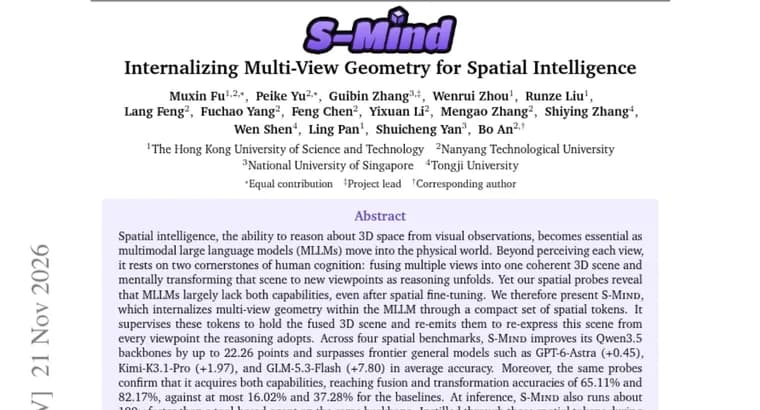
The paper starts from a problem. As multimodal large language models (MLLMs) move into the physical world, they need spatial intelligence, meaning the ability to reason about 3D space from visual observations. The authors say this rests on two cornerstones of human cognition beyond perceiving each view: fusing multiple views into one coherent 3D scene, and mentally transforming that scene to new viewpoints as reasoning unfolds. Their own spatial probes, they report, show that MLLMs largely lack both capabilities, even after spatial fine-tuning.
Their answer is S-Mind, which internalizes multi-view geometry inside the MLLM through a compact set of spatial tokens. During training, these tokens are supervised to hold the fused 3D scene. The model then re-emits them to re-express that scene from every viewpoint the reasoning adopts.
On results, the authors report that across four spatial benchmarks S-Mind improves its Qwen3.5 backbones by up to 22.26 points. It also surpasses frontier general models in average accuracy: GPT-6-Astra by 0.45, Kimi-K3.1-Pro by 1.97 and GLM-5.3-Flash by 7.80. The probes are said to confirm that S-Mind acquires both capabilities. It reaches fusion accuracy of 65.11% and transformation accuracy of 82.17%, against at most 16.02% and 37.28% for the baselines.
At inference, S-Mind runs about 100x faster than a tool-based agent on the same backbone. Finally, the authors say that because the capability is instilled through the spatial tokens during training, it becomes intrinsic to the backbone and persists even when the tokens are withheld. They describe this as a promising path toward spatial intelligence in MLLMs.
Key facts
- S-Mind uses a compact set of spatial tokens that are supervised to hold a fused 3D scene and re-emitted to re-express it from each viewpoint the reasoning adopts.
- Across four spatial benchmarks, it improves its Qwen3.5 backbones by up to 22.26 points, which is the best case, not the typical gain.
- In average accuracy it is reported to beat GPT-6-Astra by 0.45, Kimi-K3.1-Pro by 1.97 and GLM-5.3-Flash by 7.80.
- On the authors' probes, S-Mind reaches 65.11% fusion and 82.17% transformation accuracy, against at most 16.02% and 37.28% for the baselines.
- It runs about 100x faster than a tool-based agent on the same backbone, and the authors say the capability persists even when the tokens are withheld.
Why it matters
Spatial reasoning is a weak point the authors want to fix as MLLMs enter the physical world. Their probes suggest that even spatially fine-tuned models largely cannot fuse several views into one 3D scene or mentally move that scene to a new viewpoint. S-Mind tries to build both abilities into the model itself rather than calling external tools. The reported speed gap, about 100x against a tool-based agent on the same backbone, is the practical case for that approach.
Who it affects
Mainly researchers working on multimodal models and spatial reasoning benchmarks, and teams building MLLMs for physical-world settings where several camera views must be combined. The method is built on Qwen3.5 backbones, so it is most directly relevant to people working with that model family.
How to use it
There is nothing to deploy yet from the text itself. No code, model or dataset release is mentioned. For now the paper is a method description and a set of reported results. The core recipe is to add a compact set of spatial tokens, supervise them to hold the fused 3D scene, and re-emit them for each viewpoint during reasoning.
How solid is it
These are the authors' own reported results. The text is a paper abstract, so the evidence behind the numbers is not visible here. The four spatial benchmarks are not named. The Qwen3.5 backbone sizes are not given, nor which backbone gave the 22.26-point gain or on which benchmark. The baselines in the fusion and transformation probe comparison are not listed. The tool-based agent used for the 100x speed comparison is not identified, and the speed measure (latency or throughput) is not specified. The margins over the frontier models are modest for GPT-6-Astra (+0.45) and Kimi-K3.1-Pro (+1.97), and larger only against GLM-5.3-Flash (+7.80). No authors or institutions are named.
Risks and caveats
The headline gain of 22.26 points is an 'up to' figure, so typical improvements are smaller. The claim that capability persists when the tokens are withheld is stated, but no result for that case is reported. The probe accuracies come from the authors' own probes, not from an independent test. The authors' description of the method as a promising path toward spatial intelligence in MLLMs is their own framing, not a demonstrated outcome.
“spatial capability becomes intrinsic to the backbone and persists even when the tokens are withheld”
— S-Mind paper abstract