Sage S1.5 Flash, a 320B science MoE model, tops four of 33 benchmarks
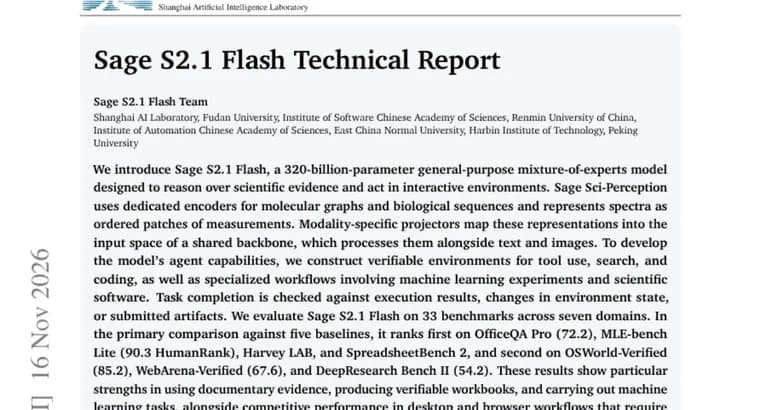
A Hugging Face papers entry titled "Sage S2.1 Flash Technical Report" introduces a 320-billion-parameter general-purpose mixture-of-experts model built to reason over scientific evidence and act in interactive environments. The abstract itself calls the model Sage S1.5 Flash, not S2.1; the source does not explain the mismatch.
The architecture centres on Sage Sci-Perception. It uses dedicated encoders for molecular graphs and biological sequences, and it represents spectra as ordered patches of measurements. Modality-specific projectors map these representations into the input space of a shared backbone, which processes them alongside text and images.
For agent capabilities, the authors built verifiable environments for tool use, search and coding, plus specialized workflows involving machine learning experiments and scientific software. Task completion is checked against execution results, changes in environment state, or submitted artifacts.
The model was evaluated on 33 benchmarks across seven domains. In the primary comparison against five baselines, it ranks first on OfficeQA Pro (72.2), MLE-bench Lite (90.3 HumanRank), Harvey LAB and SpreadsheetBench2. It ranks second on OSWorld-Verified (85.2), WebArena-Verified (67.6) and DeepResearch BenchII (54.2).
The authors read these results as showing particular strengths in using documentary evidence, producing verifiable workbooks and carrying out machine learning tasks. They describe performance in desktop and browser workflows that require acting on visual feedback as competitive, which here means second place, not first.
Key facts
- Sage S1.5 Flash is a 320-billion-parameter general-purpose mixture-of-experts model aimed at scientific evidence reasoning and interactive agent tasks; the page title says S2.1, the abstract says S1.5.
- Sage Sci-Perception uses dedicated encoders for molecular graphs and biological sequences and treats spectra as ordered patches of measurements, feeding a shared backbone through modality-specific projectors.
- Evaluated on 33 benchmarks across seven domains; in the primary comparison against five baselines it ranks first on OfficeQA Pro (72.2), MLE-bench Lite (90.3 HumanRank), Harvey LAB and SpreadsheetBench~2.
- It ranks second on OSWorld-Verified (85.2), WebArena-Verified (67.6) and DeepResearch Bench~II (54.2), which the authors call competitive performance.
Why it matters
The report pitches one model for two jobs: reading scientific data such as molecular graphs, biological sequences and spectra, and acting as an agent in tools, browsers and desktops. Most of the named wins are on office, spreadsheet and machine learning tasks (OfficeQA Pro, SpreadsheetBench~2, MLE-bench Lite), and the abstract frames the strengths that way.
Who it affects
Researchers and teams that evaluate large models for scientific or document-heavy work, and anyone tracking agent benchmarks such as OSWorld-Verified and WebArena-Verified. The source names no authors, institution or company behind Sage.
How to use it
Nothing practical to act on yet. The source gives no release date, weights availability, license or pricing. What the abstract offers is a picture of where the model is claimed to be strong: documentary evidence, verifiable workbooks and machine learning tasks.
How solid is it
The numbers come from the authors' own abstract and are not independently verified in the source. The five baselines are not named, and neither are the other 26 benchmarks of the 33. Scores for Harvey LAB and SpreadsheetBench~2 and all baseline scores are not given, and units are stated only for MLE-bench Lite (HumanRank). The model name differs between the page title (S2.1) and the abstract (S1.5).
Risks and caveats
First place is claimed on four benchmarks in one five-baseline comparison, and second place on three more. The source does not say how the model fares on the remaining benchmarks, and the seven domains are not listed. The number of active parameters per token is not given, so the 320B figure alone says little about inference cost. Treat the claims as a vendor-style summary until the full report and independent tests are available.
“These results show particular strengths in using documentary evidence, producing verifiable workbooks, and carrying out machine learning tasks, alongside competitive performance in desktop and browser workflows that require the model to act on visual feedback.”
— Abstract of the Sage technical report on Hugging Face Papers