Samsung to more than double HBM4 and HBM4E output next year
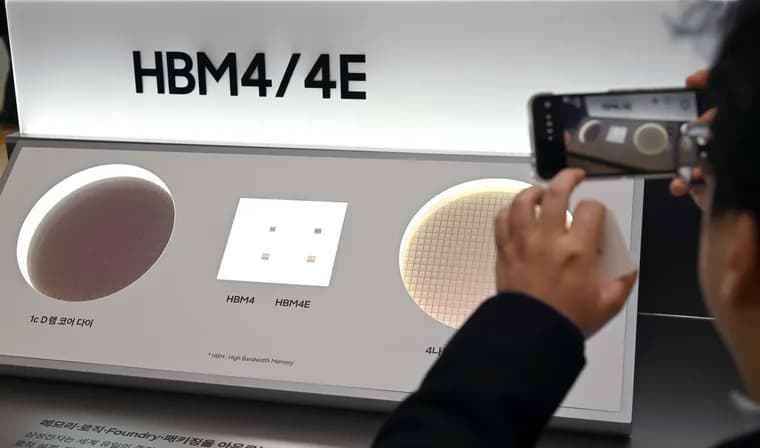
Samsung Electronics is expected to more than double output of its HBM4 family of high-bandwidth memory chips next year, covering sixth-generation HBM4 and seventh-generation HBM4E, according to unnamed semiconductor industry sources cited on the 20th. The plan centers on glass carriers, the temporary supports attached to the underside of an HBM DRAM wafer to keep it from bending or cracking while it is ground thin and drilled; Samsung intends to raise demand for them by 2.5 times from this year's level.
The clearest number behind the plan is cleaning volume: Samsung will raise outsourced cleaning of glass carriers, an essential material in HBM production, to 50,000 sheets a month next year from 20,000 sheets a month this year. Glass carrier requirements stood at just 10,000 sheets a month as recently as last year, already doubled this year, and are set to rise 2.5-fold again next year. Industry analysts say that even accounting for the fact that carriers are reused after cleaning and that consumption varies by process loading method and yield, a 2.5-fold increase in related volume makes it highly likely that HBM4 and HBM4E output will grow at least twofold from this year.
The products being scaled up center on 12-layer and higher stacks, and the reason glass carriers matter more as stack counts rise is that HBM packs multiple DRAM dies into a limited thickness, making wafer-thinning and warpage control harder to manage. Samsung began mass-production shipments of HBM4 in February, using 10-nanometer-class sixth-generation (1c) DRAM with a base die built on a 4-nanometer process. In May it went on to provide 12-layer HBM4E samples to customers including Nvidia.
The industry expects Samsung's overall HBM production scale, measured by average monthly wafer input, to grow nearly 40% to about 250,000 wafers next year from roughly 180,000 wafers this year. Within that total, the product mix is shifting toward the newer chips: the HBM4 family is projected to rise from around 40% of shipments this year to about 80% next year as HBM4E mass production ramps up. "As Samsung expands HBM production, it appears to be placing HBM4, a high-value product, at the center," an industry official said.
Key facts
- Samsung is expected to more than double HBM4 and HBM4E output next year versus this year, per unnamed industry sources.
- Outsourced glass-carrier cleaning volume rises to 50,000 sheets a month next year from 20,000 this year; requirements were just 10,000 sheets a month last year.
- Samsung's total HBM production scale is expected to grow nearly 40%, to about 250,000 wafers a month next year from roughly 180,000 this year.
- The HBM4 family's share of Samsung's HBM shipment mix is projected to rise from around 40% this year to about 80% next year.
- Samsung began HBM4 mass-production shipments in February (10nm-class 1c DRAM, 4nm base die) and shipped 12-layer HBM4E samples to Nvidia in May.
Why it matters
HBM is the memory that sits next to AI accelerators, and its supply has been a bottleneck for GPU output. A doubling of Samsung's HBM4/HBM4E capacity signals that one of the three major HBM makers expects demand from AI infrastructure buyers to keep climbing sharply through next year, not merely hold steady.
Who it affects
Nvidia, already named as a recipient of 12-layer HBM4E samples, and other GPU and AI-accelerator makers that depend on HBM supply; Samsung's own foundry and packaging operations, which have to scale wafer input, glass-carrier cleaning and stacking capacity together; and glass-carrier suppliers, whose cleaning volumes are the concrete bottleneck cited here.
How to use it
There is no product, price or purchase decision in this story; it is a supply-side capacity signal. Anyone forecasting GPU or AI-server availability next year can use the reported wafer-input and shipment-mix figures as one input on the memory-supply side of that picture.
How solid is it
The output-doubling and 2.5x glass-carrier figures come from unnamed semiconductor industry sources and unnamed industry analysts, not from a Samsung disclosure; the wafer-input and shipment-mix numbers are described as industry expectations rather than confirmed Samsung guidance. The specific, checkable facts (February HBM4 mass-production start, May 12-layer HBM4E samples to Nvidia) are stated more plainly and read as established.
Risks and caveats
The story does not name its sources, give absolute calendar years for "this year"/"next year", or state why underlying HBM4/HBM4E demand is rising beyond the production-scaling figures themselves; no pricing or revenue figures are given. The analysts' twofold output-growth estimate is explicitly a projection that already accounts for carrier reuse and yield variability, not a guaranteed outcome.
“As Samsung expands HBM production, it appears to be placing HBM4, a high-value product, at the center”
— an industry official