SELF-INDEX lets retrieval indexes optimize themselves without humans
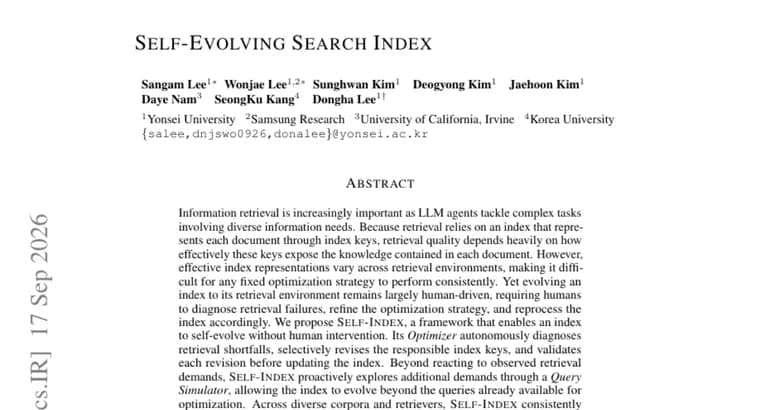
Retrieval systems depend on an index that represents each document through a set of index keys, and how well those keys expose a document's content determines how good the retrieval is. The catch, according to the paper, is that the best way to represent an index varies by environment, so no single fixed optimization strategy works everywhere, and today evolving an index to fit its environment is a manual process: a human has to notice retrieval is failing, work out how to fix the keys, and reprocess the index. The authors propose SELF-INDEX, a framework built to close that loop on its own. Its core piece is an Optimizer that autonomously diagnoses retrieval shortfalls, selectively revises only the index keys responsible for those shortfalls, and validates each revision before it is applied to the index. On top of that, a Query Simulator does not just react to queries the system has already seen: it proactively generates additional queries, so the index can evolve to handle demands beyond the ones it has been directly asked to optimize for. The authors report that across a range of corpora and retrievers, SELF-INDEX consistently improves retrieval performance and outperforms existing index optimization methods, and that the gains carry over to downstream applications, making search agents more effective and efficient and helping agent memory systems retrieve useful past interactions. The source text gives no author names, institutions, benchmark numbers, specific corpora or retrievers tested, or publication venue and date.
Key facts
- SELF-INDEX is a framework that lets a retrieval index self-evolve without human intervention.
- Its Optimizer autonomously diagnoses retrieval shortfalls, revises only the responsible index keys, and validates each revision before applying it.
- A Query Simulator proactively generates additional queries so the index can improve beyond the queries already available for optimization.
- The authors say SELF-INDEX consistently improves retrieval performance and outperforms existing index optimization methods across diverse corpora and retrievers.
- The reported gains are said to extend to downstream applications, including more effective and efficient search agents and better retrieval in agent memory systems.
Why it matters
Retrieval quality hinges on how well an index's keys expose what is actually in each document, and the best representation differs by environment, so a fixed, one-size-fits-all optimization strategy does not hold up everywhere. Today that mismatch gets fixed by hand: a person has to notice retrieval is failing, work out a new strategy, and reprocess the index. SELF-INDEX targets exactly that bottleneck by giving the index the ability to diagnose and fix itself.
Who it affects
The paper frames this for systems built around retrieval, particularly LLM agents handling complex tasks with varied information needs. It specifically calls out two downstream beneficiaries: search agents, whose effectiveness and efficiency the authors say improve, and agent memory systems, which the authors say retrieve useful past interactions better once their underlying index has been through SELF-INDEX.
How to use it
SELF-INDEX is described as a framework with two working parts. An Optimizer autonomously diagnoses where retrieval is falling short, selectively revises only the index keys responsible, and validates each revision before it updates the index, rather than reprocessing everything. A Query Simulator then goes further than reacting to demand already observed: it proactively generates additional queries so the index keeps evolving beyond what it has already been asked to optimize for. The source text gives no pricing, licensing, release, or availability details.
How solid is it
The claims in this retelling come from the authors' own description: that SELF-INDEX "consistently improves retrieval performance while outperforming existing index optimization methods" across diverse corpora and retrievers, and that these benefits extend to downstream search-agent and agent-memory applications. The source text does not include benchmark numbers, the identity of the corpora or retrievers tested, or comparison baselines beyond the general statement that existing methods are outperformed, so the strength of the result cannot be independently assessed from what is given here.
Risks and caveats
The source provides no author names, institutions, publication venue, or date, so provenance cannot be verified from the text alone. It also gives no quantitative results, meaning the size of the reported improvement is unknown. More broadly, a system that autonomously revises its own retrieval index raises the general question of how automated changes get checked; the authors state that each revision is validated before being applied, but the source gives no detail on what that validation involves.
“We propose SELF-INDEX, a framework that enables an index to self-evolve without human intervention.”
— the authors