Shieldstral: a 3B safety classifier that matches or outperforms models nearly seven times its size
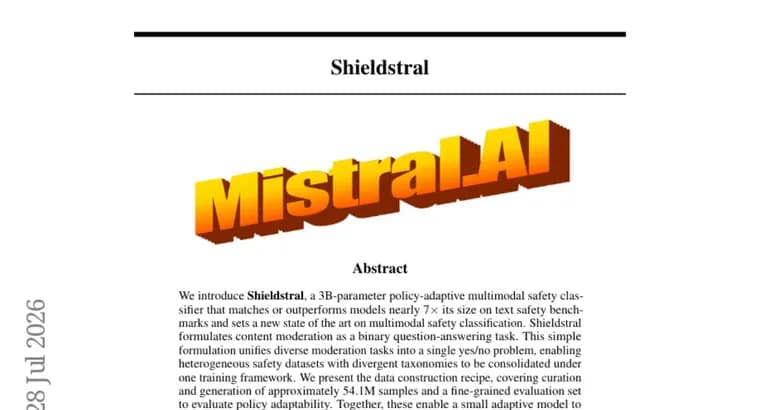
A new paper introduces Shieldstral, a 3-billion-parameter policy-adaptive multimodal safety classifier built for content moderation. On text safety benchmarks it matches or outperforms models nearly seven times its parameter count, and on multimodal safety classification it sets a new state of the art. The authors reach this by reframing content moderation as a single binary question-answering task: instead of building separate classifiers for separate moderation categories, every judgment becomes one yes-or-no question. That formulation lets the team fold heterogeneous safety datasets, built under different and often conflicting moderation taxonomies, into one shared training framework rather than maintaining parallel pipelines per taxonomy. To train the model this way, the authors built a data pipeline that curates and generates about 54.1 million samples, plus a separate, fine-grained evaluation set designed specifically to measure how well a moderation model adapts to different policies rather than just how accurately it classifies content under one fixed policy.
Key facts
- Shieldstral is a 3-billion-parameter policy-adaptive multimodal safety classifier for content moderation.
- It matches or outperforms text-safety models nearly 7 times its parameter size on text safety benchmarks.
- It sets a new state of the art on multimodal safety classification.
- Moderation is reframed as one binary yes/no question-answering task, unifying datasets built under different taxonomies into a single training framework.
- The training data pipeline curates and generates about 54.1 million samples, plus a fine-grained evaluation set built to test policy adaptability.
Why it matters
Content moderation systems have historically needed separate classifiers, or separate fine-tunes, for each moderation taxonomy a platform uses, since policies differ on what counts as unsafe. Shieldstral's contribution is a single formulation, binary question-answering, that lets one small model absorb datasets built under different, even conflicting, taxonomies without maintaining parallel pipelines. That a 3B model then matches or beats models roughly 7 times larger on text safety benchmarks, while also leading on multimodal safety classification, suggests the gain comes from how the training data and task are structured rather than from raw scale.
Who it affects
The direct audience is teams building or operating content moderation and trust-and-safety systems, including platforms that need to enforce their own custom policies rather than a single fixed one. A smaller model that reaches or exceeds the accuracy of much larger safety classifiers also matters for anyone running moderation at scale, where inference cost and latency per checked item add up quickly.
How to use it
The paper describes Shieldstral as policy-adaptive, meaning it is designed to be pointed at a given moderation policy and answer the yes/no question that policy implies, rather than being locked to one fixed taxonomy. The text does not state a release, license, or availability for the model or the 54.1-million-sample dataset, so how or whether either can be obtained and deployed is not established here.
How solid is it
The core claims, matching or outperforming models nearly 7 times larger on text safety benchmarks and a new state of the art on multimodal safety classification, are stated as the paper's own benchmark results. The paper also describes a dedicated fine-grained evaluation set built specifically to test policy adaptability, which is a meaningful methodological detail: it indicates the authors tried to measure adaptability directly rather than inferring it from raw classification accuracy alone. The source text does not specify which benchmarks or which larger models were used for the comparison.
Risks and caveats
The claims come from the paper itself, and the source text does not name the comparison models, the specific benchmarks, or provide independent verification of the results. As a policy-adaptive classifier, its real-world reliability will depend on how well the underlying 54.1-million-sample dataset covers the specific taxonomies it gets deployed against, something that cannot be assessed from the paper's abstract alone.
“We introduce Shieldstral, a 3B-parameter policy-adaptive multimodal safety classifier that matches or outperforms models nearly 7 times its size on text safety benchmarks and sets a new state of the art on multimodal safety classification.”
— Shieldstral paper