Simon Willison uses GPT-5.6-Sol and Claude Code to build a GeoJSON map viewer
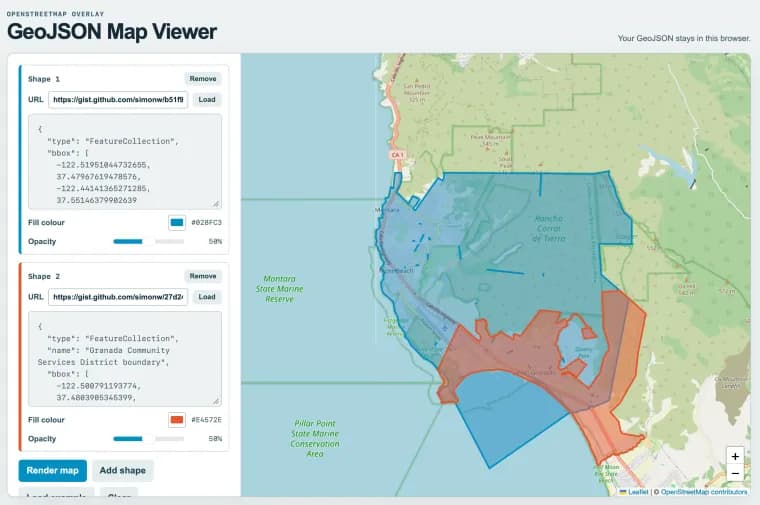
Simon Willison was helping someone named Natalie gather maps of local political boundaries, specifically for the El Granada Community Services District and the Midcoast Community Council, which operates near Half Moon Bay, California. The task needed a way to display GeoJSON boundary files on a map and export the result as a PNG. Willison asked GPT-5.6-Sol for suggestions of tools that could do this, and instead of just naming options, the model proactively built one itself. He then refined that first version through further iterations using Claude Code for web and Fable 5.1, arriving at a finished GeoJSON map viewer.
Separately, Willison found that generating the boundary data itself was straightforward with ChatGPT Work: asking it in plain language for the exact boundary of a district led it to extract and combine files from different government data sources and produce exactly what he needed. He used two prompts of that kind, one asking for the polygon representing the exact boundary of the El Granada GCSD, and another asking for a GeoJSON file for the Midcoast Community Council's boundary or boundaries near Half Moon Bay, CA. He published a link showing both resulting boundaries displayed together on the new map viewer.
Key facts
- Willison was helping Natalie map boundaries for two California special districts: the El Granada Community Services District and the Midcoast Community Council near Half Moon Bay.
- He asked GPT-5.6-Sol for suggestions of tools to display GeoJSON files on a map and export them as a PNG; the model proactively built a tool itself rather than just recommending one.
- He refined that first version with Claude Code for web and Fable 5.1 to reach the finished GeoJSON map viewer.
- Separately, ChatGPT Work generated the actual boundary GeoJSON data by extracting and combining files from different government data sources, from plain-language prompts naming each district.
- He published a link on the new tool showing both districts' boundaries displayed at the same time.
Why it matters
The post is a small but concrete example of chaining several AI tools across a single task: one model asked for a suggestion instead builds the tool itself, a coding assistant refines it, and a separate assistant sources the underlying data by digging through government records. It shows a workflow where the model is treated less like an advisor and more like the builder of first resort.
Who it affects
Developers and hobbyists doing small mapping or data-wrangling tasks, and anyone tracking how coding-capable AI models compare in practice, since the post names GPT-5.6-Sol, Claude Code for web and Fable 5.1 side by side on the same task.
How to use it
The approach described is to ask a capable model directly for a tool rather than only for tool names, then iterate on the result with a coding assistant. For sourcing boundary data specifically, Willison's method was to ask ChatGPT Work in plain language for a named district's exact boundary and let it locate and combine the relevant government sources itself. The finished map viewer is not named in the post, but a link to it, with both example boundaries loaded, is included.
How solid is it
This is a first-person account on Willison's own blog describing his own process, with no independent verification, benchmarks or code repository referenced. It documents what happened in one specific case rather than a general claim about tool reliability.
Risks and caveats
The account does not say what changed between the initial GPT-5.6-Sol build and the finished version after the further iterations, so the actual scope of that refinement work is unclear. The boundary data itself was extracted and combined by an AI model from government sources rather than pulled from a single authoritative dataset, and the post does not describe any check of that data against an official source.
“I asked GPT-5.6-Sol for suggestions of tools and it proactively built one.”
— Simon Willison