Simplified Matching Distillation targets 4-NFE diffusion with regression only
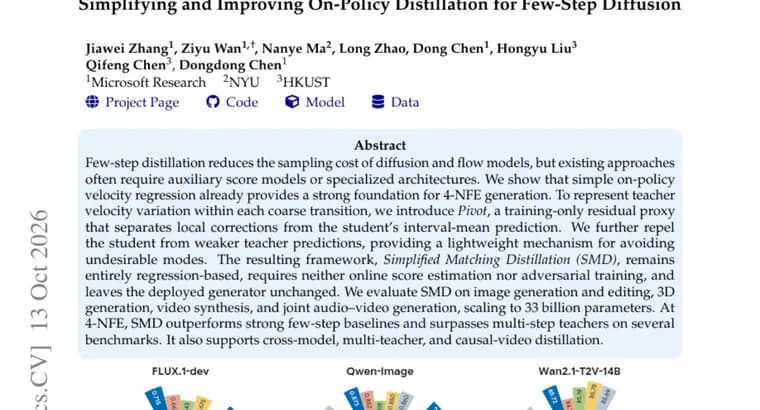
A paper on Hugging Face Papers introduces Simplified Matching Distillation (SMD), a framework for few-step distillation of diffusion and flow models. Few-step distillation cuts the sampling cost of these models, but the authors say existing approaches often require auxiliary score models or specialized architectures.
Their starting point is that simple on-policy velocity regression already provides a strong foundation for 4-NFE generation, that is, producing samples with four function evaluations. On top of that baseline they add two pieces. The first is Pivot, a training-only residual proxy that separates local corrections from the student's interval-mean prediction; it is meant to represent how the teacher's velocity varies within each coarse transition. The second is a mechanism that repels the student from weaker teacher predictions, which the authors describe as a lightweight way of avoiding undesirable modes.
The resulting framework, SMD, remains entirely regression-based, requires neither online score estimation nor adversarial training, and leaves the deployed generator unchanged.
The authors evaluate SMD on image generation and editing, 3D generation, video synthesis, and joint audio-video generation, scaling to 33 billion parameters. At 4-NFE, they report that SMD outperforms strong few-step baselines and surpasses multi-step teachers on several benchmarks. They add that it also supports cross-model, multi-teacher, and causal-video distillation.
Key facts
- Simplified Matching Distillation (SMD) distills diffusion and flow models into few-step generators using on-policy velocity regression.
- Pivot, a training-only residual proxy, separates local corrections from the student's interval-mean prediction; the student is also repelled from weaker teacher predictions.
- The method is entirely regression-based, needs neither online score estimation nor adversarial training, and leaves the deployed generator unchanged.
- It is evaluated on image generation and editing, 3D, video, and joint audio-video generation, scaling to 33 billion parameters.
- At 4-NFE, the authors report SMD beats strong few-step baselines and surpasses multi-step teachers on several benchmarks.
Why it matters
Few-step distillation is a way to cut the sampling cost of diffusion and flow models. The authors argue that existing approaches often need auxiliary score models or specialized architectures. SMD is pitched as a simpler route: plain regression on the teacher's velocity, with no online score estimation and no adversarial training, and with the deployed generator left unchanged.
Who it affects
Researchers and engineers who distill diffusion or flow models are the direct audience. The reported scope is broad: image generation and editing, 3D generation, video synthesis, and joint audio-video generation. The authors also say SMD supports cross-model, multi-teacher, and causal-video distillation.
How to use it
The abstract describes the recipe in outline: train the student with on-policy velocity regression, add the training-only Pivot residual proxy to capture teacher velocity variation within each coarse transition, and repel the student from weaker teacher predictions. Because Pivot is training-only and the deployed generator is unchanged, the model that ships keeps its original form. No code or model release is mentioned.
How solid is it
Every claim here comes from the paper's own abstract, so these are the authors' reported results. No benchmark names, metric values, or margins of improvement are given; 'several benchmarks' is not specified. The names of the teacher models, baselines and datasets are not given either. No authors or institutions are named in the source text.
Risks and caveats
The headline result is that SMD surpasses multi-step teachers on several benchmarks, which means not on all of them, and the source does not say which. The source does not say which 33-billion-parameter model was used or in which modality. No speedup factor, training cost, or wall-clock figure is stated, and no limitations or failure cases are described.
“We show that simple on-policy velocity regression already provides a strong foundation for 4-NFE generation.”
— Abstract of the SMD paper