SimWAM drops video generation at inference, tops NAVSIM planners
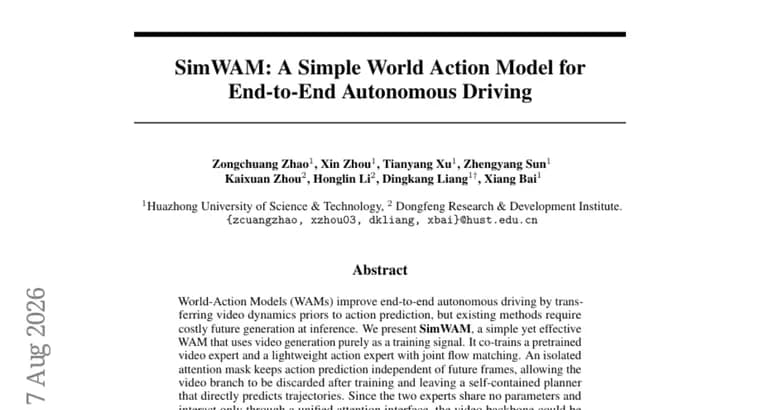
Researchers have presented SimWAM, a World-Action Model (WAM) for end-to-end autonomous driving. Prior WAMs improve action prediction by transferring dynamics priors learned from video, but they pay for it at inference: they have to generate future video frames every time they plan a move, which is costly. SimWAM keeps the video generation confined to training. It co-trains two components with joint flow matching: a pretrained video expert and a lightweight action expert. An isolated attention mask keeps the action prediction independent of future frames during training, so once training is done, the video branch can simply be thrown away, leaving a self-contained planner that predicts trajectories directly, with no video generation step at inference. Because the two experts share no parameters and only interact through a shared attention interface, the authors say the video backbone can be swapped out and the action expert scaled up independently, without touching the learning objective or the inference pipeline. On top of imitation learning from trajectories, the authors add reinforcement learning to optimize a compositional driving reward. The result, SimWAM, scores 91.5 PDMS on the NAVSIM benchmark, which the authors say surpasses state-of-the-art WAM-based planners while running with substantially lower latency, and it transfers zero-shot to the nuScenes dataset without further training. The authors position SimWAM as a simple, solid baseline that can absorb future advances in video generation without redesigning the pipeline. Code and model weights are published on GitHub.
Key facts
- SimWAM uses video generation purely as a training signal, dropping the video branch entirely at inference.
- It co-trains a pretrained video expert and a lightweight action expert with joint flow matching, kept independent by an isolated attention mask.
- SimWAM scores 91.5 PDMS on the NAVSIM benchmark and transfers zero-shot to nuScenes.
- The authors report it beats state-of-the-art WAM-based planners while running with substantially lower latency, though no specific latency numbers are given.
- Code and model weights are released at github.com/H-EmbodVis/SimWAM.
Why it matters
Existing World-Action Models borrow video-generation priors to plan driving actions more realistically, but they have had to generate future frames at inference time, adding latency to a task where reaction time matters. SimWAM's design confines video generation to training and drops it afterward, so the deployed planner predicts trajectories directly without ever generating video, which the authors say cuts latency substantially versus prior WAM-based planners while still beating them on the benchmark.
Who it affects
The work targets researchers and engineers building end-to-end autonomous driving planners, particularly anyone using or evaluating World-Action Models. Because SimWAM's video and action experts share no parameters and communicate only through a unified attention interface, teams can swap in a different video backbone or scale the action expert independently without redesigning the training objective or inference pipeline, according to the authors.
How to use it
The authors have released the code and model weights publicly, at https://github.com/H-EmbodVis/SimWAM/, so the architecture and trained model are available to use or build on directly rather than only as a paper description.
How solid is it
SimWAM reports 91.5 PDMS on NAVSIM, and the authors say this surpasses state-of-the-art WAM-based planners. It also transfers zero-shot to the nuScenes dataset, meaning it performs there without additional training, which is offered as evidence the approach generalizes beyond the benchmark it was tuned on. Beyond trajectory imitation, the authors apply reinforcement learning to optimize a compositional driving reward.
Risks and caveats
The source text gives no specific latency figures for SimWAM or the WAM-based planners it is compared against, only the qualitative claim of 'substantially lower latency.' It also names no individual authors or institutions, states no publication date, venue, or conference, and gives no details on the size or composition of the pretrained video expert or the lightweight action expert. All of this should be checked against the full paper before drawing conclusions about who built it or how it stacks up in absolute terms.