Skill-α uses RL to generate agent skills, gains up to 6.7 points
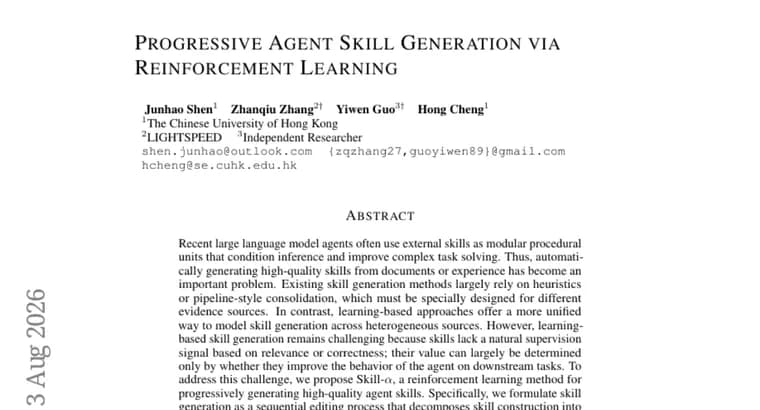
Most methods for generating skills for AI agents rely on heuristics or pipeline-style consolidation that has to be custom-built for each type of evidence source, whether that source is a document or a log of past agent experience. A newly proposed method, Skill-α, instead treats skill generation as something an agent can learn end to end across heterogeneous sources. The researchers behind it note that this is genuinely hard: unlike labeled training data, a skill has no natural signal for whether it is relevant or correct. Its real value can only be judged by whether it actually improves the agent's behavior on downstream tasks, and that signal is expensive and indirect.
Skill-α addresses this by formulating skill construction as a sequential editing process. Instead of generating a finished skill in one shot, the method breaks construction into individually evaluable edits. Each edit is scored using what the researchers call a rollback reward: downstream execution is run under the original skill and again under the edited skill, on the same anchored query, and the comparison between the two runs tells the system whether that specific edit helped or hurt. This lets the method build up a skill progressively, keeping edits that improve execution and discarding ones that do not.
The researchers tested Skill-α in two settings, generating skills from documents and generating skills from past agent experience, and report that it produces more effective skills than heuristic or pipeline baselines in both. Under a GPT-4o worker, Skill-α improves the average downstream success rate over the strongest skill-generation baseline by 3.3 points on CL-Bench and by 6.7 points on tau2-bench. Further ablation experiments show that both pieces of the design, the rollback reward and the progressive, edit-by-edit generation process, contribute to these gains; removing either weakens the result.
Key facts
- Skill-α formulates agent skill generation as a sequential editing process, breaking skill construction into individually evaluable edits.
- Each edit is scored with a novel rollback reward that compares downstream execution under the original skill versus the edited skill on the same anchored query.
- Under a GPT-4o worker, Skill-α improves average downstream success rate over the strongest skill-generation baseline by 3.3 points on CL-Bench.
- Under the same GPT-4o worker, Skill-α improves average downstream success rate by 6.7 points on tau2-bench.
- Ablation experiments confirm that both the rollback reward and the progressive generation process are necessary for the reported gains.
Why it matters
Skill generation for AI agents has mostly relied on heuristics or pipelines built by hand for each type of evidence, documents versus experience logs, which does not generalize well. Skill-α offers a learned, unified alternative by directly optimizing for the one thing that actually matters: whether a skill improves the agent's behavior on downstream tasks, rather than whether it merely looks relevant or well formed.
Who it affects
The work targets developers and researchers building agents that accumulate and reuse skills, whether those skills are extracted from documents (document-to-skill) or learned from an agent's own past interaction experience (experience-to-skill). Both settings are covered by the same method.
How to use it
Skill-α works by decomposing skill construction into a sequence of edits rather than producing a finished skill in one pass. Each edit is evaluated with the rollback reward: the same anchored query is run under the pre-edit and post-edit skill, and the difference in downstream execution decides whether the edit is kept. The source text does not state whether code, weights or a dataset have been released.
How solid is it
The method was evaluated under a GPT-4o worker on two benchmarks, CL-Bench and tau2-bench, where it outperformed the strongest skill-generation baseline by 3.3 and 6.7 points in average downstream success rate respectively, and ablations confirm both the rollback reward and progressive generation contribute to the gain. The source gives only these point differences, not the absolute success rates for either the baseline or Skill-α, and does not name the specific baseline method being compared against.
Risks and caveats
The available text does not name the authors, their institutions, a publication or submission date, or the task composition of CL-Bench and tau2-bench. It also does not address training or inference cost, or how the method performs with workers other than GPT-4o.