Small open-source multi-agent framework beats GPT, Gemini on new deepfake benchmark
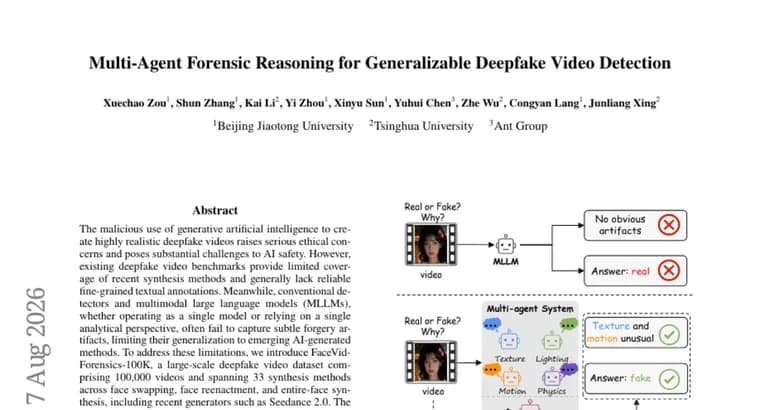
A team of researchers introduced FaceVid-Forensics-100K, a deepfake video dataset spanning 100,000 videos across 33 synthesis methods, covering face swapping, face reenactment, and entire-face synthesis, including recent generators such as Seedance 2.0. The authors built the dataset because existing deepfake video benchmarks, in their assessment, cover recent synthesis methods only partially and generally lack reliable fine-grained textual annotations. FaceVid-Forensics-100K instead carries fine-grained textual annotations of visual observations plus forensic explanations that are consistent with each video's verdict; these were generated automatically through a multi-model aggregation and conflict-resolution pipeline built on multiple MLLMs. On top of the benchmark, the team proposed a multi-agent forensic reasoning framework. Four specialized domain-expert agents each independently analyze a video for forgery cues from one of four perspectives: texture, lighting, motion, and physics. A judge agent then reconciles the four reports into a single prediction with an explanation. The stated motivation is that conventional detectors and multimodal large language models, when run as a single model or from a single analytical angle, often miss subtle forgery artifacts and generalize poorly to new AI-generated methods. In evaluations on out-of-domain test sets, the framework, built entirely from small open-source MLLMs, outperformed all compared methods, including closed-source GPT and Gemini models, and ranked first on every reported metric on the benchmark. The paper does not give the specific accuracy or F1 figures behind that ranking, nor which GPT or Gemini versions were used for comparison. A project page for the work is hosted separately from the paper text.
Key facts
- FaceVid-Forensics-100K: a new deepfake video dataset with 100,000 videos across 33 synthesis methods (face swapping, face reenactment, entire-face synthesis), including generators such as Seedance 2.0
- The dataset's textual annotations and forensic explanations were produced automatically by a multi-model aggregation and conflict-resolution pipeline using multiple MLLMs
- The proposed detection framework uses four domain-expert agents analyzing texture, lighting, motion, and physics cues, reconciled by a judge agent into a final prediction and explanation
- Built entirely from small open-source MLLMs, the framework beat closed-source GPT and Gemini models and ranked first on every reported metric on out-of-domain test sets
- No specific accuracy or F1 numbers, and no GPT/Gemini version names, are given in the source text
Why it matters
Deepfake video generation keeps adding new synthesis methods, and single-model or single-perspective detectors struggle to keep up: a detector tuned to catch one kind of forgery artifact often misses another. This work targets both halves of that problem at once, a benchmark broad enough to represent current synthesis methods and a detection approach that splits the analysis across independent expert angles instead of relying on one model's single pass.
Who it affects
The direct audience is researchers and engineers building or evaluating deepfake detection systems, who gain both a larger, more annotated benchmark and a reference architecture that beat proprietary models without using any. It also matters to anyone relying on automated deepfake detection downstream, since a detector that generalizes better to unseen synthesis methods is more useful once deployed against real, evolving forgeries rather than only the methods it was trained on.
How to use it
The dataset and the multi-agent framework are presented as a benchmark and a reference method built on small open-source MLLMs, with a project page hosted separately from the paper. The source text does not give pricing, licensing terms, or release details for either the dataset or the framework, so nothing beyond their existence and design can be stated here.
How solid is it
The central claim, that the framework outperforms closed-source GPT and Gemini models and ranks first on every reported metric, comes from the authors' own evaluations on out-of-domain test sets, which is a reasonable way to test generalization to unseen forgery methods. The source text does not provide the specific accuracy, F1, or other metric values behind that ranking, nor which GPT or Gemini versions were used for comparison, so the size of the margin cannot be independently assessed from what's given here.
Risks and caveats
The benchmark's own textual annotations and forensic explanations were generated automatically by an MLLM pipeline rather than fully by human annotators, which is itself a potential source of labeling noise the paper does not quantify. The comparison against 'closed-source GPT and Gemini models' is also unspecified as to exact versions, and no author institutions or affiliations are named in the source text, which limits independent verification of the results.