SPADE trains language agents by having an LLM design its own environments
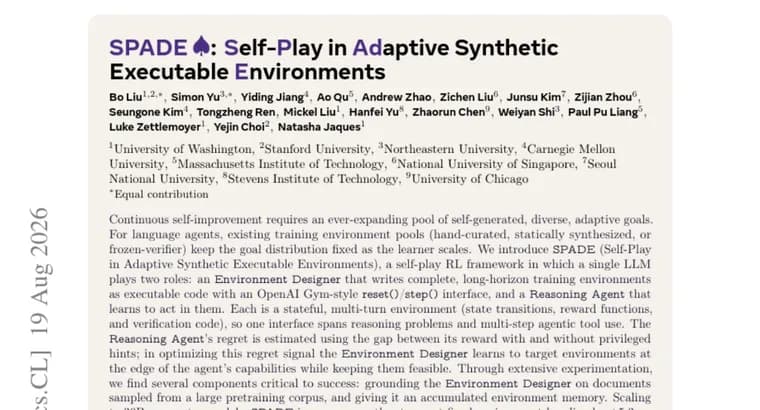
Researchers have introduced SPADE (Self-Play in Adaptive Synthetic Executable Environments), a reinforcement-learning framework built to solve a specific bottleneck in training language agents: existing pools of training environments are hand-curated, statically synthesized, or built around frozen verifiers, so the distribution of goals an agent trains on stays fixed even as the agent itself keeps improving. SPADE addresses this by having a single LLM play two roles at once. One role, the Environment Designer, writes complete, long-horizon training environments as executable code, using an OpenAI Gym-style reset()/step() interface, complete with state transitions, reward functions, and verification code. The other role, the Reasoning Agent, learns to act inside the environments the Designer creates. Because both reasoning problems and multi-step agentic tool use share the same stateful, multi-turn interface, one framework covers both. The Designer is steered by the Reasoning Agent's regret, estimated as the gap between the reward the agent earns with privileged hints and without them; by optimizing this regret signal, the Designer learns to generate environments that sit at the edge of the agent's current capability while remaining solvable. The authors found two components critical to making this work: grounding the Environment Designer on documents sampled from a large pretraining corpus, and giving it an accumulated memory of environments it has already built. Scaled to 30B-parameter models, SPADE improved on the strongest fixed-environment baseline by an average of +5.3 points across eight held-out math, science, code, and reasoning benchmarks. In the tool-use setting, it lifted scores by +5.7 on BFCL-v4 multi-turn and by +13.9 on ACEBench-Agent. In a games setting, the margin over the strongest baseline widened as model scale increased. The authors present this as a step toward open-ended self-improvement, framing environment design itself as a learnable component rather than a fixed, human-authored resource.
Key facts
- SPADE uses a single LLM in two roles: an Environment Designer that writes executable training environments as code, and a Reasoning Agent that trains inside them.
- The Designer targets environments at the edge of the Reasoning Agent's capability by optimizing a regret signal, the gap between reward with and without privileged hints.
- Grounding the Designer on documents from a large pretraining corpus, plus giving it accumulated environment memory, were found critical to success.
- At 30B parameters, SPADE beat the strongest fixed-environment baseline by +5.3 points on average across eight math, science, code, and reasoning benchmarks.
- Tool-use scores rose by +5.7 on BFCL-v4 multi-turn and by +13.9 on ACEBench-Agent; on games, the advantage over the baseline grew with model scale.
Why it matters
Training pools for language agents have mostly been static: a fixed set of hand-written or pre-synthesized tasks that stop challenging the agent once it masters them. SPADE's contribution is making the environment itself a moving target, generated on the fly by an LLM that is explicitly optimizing for tasks that stay hard as the learner improves. That reframes environment design as something a model can learn to do well, rather than a fixed cost paid once by human engineers.
Who it affects
The work is aimed at teams building and training language agents, particularly for reasoning and tool-use tasks, where the difficulty of hand-curating enough diverse, well-calibrated training environments limits how far continued self-improvement can go. It is also relevant to anyone evaluating agentic benchmarks like BFCL-v4 and ACEBench-Agent, since SPADE reports concrete gains on both.
How to use it
SPADE is presented as a research framework rather than a released product: the source material gives no code or model release, no availability details, and no publication venue. The core mechanism, an LLM alternating between writing a reset()/step() environment and training an agent against it, guided by a regret signal, is described in enough detail to be reproduced, but there is nothing here to install or run today.
How solid is it
The reported gains are consistent across three separate axes: an average +5.3-point lift across eight held-out benchmarks spanning math, science, code, and reasoning; specific tool-use gains of +5.7 and +13.9 points on two multi-turn benchmarks; and a scale-dependent advantage on a games setting. All comparisons are against the strongest fixed-environment baseline the authors tested, at a model scale of 30B parameters, which gives the results a reasonably concrete anchor even without individual baseline scores being disclosed.
Risks and caveats
The source text names no specific baseline models, no exact benchmark scores beyond the reported deltas, and no authors or institutions in the body of the paper itself. The precise computation behind the regret signal and the full interface between the Environment Designer and Reasoning Agent beyond the Gym-style reset()/step() description are not detailed in what is available. As with any self-play result, gains measured against one baseline and one benchmark suite may not generalize to other agent architectures or task domains without further testing.