Spatial Memory Intelligence uses an MLLM to manage memory in long-video world models
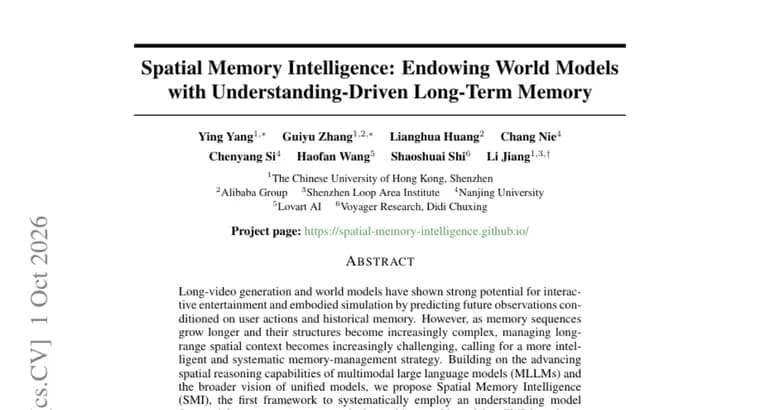
Long-video generation and world models predict future observations from user actions and a history of past frames, which the paper calls memory. The authors note these systems have shown strong potential for interactive entertainment and embodied simulation. The difficulty they point to is scale: as memory sequences grow longer and their structure becomes more complex, managing long-range spatial context gets harder, and they argue this calls for a more intelligent and systematic memory-management strategy.
Their answer is Spatial Memory Intelligence (SMI). It builds on the advancing spatial reasoning of multimodal large language models (MLLMs) and on the broader vision of unified models. The authors describe SMI as the first framework to systematically employ an understanding model for spatial-memory management in long-video world models.
SMI introduces four coordinated atomic operations: spatial clustering, within-cluster sparsification, action-aware retrieval, and reliability-aware filtering. In plain terms, the understanding model groups memory by spatial layout, thins out the entries inside each group, retrieves the entries that fit the current action, and filters out memory that is unreliable.
The authors say extensive experiments across multiple baselines, benchmarks and world-model backbones demonstrate the effectiveness and generalizability of SMI. They report comprehensive improvements in memory sparsity, generation stability and spatial consistency. The abstract gives no figures for these gains.
Key facts
- Spatial Memory Intelligence (SMI) is a framework that uses an understanding model, a multimodal LLM, to manage spatial memory in long-video world models.
- SMI introduces four coordinated atomic operations: spatial clustering, within-cluster sparsification, action-aware retrieval and reliability-aware filtering.
- The authors call it the first framework to systematically use an understanding model for spatial-memory management in this setting.
- They report improvements in memory sparsity, generation stability and spatial consistency across multiple baselines, benchmarks and world-model backbones.
Why it matters
World models that predict what happens next from user actions depend on remembering what they have already shown. The authors argue that as memory sequences grow longer and more complex, handling long-range spatial context becomes harder. SMI's pitch is to hand that job to a model that understands space, rather than to a fixed rule for what to keep. They frame it as the first systematic use of an understanding model for this purpose.
Who it affects
The paper targets work on long-video generation and world models, which the authors link to interactive entertainment and embodied simulation. Teams building such systems and researchers studying memory in them are the natural audience.
How to use it
The source is an abstract and describes the method at the level of its four operations: spatial clustering, within-cluster sparsification, action-aware retrieval and reliability-aware filtering. Anyone wanting to apply it would need the full paper for the details.
How solid is it
The claims are the authors' own, drawn from a paper abstract. They say experiments across multiple baselines, benchmarks and world-model backbones show effectiveness and generalizability. The abstract gives no numerical results, so the size of the improvements cannot be judged from it. The benchmarks, baselines and backbones are not named. The first-of-its-kind claim is also the authors' own.
Risks and caveats
The abstract names no authors or institutions, and does not say which MLLM serves as the understanding model. It gives no compute cost, latency or video-length figures. It does not mention a code, model or data release. Treat the reported gains in memory sparsity, generation stability and spatial consistency as unquantified until the full paper is read.