Steerling-8B shows interpretability scales with capability
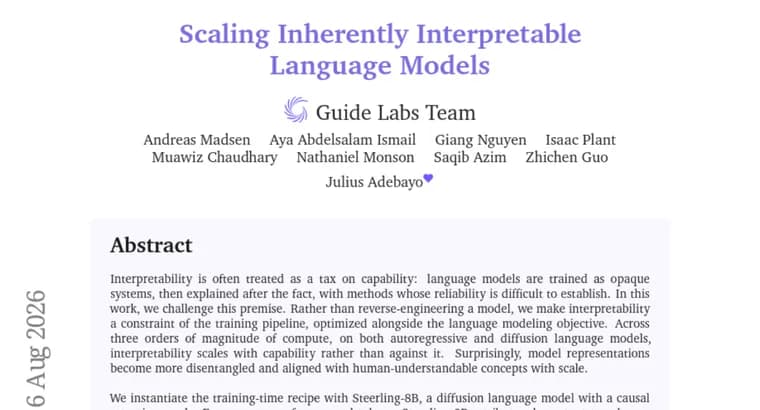
A paper titled "Scaling Inherently Interpretable Language Models" pushes back on the common assumption that interpretability is a tax on capability, paid by training an opaque model first and reverse-engineering explanations for it afterward, with methods whose reliability is hard to establish. The authors instead make interpretability part of the training objective itself, optimized jointly with the language modeling objective rather than bolted on after the fact. Tested across three orders of magnitude of compute, on both autoregressive and diffusion language models, they find that interpretability scales with capability rather than against it. The result they call surprising: as models get bigger, their internal representations become more disentangled and more aligned with concepts a human can understand, not less.
The recipe is instantiated in Steerling-8B, a diffusion language model that uses a causal attention mask. For any group of generated tokens, Steerling-8B can attribute the output back to the specific input tokens that drove it, to human-understandable concepts, and to training data. That attribution supports what the authors describe as closed-loop intervention: diagnose a problematic output through its concept or feature attribution, retrieve the similar training data behind it, and correct the model's behavior through concept steering, all without retraining. On overall performance, Steerling-8B stays competitive with open peer models that were trained on substantially more compute, 2 to 16 times more, which the authors read as evidence for a different scaling paradigm: interpretability does not have to be reverse-engineered after training; it can be designed in, and it gets better as the model scales.
The abstract does not give specific benchmark names, datasets, or numeric accuracy scores for Steerling-8B, nor does it state the compute figures in absolute units such as FLOPs or GPU-hours, nor whether the model's weights, code, or training data are being released.
Key facts
- The paper argues interpretability can be trained in jointly with the language modeling objective, rather than reverse-engineered after training.
- Across three orders of magnitude of compute, on both autoregressive and diffusion language models, interpretability scaled with capability rather than against it.
- Model representations became more disentangled and more aligned with human-understandable concepts as scale increased.
- The demonstration model, Steerling-8B, is a diffusion language model with a causal attention mask that attributes generated tokens to input tokens, concepts, and training data.
- Steerling-8B stayed competitive with open peer models trained on 2 to 16 times more compute.
Why it matters
Interpretability is usually treated as something you pay for after the fact: train a capable but opaque model, then try to explain it with methods that are hard to trust. This paper's central claim cuts against that framing. By making interpretability part of the training objective rather than a post-hoc add-on, the authors report that it scales alongside capability instead of trading off with it, tested across three orders of magnitude of compute on both autoregressive and diffusion models. If that holds up, it undercuts the assumption that more capable models must become harder to understand.
Who it affects
The direct audience is researchers and teams working on model interpretability and safety, plus anyone building or evaluating language models who has been treating explainability as a cost center. The attribution and steering mechanism described here is also relevant to teams that need to diagnose and correct model behavior in production without a retraining cycle.
How to use it
The paper instantiates its approach in Steerling-8B, a diffusion language model with a causal attention mask. For any group of generated tokens, it attributes the output to the relevant input tokens, to human-understandable concepts, and to training data. That attribution chain enables closed-loop intervention: diagnose an output through its concept or feature attribution, retrieve the similar training data behind it, and correct the behavior through concept steering, without retraining. The source does not state whether Steerling-8B's weights, code, or training data are being released, so nothing here should be read as an availability claim.
How solid is it
The interpretability-scales-with-capability result is reported across three orders of magnitude of compute and across both autoregressive and diffusion language models, which is a broad sweep. On raw performance, Steerling-8B is described as competitive with open peer models trained on substantially more compute, 2 to 16 times more. The abstract does not name specific benchmarks, datasets, or numeric accuracy figures to back either the interpretability or the performance claims, and it does not give the compute figures in absolute units like FLOPs or GPU-hours, so the comparison stands only in the relative terms the authors state.
Risks and caveats
The claims summarized here come from the paper's own abstract; no independent benchmark scores, datasets, or absolute compute figures are given to verify them against. The abstract also does not say whether Steerling-8B's weights, code, or training data will be made available, so it is not yet possible to say who could reproduce or build on this work.
“Surprisingly, model representations become more disentangled and aligned with human-understandable concepts with scale.”
— from the paper's abstract