Stela, an early open-source layer, aims to run macOS on x86-64 PCs
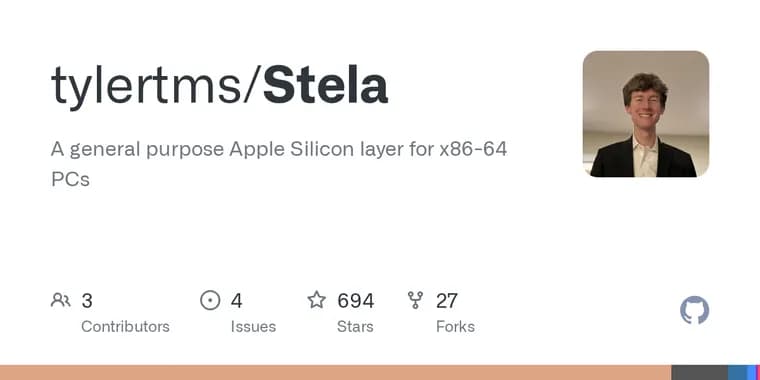
Stela is an open-source project on GitHub that describes itself as a general purpose Apple Silicon layer for x86-64 PCs. According to its README, it is a UEFI boot program that combines three parts: an arm64-to-x86-64 translator, a Metal driver for NVIDIA GPUs, and a model of Apple silicon hardware. The stated result at version v0.1.0 is that macOS and most apps start, but it is slow and needs much more testing.
The README opens with a warning: Stela is very much still in development, the current chances of it booting are low, and major hardware support and fixes are on the way.
The translator is an ahead-of-time and just-in-time compiler that turns arm64e code into x86-64. It covers more than 3,000 AArch64 instruction encodings, maps guest registers to host registers and caches translated code. It runs on any x86-64-v2 CPU, Intel or AMD.
The Metal driver supports GTX 16 and RTX 20 series GPUs and newer. It compiles AIR, Metal's shader IR, directly to NIR, Mesa's IR, and supports the Metal3 and Apple7 GPU families.
Requirements are an x86-64-v2 CPU (about 2011 or newer), UEFI with Secure Boot off, 8 GB of RAM, an NVIDIA GTX 16 or RTX 20 series GPU or newer, a USB stick of 8 GB or more, an empty GPT partition of at least 60 GB, and network access during the install, which downloads macOS. Stela currently models the Mac mini (M2) and runs macOS 27.
Installation: download stela from the releases page; run sudo ./stela setup on Linux or macOS, or double-click stela.exe on Windows; choose the USB stick, the macOS version and the Mac model, then confirm (setup erases the USB stick); then boot the PC from the stick. An older stick can be updated by plugging it in and running sudo ./stela setup update stela (Linux, macOS) or stela.exe setup update stela (Windows).
Building from source needs Rust and LLVM with Clang 21 or newer. After cloning the repository, cargo xtask dist writes target/release/stela. The first build fetches and compiles Linux, Mesa and LLVM sources and takes a long time. The README also states that Stela contains no Apple software and that users are responsible for following Apple's software license agreement and terms of use.
Key facts
- Stela is a UEFI boot program with an arm64-to-x86-64 translator, a Metal driver for NVIDIA GPUs and a model of Apple silicon hardware.
- At v0.1.0 the README says macOS and most apps start, but it is slow and needs much more testing; it also warns the chances of booting are currently low.
- The translator covers more than 3,000 AArch64 instruction encodings and runs on any x86-64-v2 CPU, Intel or AMD.
- The Metal driver supports GTX 16 and RTX 20 series GPUs and newer; Stela currently models the Mac mini (M2) and runs macOS 27.
- Setup needs a USB stick of 8 GB or more (erased during setup) and an empty GPT partition of at least 60 GB; Stela contains no Apple software.
Why it matters
Stela attempts to run macOS on ordinary x86-64 PCs by translating arm64e code to x86-64 and emulating Apple silicon hardware. The README claims it already starts macOS and most apps, which makes it an early but concrete project in this space. It is v0.1.0, and the authors themselves say it is slow and needs much more testing.
Who it affects
The target is owners of x86-64 PCs with an x86-64-v2 CPU (Intel or AMD, about 2011 or newer), 8 GB of RAM and an NVIDIA GTX 16 or RTX 20 series GPU or newer. Anyone building from source also needs Rust and LLVM with Clang 21 or newer. The README mentions only NVIDIA GPUs as supported.
How to use it
Download stela from the releases page and run sudo ./stela setup on Linux or macOS, or double-click stela.exe on Windows. Pick the USB stick, the macOS version and the Mac model, and confirm. Setup erases the USB stick, so use one with nothing on it that you need. You also need an empty GPT partition of at least 60 GB and network access, because the install downloads macOS. Then boot the PC from the stick, with Secure Boot off. To build from source, clone the repository and run cargo xtask dist; the first build takes a long time.
How solid is it
Everything here comes from the project's own README. It states that macOS and most apps start as of v0.1.0, but that the software is slow and needs much more testing. No benchmark or performance figure is given, and no list of tested hardware, working apps or failing apps is given beyond 'most apps start'. The README names no author or maintainer in its text and gives no release date.
Risks and caveats
The README warns that your current chances of it booting are low and that major hardware support and fixes are on the way, with no timescale given. Setup erases the USB stick. Only the Mac mini (M2) model and macOS 27 are named as current. On licensing, the README says Stela contains no Apple software and that you are responsible for following Apple's software license agreement and terms of use; it states nothing further on legal status.
“Stela is very much still in development. Your current chances of it booting are low, major hardware support/fixes are on the way.”
— Stela project README